
präsentiert von

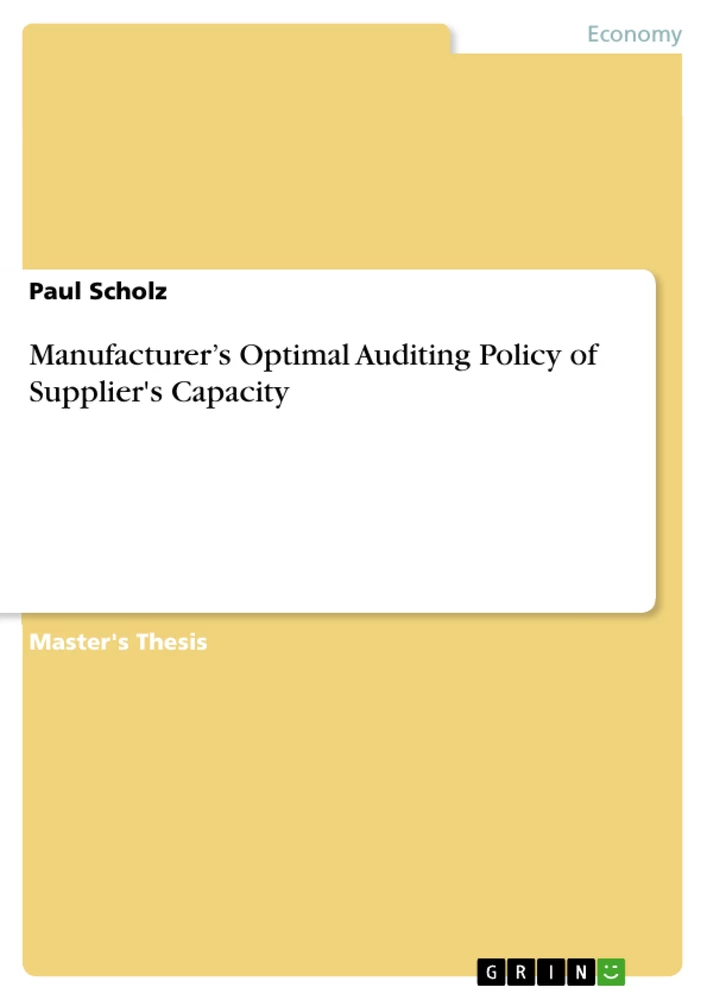
Table of Contents
1 INTRODUCTION
1.1 Intention and Context of the Research
1.2 Motivation and Academic Purpose
2 LITERATURE REVIEW
2.1 Newsvendor Model: Optimal Inventory and Production Capacity Policy
2.2 Competition in the Supply Chain
2.3 Principal-Agent Models and Asymmetric Information
2.4 Optimal Equilibrium Procurement Strategies
2.5 Supplier Auditing
3 ORGANIZATION OF THE ARTICLE
4 MATHEMATICAL MODEL DEVELOPMENT
4.1 Pre-Assumptions and External Contracting Conditions in the Manufacturing Context
4.2 Application-Implicit Transformation of Action into Reasonable Variables for the Mathematical Model
4.3 Mathematical Model Formulation
4.4 Mathematical Model Specification
4.4.1 Assumption of Two Types of Suppliers and Two Different Production Schedules
4.4.2 Simplification Approach: Reduction of Decision Variables
4.4.3 Individual and Overall Welfare Considerations
4.5 Optimality Analysis
4.5.1 Conversion of Min / Max Functions
4.5.2 Optimal Capacity Auditing Probability of the Inefficient Supplier Type
4.5.3 Optimal Order Quantities for the Efficient and Inefficient Supplier Type
5 NUMERICAL STUDY AND SENSITIVITY ANALYSIS
5.1 Transfer of the General Model into MATLAB
5.2 MATLAB Solver for Optimal Selection of Decision Variables
5.3 Sensitivity Analysis
5.3.1 Impact of Efficient Supplier Occurrence Probability on Manufacturer’s Profit
5.3.2 Impact of Marginal Retailing Price Level on Manufacturer’s Profit
5.3.3 Impact of Efficient Supplier Occurrence Probability on Inefficient Supplier Capacity Audit Probability
5.3.4 Impact of Inefficient Supplier’s Untrustworthiness Penalty on Inefficient Supplier Capacity Audit Probability
5.3.5 Impact of Market Demand Variation on Optimal Order Quantity
5.3.6 Impact of Efficient Supplier Occurrence Probability on Optimal Order Quantity
6 SUMMARY AND FUTURE OUTLOOK
6.1 Summary of Results and Research Process
6.2 Limitations and Future Outlook
Objectives and Research Themes
This thesis examines the optimal auditing policy for a manufacturer to mitigate risks in a principal-agent relationship characterized by asymmetric information regarding supplier production capacity. The central research question focuses on how a manufacturer can design an effective contract and audit mechanism to maximize expected profit under conditions of stochastic demand and private supplier capacity information.
- Optimal audit mechanisms in supply chain contracting.
- Impact of asymmetric information on procurement strategies.
- Mathematical modeling of capacity-constrained supply chains.
- Incentive compatibility and participation constraints in supplier relationships.
- Numerical sensitivity analysis using MATLAB to derive robust auditing policies.
Excerpt from the Book
1.1 Intention and Context of the Research
A continuously increasing price pressure and more specific production orders are two indicators of the structural change the manufacturing industry is facing during the last years. Intensified customer and market expectations force companies to focus on their core competencies and outsource more general work processes to specialized partners. The inter-company cooperation logically becomes a very important piece of production planning and control. The network of related companies today is the modern and most important organizational form.
Due to the reasons just mentioned and others, companies are facing an increasing competitive pressure [2]. A consequent and iterative alignment with customer requirements is an important prerequisite of sustainable long-term success [3]. According to an AT Kearny study count the companies’ logistic capabilities as a crucial purchase criterion for customers [4]. Differentiation only through product features is no longer enough to survive the tough competition [5; 6]. The logistic indicators delivery time and delivery reliability developed as purchase criteria next to product quality and price. To fulfill the customer requirements economically efficient – facing high endogenous and exogenous uncertainty in this complex network structures – a rather holistically approach is required [7].
Several reasons for limited growth potential of the profit margins in companies can be found. First, the main trends of globalization and digitalization lead to transparency of cost, diverse procurement channels and therefore to international competition. Second, a higher volatility in all sections of the market has to be noticed. Technical developments or exogenous shocks possibly lead to a highly variable market price and demand at any time. This new level of uncertainty has to be addressed with appropriate risk management. Third, technical products’ optimization potential decreases with every attempt on that subject. By now for many products only incremental product development is possible. Respectively high cost savings are hard to realize when changing the technical product itself and without loss of product quality.
Summary of Chapters
1 INTRODUCTION: This chapter introduces the context of structural changes in the manufacturing industry and outlines the motivation for addressing audit uncertainty in supply chain procurement.
2 LITERATURE REVIEW: This chapter provides an overview of existing research related to inventory policy, principal-agent models, supply chain competition, and supplier auditing practices.
3 ORGANIZATION OF THE ARTICLE: This chapter details the research gap and the objective to model an equilibrium of an incomplete information game involving a manufacturer and a capacity-constrained supplier.
4 MATHEMATICAL MODEL DEVELOPMENT: This chapter presents the formal model, defining profit functions and incentive constraints, while introducing a simplification approach to derive optimal order quantities and audit probabilities.
5 NUMERICAL STUDY AND SENSITIVITY ANALYSIS: This chapter describes the implementation of the model into MATLAB and conducts a series of sensitivity analyses to evaluate the impact of various parameters on manufacturer profit and audit probability.
6 SUMMARY AND FUTURE OUTLOOK: This chapter synthesizes the research findings, summarizes the implications for supply chain efficiency, and provides recommendations for future research directions.
Keywords
Supply Chain Efficiency, Supply Chain Coordination, Newsvendor Model, Principal-Agent, Asymmetric Information, Supplier Auditing, Optimal Procurement Strategy, Capacity Constraints, Incentive Compatibility, Risk Management, Contract Design, Optimization, MATLAB Solver, Sensitivity Analysis, Manufacturing Context.
Frequently Asked Questions
What is the primary focus of this research?
The research investigates the manufacturer's optimal capacity auditing policy within a principal-agent framework where the supplier's production capacity is private information.
What are the central themes discussed in this work?
Key themes include supply chain coordination, the management of asymmetric information, the use of capacity audits to ensure truthfulness, and the design of optimal price-quantity contracts.
What is the main objective of the thesis?
The objective is to derive an analytical, utility-maximal contracting policy for a manufacturer that addresses the risk of untruthful supplier reports regarding production capacity.
Which scientific methods are employed?
The author utilizes game theory (Stackelberg model), mathematical modeling with incentive compatibility constraints, and numerical optimization implemented via the MATLAB "fmincon" solver.
What topics are covered in the mathematical section?
The mathematical section covers the formalization of profit functions, the transformation of decision variables for tractability, the analysis of optimality, and the derivation of audit probabilities and order quantities.
Which keywords best describe this study?
The work is characterized by terms such as Supply Chain Efficiency, Asymmetric Information, Principal-Agent, Supplier Auditing, and Optimal Procurement Strategy.
How does the manufacturer determine whether to audit a supplier?
The decision to audit is based on the marginal cost of auditing compared to the expected welfare gain from revealing the true supplier capacity, particularly when the supplier claims to be inefficient.
What role does the revelation principle play in the model?
The revelation principle assumes that in an equilibrium state, the designed mechanism makes truth-telling the dominant strategy, thereby ensuring that reports are truthful and audits are rarely necessary in practice.
How does market demand variation influence optimal order quantities?
The research demonstrates that an increasing variation in market demand leads to a decreasing optimal order quantity, as the expected risks associated with penalty payments begin to outweigh expected sales.
Ende der Leseprobe aus 73 Seiten
- nach oben
- Arbeit zitieren
- Paul Scholz (Autor:in), 2016, Manufacturer’s Optimal Auditing Policy of Supplier's Capacity, München, Page::Imprint:: GRINVerlagOHG, https://www.diplomarbeiten24.de/document/369835

neugierig - aktuell - relevant
Entdecken Sie hilfreiche Tipps und Tricks rund ums Studium!

Entdecken Sie hilfreiche Tipps und Tricks rund ums Studium!
Ihre Hausarbeit / Abschlussarbeit:

- - Publikation als E-Book und Buch
- - Hohes Honorar auf die Verkäufe
- - Für Sie komplett kostenlos - mit ISBN
- - Es dauert nur 5 Minuten
- - Jede Arbeit findet Leser

- © GRIN Publishing GmbH.
- Alle Inhalte urheberrechtlich geschützt. Kopieren und verbreiten untersagt.
- info@grin.com
- AGB
- Open Publishing
Der GRIN Verlag hat sich seit 1998 auf die Veröffentlichung akademischer eBooks und Bücher spezialisiert. Der GRIN Verlag steht damit als erstes Unternehmen für User Generated Quality Content. Die Verlagsseiten GRIN.com, Hausarbeiten.de und Diplomarbeiten24 bieten für Hochschullehrer, Absolventen und Studenten die ideale Plattform, wissenschaftliche Texte wie Hausarbeiten, Referate, Bachelorarbeiten, Masterarbeiten, Diplomarbeiten, Dissertationen und wissenschaftliche Aufsätze einem breiten Publikum zu präsentieren.
Kostenfreie Veröffentlichung: Hausarbeit, Bachelorarbeit, Diplomarbeit, Dissertation, Masterarbeit, Interpretation oder Referat jetzt veröffentlichen!
Folgen Sie GRIN auf


- GRIN Verlag GmbH
-
- Nymphenburger Str. 86
- 80636
- Munich, Deutschland
- +49 89-550559-0
- +49 89-550559-10
- info@grin.com
-
