
präsentiert von

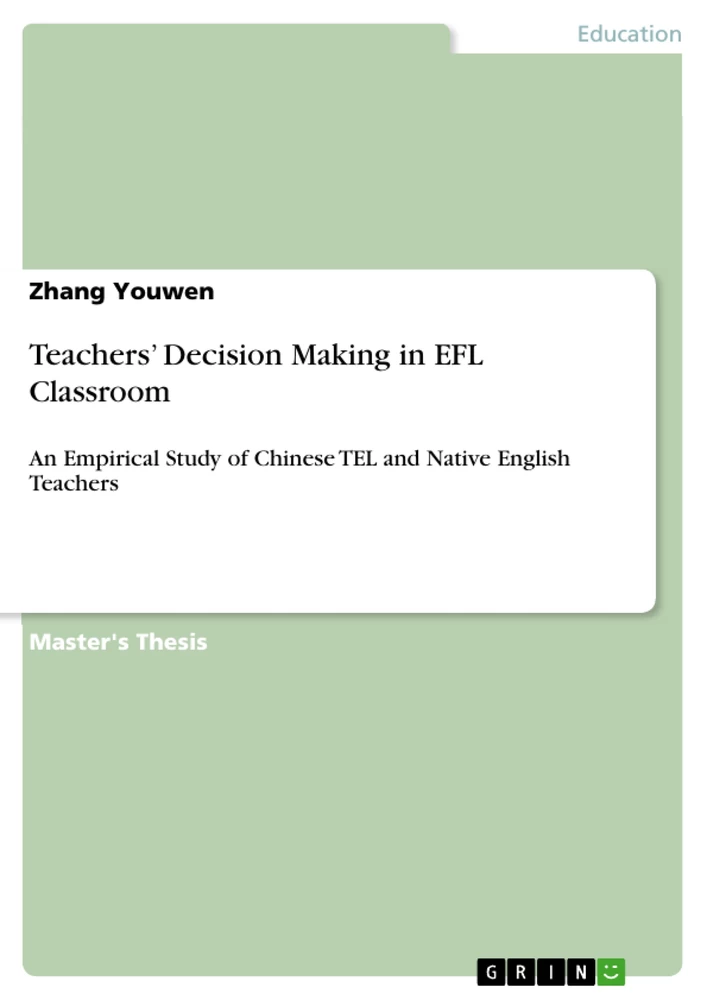
Table of Contents
Chapter One Introduction
Chapter Two Theoretical Background
2.1 Decision Making and Beliefs
2.2 Decision Making and Cognition
2.3 Decision Making and Experience
2.4 Decision Making and Context
2.5 Decision Making in Classroom Practice
Chapter Three Design of the Study
3.1 Research Questions
3.2 Data Sample
3.2.1 Teachers
3.2.2 Institutions
3.3 Data Collection Procedures
3.3.1 Pre-observation Interviews
3.3.2 Observations
3.3.3 After-class Interviews
3.3.4 Scheduled Interviews
Chapter Four Presentations of Data
4.1 Planning Decisions
4.2 Interactive Decisions
Chapter Five Data Analysis and Discussion
Chapter Six The Influential Factors of Teachers’ Decision Making
6.1 The Role of Teacher Beliefs in Pedagogic Decisions
6.2 The Role of Contextual Factors in Decision Making
6.2.1 Administrative2 Factors
6.2.2 Collegial Factors
6.2.3 Student Characteristics
6.3 The Role of Experience in Decision Making
6.4 The Role of Teacher Cognition in Decision Making
6.5 The Role of Cultural Factors in Decision Making
Chapter Seven The Soft Power of Instructional Decision
7.1 Decision Making and Soft Power
7.2 Teachers’ Decisions of Tasks and Participation Structure: Three Cases of Real-World Practice
7.3. The Underlying Factors Affecting Decision-making Soft Power
7.3.1 Teacher’s Beliefs and Knowledge Shaping Decision-making Soft Power
7.3.2 Prior Experience Enhancing Decision- making Soft Power
7.3.3 Perceptions of the Context Facilitating Decision-making Soft Power
7.4 The Logicality of Teacher’s Decision Making and Soft Power
Chapter Eight Decision Making and Critical Discourse Analysis
8.1 The Critical Analysis of Teacher’s Classroom Decision Making
8.2 Micro Discourse Analysis of Teachers' Instructional Decisions
8.3 Macro Discourse Analysis of Teachers’ Decision Making
Objectives and Research Themes
The primary aim of this research is to investigate and compare the pedagogical decision-making processes of Chinese Teachers of English (TEL) and native English-speaking teachers within the Chinese EFL classroom context. The study explores how these two groups approach lesson planning, instruction, and classroom management, and identifies the underlying cognitive, contextual, experiential, and cultural factors that shape their decision-making behaviors.
- The impact of teacher beliefs and cognition on pedagogical choices.
- The influence of institutional context, curriculum, and administrative pressures.
- The role of teaching experience and "apprenticeship of observation" in forming teaching routines.
- Cultural differences in classroom participation structures and student-teacher interactions.
- The application of "soft power" and Critical Discourse Analysis (CDA) in understanding teacher instructional decisions.
Excerpt from the Book
4.1 Planning Decisions
All teaches plan. No teacher enters the classroom without having an idea of what to present. And sound planning definitely contributes to good teaching. However, the nature of plans differs widely from teacher to teacher. Teachers differ in the extent to which they use lesson plans and in the kinds of strategies they employ. Some teachers “develop macro-plans or overall goals for a course or a class” (Richards & Lockhart 1996) so that they had a global sense of the whole term’s work, which is mostly a curriculum-level decision. A mode of working with planning at the curriculum stage by native English teachers in the current teaching setting involved the interpretation of Chinese students, materials and the total culture of English. As native English teachers, English is their native language. They don’t have any problem or frustration on language or expressing their ideas. While working in an EFL context, the most important things they are confronted with in their lesson planning and first days teaching in particular is how to interpret and assess the group of students who may not comprehend or understand their program or directions completely.
Summary of Chapters
Chapter One Introduction: Provides an overview of the significance of teacher decision-making as a cognitive and conceptual framework in language education, outlining the aims and structure of the study.
Chapter Two Theoretical Background: Examines foundational literature on teacher cognition, beliefs, the role of prior experience, contextual constraints, and classroom practice.
Chapter Three Design of the Study: Details the research questions, participant selection, and the ethnographic data collection procedures including observations and interviews.
Chapter Four Presentations of Data: Organizes and presents the findings regarding teacher planning and interactive decisions, focusing on specific classroom episodes.
Chapter Five Data Analysis and Discussion: Describes the cyclical, interpretative approach to analyzing the collected data and identifies emerging conceptual categories.
Chapter Six The Influential Factors of Teachers’ Decision Making: Analyzes the critical roles of teacher beliefs, contextual factors, experience, and cultural backgrounds in shaping pedagogical choices.
Chapter Seven The Soft Power of Instructional Decision: Explores teacher decision-making through the lens of "soft power" and provides case studies of real-world practice.
Chapter Eight Decision Making and Critical Discourse Analysis: Analyzes classroom decision-making as a form of social discourse, applying CDA to understand power relations and moral dimensions in the classroom.
Keywords
teachers’ decision making, EFL classroom, empirical study, planning decisions, interactive decisions, teacher cognition, teacher beliefs, pedagogical knowledge, participation structure, language teaching, ethnography, soft power, critical discourse analysis, teaching practice, professional autonomy
Frequently Asked Questions
What is the primary focus of this work?
The book focuses on the decision-making processes of two distinct groups—Chinese Teachers of English (TEL) and native English teachers—and how they navigate the pedagogical challenges of the Chinese EFL classroom.
What are the central themes of the research?
The central themes include teacher beliefs, the role of experience, institutional and cultural contexts, and the logical dimensions of instructional decisions.
What is the primary research question?
The research asks how these two groups approach instructional decisions, what factors influence their pedagogy, and whether their actions are consistent with their theoretical beliefs.
Which scientific method is employed?
The study adopts a comparative ethnographic approach, utilizing a qualitative design with surveys, non-participant observations, and semi-structured interviews.
What does the main body cover?
The main body covers the development of the study's design, the presentation and analysis of data regarding planning and interactive decisions, and in-depth discussions on factors like teacher cognition and "soft power."
Which keywords best characterize the work?
Key terms include "teachers’ decision making," "EFL classroom," "empirical study," "teacher cognition," "soft power," and "critical discourse analysis."
How does the "apprenticeship of observation" influence teachers?
The book suggests that teachers often internalize teaching models from their own long history as students, which makes these established beliefs highly resistant to change in teacher training programs.
What role does the "soft power" concept play in the analysis?
The author uses "soft power" to conceptualize a teacher's ability to influence the learning environment through cognitive, judgmental, executive, and creative actions.
What is the significance of the cultural analysis in Chapter 8?
Chapter 8 uses Critical Discourse Analysis to highlight how classroom decisions are not just technical choices, but are embedded in power relations and moral frameworks within educational institutions.
Ende der Leseprobe aus 114 Seiten
- nach oben
- Arbeit zitieren
- Zhang Youwen (Autor:in), 2017, Teachers’ Decision Making in EFL Classroom, München, Page::Imprint:: GRINVerlagOHG, https://www.diplomarbeiten24.de/document/370563

neugierig - aktuell - relevant
Entdecken Sie hilfreiche Tipps und Tricks rund ums Studium!

Entdecken Sie hilfreiche Tipps und Tricks rund ums Studium!
Ihre Hausarbeit / Abschlussarbeit:

- - Publikation als E-Book und Buch
- - Hohes Honorar auf die Verkäufe
- - Für Sie komplett kostenlos - mit ISBN
- - Es dauert nur 5 Minuten
- - Jede Arbeit findet Leser

- © GRIN Publishing GmbH.
- Alle Inhalte urheberrechtlich geschützt. Kopieren und verbreiten untersagt.
- info@grin.com
- AGB
- Open Publishing
Der GRIN Verlag hat sich seit 1998 auf die Veröffentlichung akademischer eBooks und Bücher spezialisiert. Der GRIN Verlag steht damit als erstes Unternehmen für User Generated Quality Content. Die Verlagsseiten GRIN.com, Hausarbeiten.de und Diplomarbeiten24 bieten für Hochschullehrer, Absolventen und Studenten die ideale Plattform, wissenschaftliche Texte wie Hausarbeiten, Referate, Bachelorarbeiten, Masterarbeiten, Diplomarbeiten, Dissertationen und wissenschaftliche Aufsätze einem breiten Publikum zu präsentieren.
Kostenfreie Veröffentlichung: Hausarbeit, Bachelorarbeit, Diplomarbeit, Dissertation, Masterarbeit, Interpretation oder Referat jetzt veröffentlichen!
Folgen Sie GRIN auf


- GRIN Verlag GmbH
-
- Nymphenburger Str. 86
- 80636
- Munich, Deutschland
- +49 89-550559-0
- +49 89-550559-10
- info@grin.com
-
