
präsentiert von

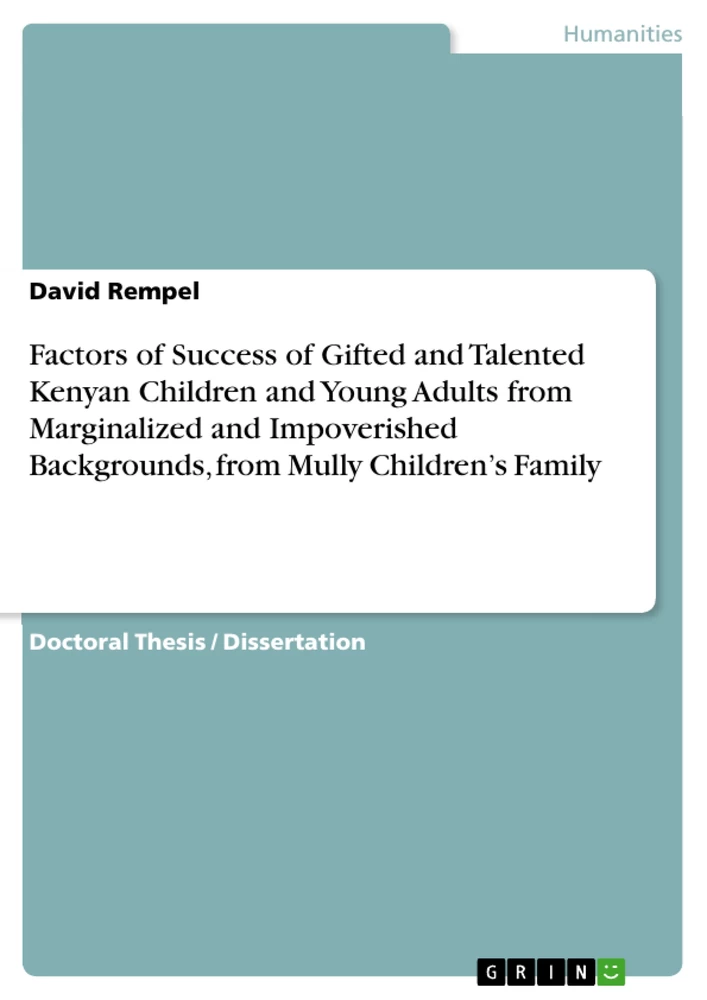
Table of Contents
1.0 Introduction
1.1. Purpose
1.2. Goals
1.3. Significance
1.4. Research Questions
1.5. Overview of the Study
2.0 Literature Review
2.1. Untapped Potential in Marginalized Children and Youth
2.2. Role of the Environment
2.3. Performance and System Theories
2.4. Societal Impact and Responsibility
2.5. Creating a conducive Microsystem to create a condusive Mesosystem
2.6. Systems and Programs to Promote High Achievers
2.7. Impact and Development of Personalized Goals
2.8. Relationship between Goals and Role Models or Mentors
2.9. Differentiated Model of Giftedness and Talent as it relates to MCF
2.10. Social Interdependency of Each Individual within the Larger Construct.
2.11. Learning Process:
2.12. Regulation types
2.13. Resources
2.14. A systemic approach: the Actiotope Model
2.15 An overview of the Actiotope Model of Giftedness
2.16. Learning Resources in the Actiotope: Educational and learning capital
2.17. Education Capital
2.18. Learning Capital
2.19. Consequences for gifted education
2.20. Education and Learning Capitals among the general Kenyan population and within the Marginalized in the Kenyan Society
2.21. Discovering the Gifted and Talented
2.22. The Role of Intuition and deciding who enters the MCF Program
2.23. Discussion of theory
3. Methodology
3.1 Appropriateness of the Research Design
3.2 Research Design / Method
3.2.1. MCF Construct
3.2.2. Questionnaire Beneficiaries
3.2.3. Qualitative Interviews Beneficiaries
3.2.4. Qualitative Interviews staff
3.2.5. Questionnaire People in Shadows
3.2.6. Qualitative Interviews Community members
3.3. Setting and Participants
3.4. Instrumentation
3.5. Data findings:
4. 0. Ethics
5.0 Internal and External Validity
6. Findings
6.1.1 Findings Part 1: MCF Construct:
6.1.2. MCF as it relates to Educational Capital
6.1.3. MCF as it relates to Educational Learning Capital
6.2 Part 2: MCF Awards and Achievements
6.2.1. General Overview of Awards and Achievements of MCF beneficiaries up to date
6.2.3. General Achievements and Awards for MCF and for the Founders Dr. Charles Mulli and Esther Mulli
6.3 Questionnaires and Interviews
6.3.1 Questionnaire Beneficiaries QELC
6.3.2Qualitative Interviews Beneficiaries
6.3.3. Qualitative Interviews staff
6.3.4. NBLC Questionnaire people in shadows
6.3.5Qualitative Interviews Community members
7. Conclusions
7.1. MCF Construct
7.1.1. Education Capital Applied in the MCF Construct
7.1.2. MCF Construct providing Learning Capital Development Opportunities
7.2. Understanding Individual success factors
7.3. Impact of Important Individuals / People in the shadows
7.4. Final Thoughts and Discussion
7.5. Educational Impact
7.6. Limitations
7.6. Further Research
Research Objectives and Topics
This study aims to analyze the success factors of individual beneficiaries and the organization as a whole within the Mully Children's Family (MCF) in Kenya. It investigates how this non-governmental organization, focused on marginalized and traumatized children, facilitates the development of excellence through specific educational and learning structures. The primary research goal is to understand how the "MCF Construct" provides a supportive environment that enables children to move beyond their impoverished backgrounds and achieve academic, athletic, and artistic excellence.
- The role of the MCF environment in rehabilitating and supporting marginalized children.
- Application of the Actiotope Model to explain talent development within the MCF structure.
- The impact of "Educational Capital" and "Learning Capital" on the success of beneficiaries.
- The influence of mentors, role models, and peer encouragement ("people in the shadows") on individual success.
- Success factors related to goal setting, discipline, and overcoming past trauma.
Extract from the Book
1.1. Purpose
This study is an exploration of both the Mully Children’s Family, referred to as the MCF Construct, which has seen a high number of award winners individually and as teams in the areas of Academics, Fine Arts, and Sports while in the MCF construct; the MCF schools have also achieved tops standings on final exams both at primary and secondary levels. For the purpose of this study the terms gifted and talented as well as excellence will be defined as having won some kind of award of achievement, across all academic disciplines, athletic competitions, and in the areas of arts and performances. Unlike most award winners, these young people come from marginalized and highly vulnerable backgrounds, and have grown up in large homes with hundreds of children in each (mulychildrensfamily, 2013).
Hypothesis 1. The MCF Construct has been able to create the complex environment as well as a substitute family atmosphere, in which children can not only develop but also achieve excellence. The MCF Construct has been able to develop opportunities for individuals within the construct to develop themselves, using both Learning Capital and Educational Capital, (the term capital, as opposed to resources, was chosen by Ziegler & Baker because the they can both take on negative values, is the product of some activity and can grow). These capitals can be divided into those that are exogenous resources (school, teachers, classmates, educational system, sports facilities etc,) and provide people and systems so that the endogenous resources (subject exclusively to the subsystem of ‘person’) (Ziegler & Baker, 2013) .
Hypthesis 2. The MCF Construct’s success in helping to make it possible for many of those in its care to achieve awards can be explained using the Actiotope Model. The actiotope approach is actions and the possibilities for acting possessed by individuals. These must be recognized as a result of three adaptations:
• A biological assimilation that was mainly carried by the human species and is conceptually locatable in biotopes;
• A social assimilation that is mainly carried by social associations, which we can conceptually locate in sociotopes; and
• An individual assimilation that is carried by individuals, which we can conceptually locate in actiotopes (Ziegler & Baker, 2013).
Summary of Chapters
1.0 Introduction: This chapter introduces the study, its purpose, research goals, hypothesis, and the context of marginalized children in Kenya.
2.0 Literature Review: Provides a comprehensive background on talent development, environmental influences, performance theories, and the Actiotope Model in relation to marginalized youth.
3. Methodology: Details the mixed-methods approach, including quantitative questionnaires (QELC, NBLC) and qualitative interviews with beneficiaries, staff, and community members.
6. Findings: Presents the empirical results, categorized into the MCF construct, award achievements, and the insights gathered from various questionnaires and interviews.
7. Conclusions: Synthesizes the findings, confirming the research hypotheses and discussing the impact of the MCF model on educational success and talent development.
Keywords
Impoverished and marginalized award winners, Actiotope Model, Educational Capital, Learning Capital, success factors, Kenyan Award Winners, Mully Children's Family, Giftedness, Talent Development, Mentoring, Role Models, Forgiveness, Resilience, Rehabilitation, Systemic Approach.
Frequently Asked Questions
What is the core focus of this research?
The work investigates the success factors of former marginalized and impoverished children who have become award winners while under the care of the Mully Children's Family (MCF) in Kenya.
What are the central themes of the study?
The research explores talent development, the role of supportive environments, the impact of educational and learning capital, and the influence of social networks like mentors and role models.
What is the primary goal of the study?
The study aims to understand how the MCF construct fosters excellence and why its beneficiaries are able to achieve success and awards despite coming from highly vulnerable backgrounds.
Which scientific methods are employed?
The author uses a mixed-methods research design, combining quantitative surveys (QELC and NBLC checklists) and qualitative interviews with beneficiaries, staff, and community members.
What is treated in the main part of the book?
The main part covers the theoretical literature review on systems and performance theories, followed by a detailed methodology and the presentation and discussion of findings regarding the MCF system and individual development.
Which keywords characterize this work?
Keywords include the Actiotope Model, Educational and Learning Capital, marginalized youth, resilience, talent development, and the role of systemic support structures.
How does MCF define "giftedness" and "excellence" for this study?
Excellence is pragmatically defined as having achieved regional, national, or international awards in various disciplines, including academics, sports, and the arts.
What role do "people in the shadows" play?
These individuals—teachers, mentors, coaches, and caregivers—are essential as role models and supporters who provide the necessary psychological and educational encouragement for the children's success.
Ende der Leseprobe aus 363 Seiten
- nach oben
- Arbeit zitieren
- David Rempel (Autor:in), 2017, Factors of Success of Gifted and Talented Kenyan Children and Young Adults from Marginalized and Impoverished Backgrounds, from Mully Children’s Family, München, Page::Imprint:: GRINVerlagOHG, https://www.diplomarbeiten24.de/document/371685

neugierig - aktuell - relevant
Entdecken Sie hilfreiche Tipps und Tricks rund ums Studium!

Entdecken Sie hilfreiche Tipps und Tricks rund ums Studium!
Ihre Hausarbeit / Abschlussarbeit:

- - Publikation als E-Book und Buch
- - Hohes Honorar auf die Verkäufe
- - Für Sie komplett kostenlos - mit ISBN
- - Es dauert nur 5 Minuten
- - Jede Arbeit findet Leser

- © GRIN Publishing GmbH.
- Alle Inhalte urheberrechtlich geschützt. Kopieren und verbreiten untersagt.
- info@grin.com
- AGB
- Open Publishing
Der GRIN Verlag hat sich seit 1998 auf die Veröffentlichung akademischer eBooks und Bücher spezialisiert. Der GRIN Verlag steht damit als erstes Unternehmen für User Generated Quality Content. Die Verlagsseiten GRIN.com, Hausarbeiten.de und Diplomarbeiten24 bieten für Hochschullehrer, Absolventen und Studenten die ideale Plattform, wissenschaftliche Texte wie Hausarbeiten, Referate, Bachelorarbeiten, Masterarbeiten, Diplomarbeiten, Dissertationen und wissenschaftliche Aufsätze einem breiten Publikum zu präsentieren.
Kostenfreie Veröffentlichung: Hausarbeit, Bachelorarbeit, Diplomarbeit, Dissertation, Masterarbeit, Interpretation oder Referat jetzt veröffentlichen!
Folgen Sie GRIN auf


- GRIN Verlag GmbH
-
- Nymphenburger Str. 86
- 80636
- Munich, Deutschland
- +49 89-550559-0
- +49 89-550559-10
- info@grin.com
-
