
präsentiert von

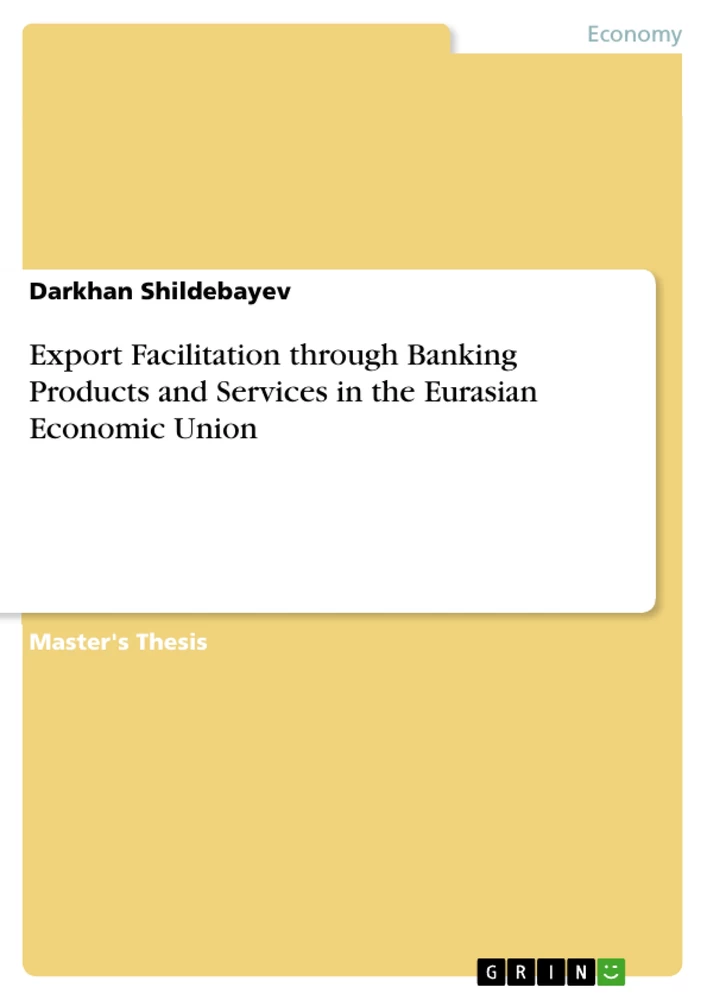
Table of Contents
1. Introduction
1.1. Background
1.2. Research question, objectives and purpose
1.3. Structure of the thesis
2. Literature Review
2.1. Current Economic Developments
2.2. The role of Exports in the Economy of Kazakhstan
2.3. Characteristics of SMEs and Their Role in an Economy
2.4. The role of Banking Industry in Facilitating Exports
2.5. Conceptualized Model
3. Methodology
3.1. Research Method
3.2. Questionnaire Design
4. Results
4.1. Summary of the findings
4.2. Generalizability of the results
5. Discussion
5.1. Answer to the research question
6. Conclusion
6.1. Practical implications and contribution to the existing knowledge
6.2. Limitations
6.3. Recommendations for future research
Research Objectives and Themes
The primary objective of this thesis is to examine the role of the banking industry in facilitating the export activities of Small and Medium Enterprises (SMEs) in Kazakhstan and to identify the specific challenges these enterprises face when attempting to access export-related banking products, with the ultimate goal of proposing measures for financial institutions to improve service accessibility.
- Analysis of the current economic environment in Kazakhstan following the formation of the Eurasian Economic Union.
- Evaluation of the contribution of SMEs to the national economy and their specific role in export activities.
- Investigation into the banking products currently utilized by SMEs for international trade.
- Identification of primary challenges faced by exporting SMEs regarding bank requirements, communication, and interest rates.
- Formulation of strategic recommendations for banks to better support the needs of exporting SMEs.
Auszug aus dem Buch
2.1. Current Economic Developments
After the collapse of the Union of Soviet Socialist Republics (USSR) in the early 1990’s, it was clear for Kazakhstan that being isolated was not the best way that would lead the country to a prosperity. Moreover, the interdependencies of the economies of the former members of the Soviet Union did not let the countries separate one from another. For instance, Kazakhstan was considered as a metallurgical center of the union, while Belarus was best known for mechanical engineering. As a result, the independent but still interdependent states of former Soviet Union decided to reunite under the so-called Commonwealth of Independent States (CIS). The treaty on the formation of the CIS was signed in Almaty in December of 1991 by Kazakhstan, Russia, Azerbaijan, Armenia, Belarus, Tajikistan, Turkmenistan, Moldova, Ukraine, Uzbekistan and Georgia. The emergence of such an institution allowed the former Soviet states to reestablish the mutual trade among each other.
The CIS was among the first establishments to liberalize trade within the territory of the former USSR. Later, there were many attempts to minimize not only the trade barriers among the states but also the borders between the states as such. However, now independent, the states were reluctant to reunite under any circumstances, apart from purely economic reasons. Therefore, the reintegration attempts were mostly unsuccessful.
Nevertheless, the attempts of economic integration were gradually becoming more and more fruitful. However, the deeper the integration, the fewer members were participating in the unions. For instance, the CIS consisted of 11 members including Georgia when it was formed in 1991, while Eurasian Economic Community (EURASEC) in 2000 and the EEU in 2015 had only 5 and 3 members respectively. One of the main reasons why the states were reluctant to reunite, according to Obydenkova, was that the states were not willing to transfer their powers to supranational institutions without which almost no integration is possible.
Summary of Chapters
1. Introduction: This chapter contextualizes the economic importance of exporting for Kazakhstani firms and defines the research question regarding banking support for SMEs.
2. Literature Review: This section surveys existing studies on economic integration, the role of exports in growth, SME characteristics, and the banking industry's function in international trade.
3. Methodology: This chapter details the quantitative research approach, the distribution of questionnaires to 388 exporting companies, and the use of SPSS for data analysis.
4. Results: This chapter presents the empirical findings gathered from the survey, including statistical analyses of challenges faced by exporting SMEs regarding banking services.
5. Discussion: This chapter interprets the survey results in the context of the literature review and proposes actionable recommendations for banks to support SME exports.
6. Conclusion: This final chapter synthesizes the main research findings, outlines the practical implications for policy and banking management, and suggests areas for future research.
Keywords
exports, banking products for exports, challenges of SMEs, Kazakhstan, Eurasian Economic Union, SME competitiveness, export-led growth, trade finance, banking sector, economic integration, financial constraints, credit access, collateral requirements, SME development, bank services.
Frequently Asked Questions
What is the primary focus of this master's thesis?
The research focuses on analyzing the challenges faced by exporting Small and Medium Enterprises (SMEs) in Kazakhstan when accessing banking products and services, aiming to provide solutions for more effective financial support.
What are the central thematic areas covered in the study?
The study covers the impact of the Eurasian Economic Union on Kazakhstan, the economic role of SMEs, the relationship between exports and economic growth, and the role of the banking sector in facilitating international trade.
What is the core research question of this study?
The research asks: What measures should be taken by banks to make export-related products more accessible to small and medium enterprises in order to facilitate their export activities?
Which methodology was employed to gather data?
The author utilized a quantitative research method, distributing questionnaires to 388 exporting companies in Kazakhstan and employing the Statistical Package for the Social Sciences (SPSS) for analyzing the survey data.
What topics are explored in the main body of the work?
The main body examines current economic developments in the region, the theoretical link between exports and economic growth, the specific operational challenges of SMEs, and how these firms interact with the banking sector for trade financing.
Which keywords characterize this thesis?
Key terms include exports, banking products for exports, challenges of SMEs, Kazakhstan, Eurasian Economic Union, trade finance, and financial constraints.
What are the primary challenges identified for SMEs regarding banks?
The study identifies high interest rates and fees, excessive documentary requirements, and difficulties in communication between banks and SMEs as the most significant barriers.
What specific recommendations does the author provide to banks?
The author recommends improving risk assessment methodologies, developing educational training programs for SMEs regarding financial documentation, enhancing communication channels, increasing operational efficiency to reduce processing time, and assisting SMEs in exploring new market opportunities.
How does the author propose to reduce the time needed for loan processing?
The author suggests that eliminating the identified issues with excessive documentary requirements will directly reduce the time needed for issuing banking products.
What observation does the author make about export destinations of Kazakh SMEs?
The research found that most SMEs in Kazakhstan primarily export to neighboring CIS and Customs Union states, whereas larger companies are more likely to export to distant regions such as the EU and South East Asia.
Ende der Leseprobe aus 116 Seiten
- nach oben
- Arbeit zitieren
- Darkhan Shildebayev (Autor:in), 2015, Export Facilitation through Banking Products and Services in the Eurasian Economic Union, München, Page::Imprint:: GRINVerlagOHG, https://www.diplomarbeiten24.de/document/372169

neugierig - aktuell - relevant
Entdecken Sie hilfreiche Tipps und Tricks rund ums Studium!

Entdecken Sie hilfreiche Tipps und Tricks rund ums Studium!
Ihre Hausarbeit / Abschlussarbeit:

- - Publikation als E-Book und Buch
- - Hohes Honorar auf die Verkäufe
- - Für Sie komplett kostenlos - mit ISBN
- - Es dauert nur 5 Minuten
- - Jede Arbeit findet Leser

- © GRIN Publishing GmbH.
- Alle Inhalte urheberrechtlich geschützt. Kopieren und verbreiten untersagt.
- info@grin.com
- AGB
- Open Publishing
Der GRIN Verlag hat sich seit 1998 auf die Veröffentlichung akademischer eBooks und Bücher spezialisiert. Der GRIN Verlag steht damit als erstes Unternehmen für User Generated Quality Content. Die Verlagsseiten GRIN.com, Hausarbeiten.de und Diplomarbeiten24 bieten für Hochschullehrer, Absolventen und Studenten die ideale Plattform, wissenschaftliche Texte wie Hausarbeiten, Referate, Bachelorarbeiten, Masterarbeiten, Diplomarbeiten, Dissertationen und wissenschaftliche Aufsätze einem breiten Publikum zu präsentieren.
Kostenfreie Veröffentlichung: Hausarbeit, Bachelorarbeit, Diplomarbeit, Dissertation, Masterarbeit, Interpretation oder Referat jetzt veröffentlichen!
Folgen Sie GRIN auf


- GRIN Verlag GmbH
-
- Nymphenburger Str. 86
- 80636
- Munich, Deutschland
- +49 89-550559-0
- +49 89-550559-10
- info@grin.com
-
