
präsentiert von

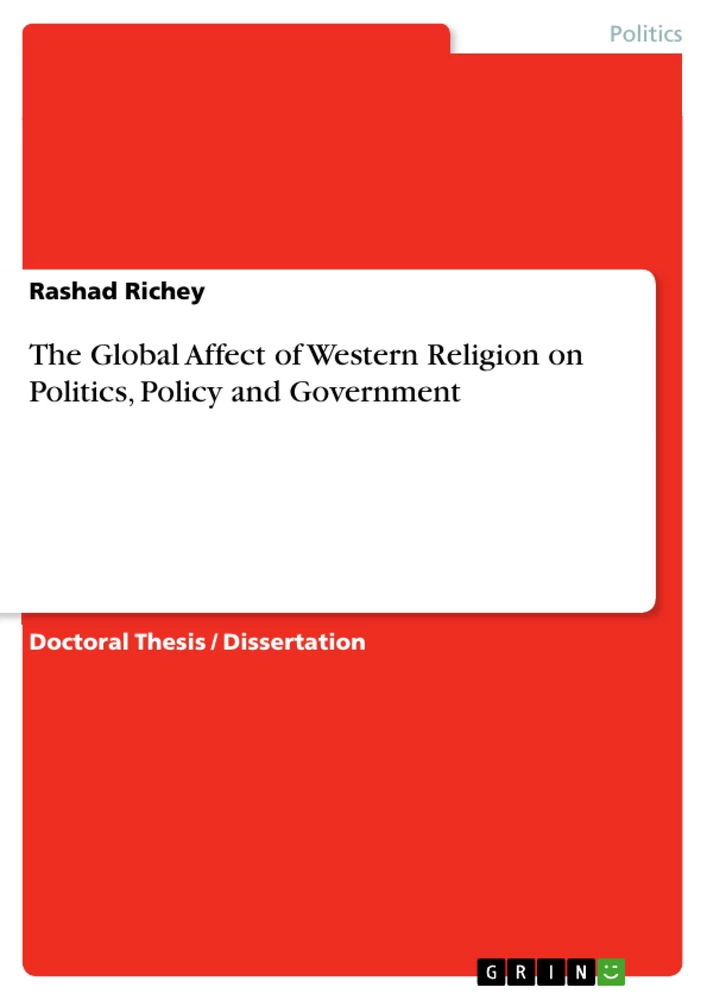
Table of Contents
Executive Summary
1. Introduction/Background
1.1 The Descriptive Angle
1.2 The Aspirational Angle
1.3 The Foreign Perspective
1.4 The Domestic Perspective
1.5 A Further Conceptual Clarification
1.6 The Map for the Present Paper
2. Theoretical Review and Analysis
2.1 The Marxist Perspective
2.2 The Rebuttal from Castoriadis
2.3 Case Study: Gay Marriage
2.4 Case Study: ISIS
2.5 Liberty and the Evangelical Mentality
2.6 Description versus Aspiration, Revisited
3. Methodology and Results
3.1 The Interview
3.2 Synopsis and Analysis
4. Findings and Discussion
4.1 Pushing Ideology
4.2 Capitalism as Religion
4.3 The Current Moment
4.4 A "Progressive" Nation
4.5 The Decline of Western Religion?
5. Conclusion
Research Objectives and Thematic Focus
This paper investigates the multifaceted impact of Western religion on governance, policy, and politics within both domestic and global contexts. It seeks to demonstrate that Western religion is fundamentally inseparable from Western civilization, as many values perceived as secular actually possess ideological roots traceable to this religious tradition. The central research question explores the governmental impact of Western religion on world affairs, leading to the examination of how ideological conflicts influence contemporary political landscapes, particularly the tension between traditional Western religion and secular progressivism.
- The role of ideology as a foundational driver of political and social structures.
- The evolution of secular progressivism as a quasi-religious ideology derived from Western religious roots.
- The clash between Western ideological values and non-Western worldviews (e.g., Islamic sharia law).
- The qualitative analysis of political perspectives on the intersection of faith and public policy.
- The necessity of critical ideological awareness for modern democratic governance.
Excerpt from the Book
The Marxist Perspective
Most dismissals of the importance of ideology in world affairs tend to be influenced by the political theory of Karl Marx, whether they are consciously aware of that or not. A key idea of the Marxist perspective is that ideology is always a kind of projection, or bad faith, that conceals the realities that are actually going on at the level of the material ground (Marx & Engels, 1932). For example, a person who feels like a "loser" in this world may begin to imagine another world, or a Kingdom of Heaven, in which he will no longer feel that way. The implication would be that if that person became a "winner," then he would no longer have a need for such projections, since his actual material needs and desires would be satisfied. In this sense, ideology would always be understood as the symptom of some sort of psychological disorder. People begin to worship Nature, in order to conceal the fact that they are terrified of Nature; people begin to believe in Heaven, because their own lives in this world are awful; and so on. Achieving true and autonomous self-consciousness, then, would involve withdrawing the projections of ideology, such that one is then able to confront the world as it actually stands and fulfill one's needs and desires in real terms.
This perspective would seem to have a certain face-value plausibility. After all, most people probably know at least someone or another who does in fact behave very much in the way described above: a person who develops fantasies, out of an inability to deal with realities. This is undoubtedly a real dynamic of human psychology, which makes it difficult to dismiss this analysis out of hand entirely. The argument that will be made here, however, is that this is not a general description of ideology per se, but rather only a description of the pathological perversion of ideology.
Summary of Chapters
1. Introduction/Background: This chapter establishes the tension between America's religious roots and secular governance, introducing the distinction between descriptive and aspirational avenues of inquiry.
2. Theoretical Review and Analysis: This section deconstructs ideological frameworks, contrasting Marxist materialist reductionism with the work of Cornelius Castoriadis and analyzing how specific cases like gay marriage and ISIS reflect deeper ideological conflicts.
3. Methodology and Results: This chapter outlines the qualitative research approach, documenting an interview with an anonymous U.S. congressman regarding his views on the intersection of his faith and political duty.
4. Findings and Discussion: This section cross-examines the interview data against the theoretical framework, identifying key themes such as the evangelical nature of Western policy and the characterization of capitalism as a religion.
5. Conclusion: The final chapter synthesizes the findings, asserting that Western religion remains a foundational force in modern political life and that ideological blindness in the West poses a significant threat to its social and political stability.
Keywords
Western religion, Ideology, Governance, Secular progressivism, Political theory, Marxism, Castoriadis, Sharia supremacism, Judeo-Christian tradition, Qualitative analysis, American politics, Human rights, Ideological conflict, Church and state, Secularism.
Frequently Asked Questions
What is the core subject of this dissertation?
The paper examines how Western religion continues to shape governance, policies, and politics in the United States and globally, despite the common perception that modern politics has become entirely secularized.
What are the primary ideological themes explored?
The work focuses on the nature of ideology, the historical and genealogical links between Western religion and modern secular concepts like universal human rights, and the emerging conflicts between traditional Western values and secular progressivism.
What is the primary research objective?
The objective is to determine the governmental impact of Western religion on world affairs and to demonstrate that ideology—viewed as a set of aspirational values—is an inescapable factor in all political systems.
Which methodologies are employed in this research?
The study utilizes a qualitative case study approach, involving an in-depth interview with a selected U.S. congressman, analyzed through the lens of a previously constructed theoretical framework.
What does the main body of the work address?
The main body conducts a theoretical critique of Marxist perspectives on ideology, contrasts them with the insights of Cornelius Castoriadis, and applies these concepts to contemporary issues like gay marriage, the rise of ISIS, and the political behavior of American evangelicals.
Which key terms define this work?
Key terms include Western religion, ideology, secular progressivism, Judeo-Christian tradition, political theology, and the aspirational dimension of governance.
How does the author define "Western religion" for the purpose of this study?
The author primarily defines Western religion as the Judeo-Christian tradition, emphasizing its role in shaping Western civilization and its foundational influence on modern legal and social institutions.
What is the "aspirational" versus "descriptive" distinction made by the author?
The descriptive perspective analyzes the state of affairs as they currently exist, while the aspirational perspective focuses on how societal structures and moral values should ideally be configured based on an underlying ideology.
Why does the author argue that secular progressivism is a form of Western religion?
The author argues that secular progressivism shares the same historical and cultural DNA as Western religion, including an "evangelical" impulse to spread its values globally, making it a quasi-religious ideology despite its secular appearance.
What is the significance of the congressman's interview in this study?
The interview serves as a practical prism to examine how a modern policymaker reconciles his personal faith with his professional duties and how he navigates the ideological pressures of contemporary American politics.
Ende der Leseprobe aus 104 Seiten
- nach oben
- Arbeit zitieren
- Dr. Rashad Richey (Autor:in), 2016, The Global Affect of Western Religion on Politics, Policy and Government, München, Page::Imprint:: GRINVerlagOHG, https://www.diplomarbeiten24.de/document/372219

neugierig - aktuell - relevant
Entdecken Sie hilfreiche Tipps und Tricks rund ums Studium!

Entdecken Sie hilfreiche Tipps und Tricks rund ums Studium!
Ihre Hausarbeit / Abschlussarbeit:

- - Publikation als E-Book und Buch
- - Hohes Honorar auf die Verkäufe
- - Für Sie komplett kostenlos - mit ISBN
- - Es dauert nur 5 Minuten
- - Jede Arbeit findet Leser

- © GRIN Publishing GmbH.
- Alle Inhalte urheberrechtlich geschützt. Kopieren und verbreiten untersagt.
- info@grin.com
- AGB
- Open Publishing
Der GRIN Verlag hat sich seit 1998 auf die Veröffentlichung akademischer eBooks und Bücher spezialisiert. Der GRIN Verlag steht damit als erstes Unternehmen für User Generated Quality Content. Die Verlagsseiten GRIN.com, Hausarbeiten.de und Diplomarbeiten24 bieten für Hochschullehrer, Absolventen und Studenten die ideale Plattform, wissenschaftliche Texte wie Hausarbeiten, Referate, Bachelorarbeiten, Masterarbeiten, Diplomarbeiten, Dissertationen und wissenschaftliche Aufsätze einem breiten Publikum zu präsentieren.
Kostenfreie Veröffentlichung: Hausarbeit, Bachelorarbeit, Diplomarbeit, Dissertation, Masterarbeit, Interpretation oder Referat jetzt veröffentlichen!
Folgen Sie GRIN auf


- GRIN Verlag GmbH
-
- Nymphenburger Str. 86
- 80636
- Munich, Deutschland
- +49 89-550559-0
- +49 89-550559-10
- info@grin.com
-
