
präsentiert von

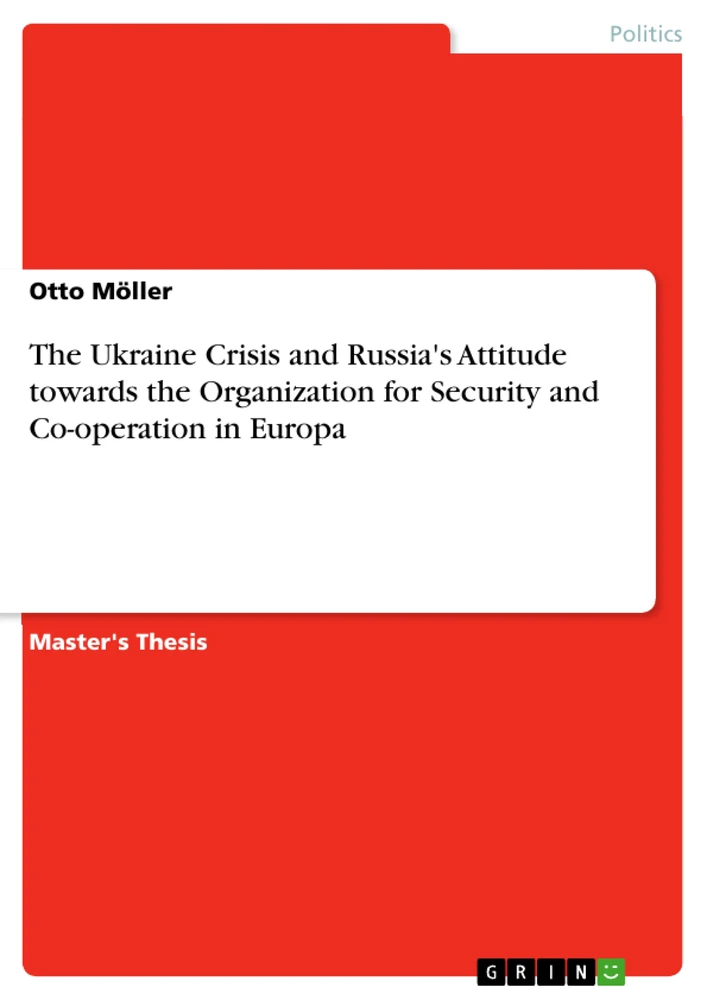
Table of Contents
1. Introduction
2. Theory and Background Perspectives
2.1 Neoclassical Realism
2.2 Collective Security and the structure of the OSCE
2.3 Collective Security and the success of the OSCE
2.4 The crisis of the OSCE and the decisive role of Russia in it
3. Context: Background of the Russia-OSCE relationship: The stages of the Kremlin’s OSCE policy
4. Methodology
5. Limitations
6. Case Study Analysis: Through the lens of Neoclassical Realism
6.1 Power considerations as a driver of Russia´s foreign policy
6.2 How the Kremlin’s interests in the crisis shaped its attitude towards the OSCE
6.3 The perception of the OSCE during the crisis and the Russian ‘shock’
7. Further Implications
8. Conclusion
Objectives & Themes
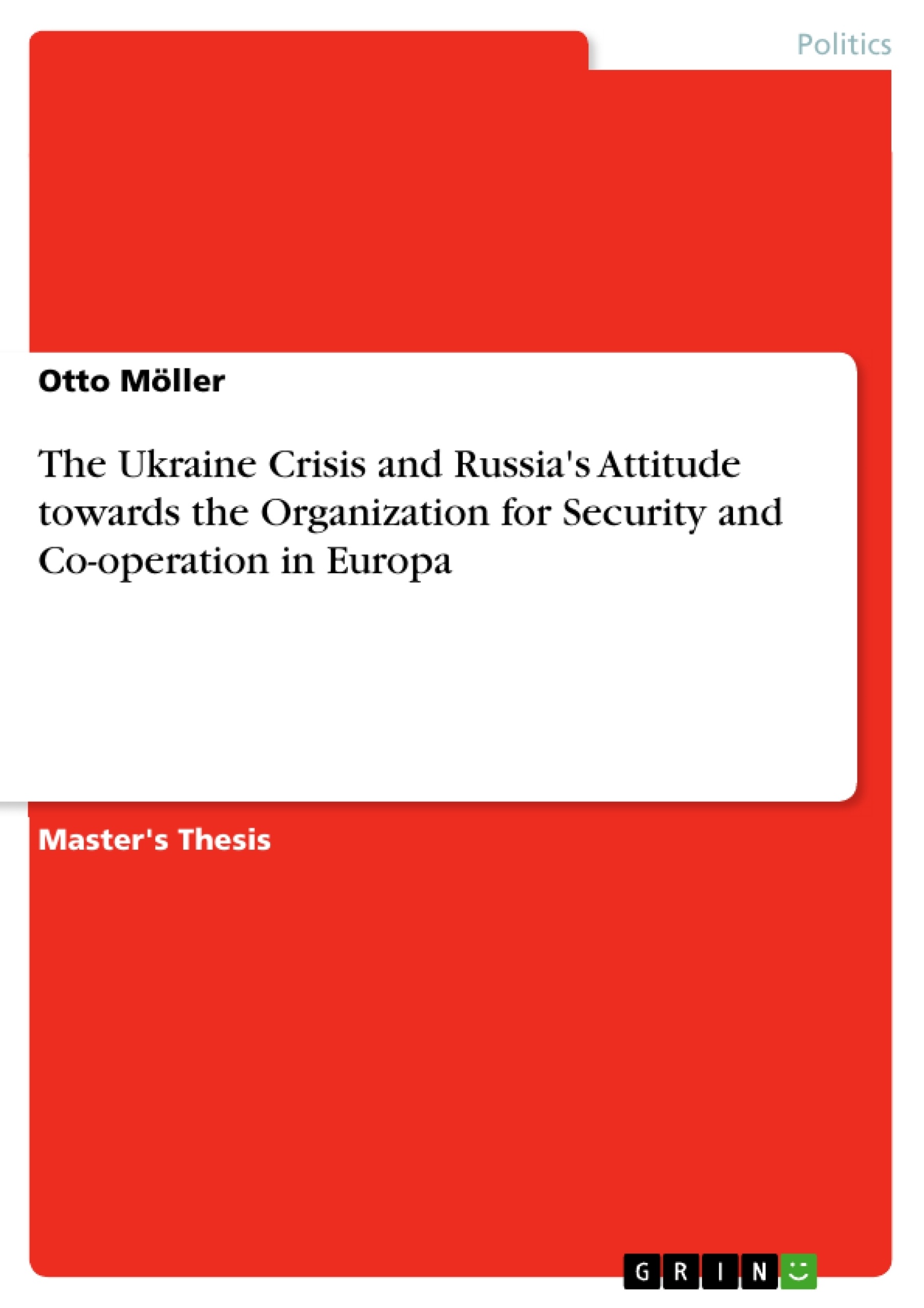
This dissertation investigates the Russian attitude towards the Organization for Security and Co-operation in Europe (OSCE) during the Ukraine crisis (2013-2016). The central research question seeks to determine whether Russia's stance towards the organization shifted during this period of geopolitical tension, testing the hypothesis that while Russia dislikes the OSCE, it utilizes the forum as a strategic tool to further its foreign policy interests.
- Neoclassical Realist analysis of Russian foreign policy.
- The role of the OSCE in the context of collective security versus collective defense.
- The impact of Russian power considerations and perceived threats on its OSCE policy.
- Examination of the Kremlin's strategic use of the Special Monitoring Mission to Ukraine (SMM).
- The influence of internal Russian political drivers and 'shocks' on foreign policy behavior.
Excerpt from the Book
6.2 How the Kremlin’s interests in the crisis shaped its attitude towards the OSCE
Russia’s interest in Ukraine and its subversion of the subsequent crisis is based on its status as a revisionist state. The Kremlin strives to alter the balance of power in Europe again. In interpreting these actions through NCR, one understands Moscow’s interventionist activity as a result of its previous position as a hegemon and current position as an ascending power and revisionist state. Due to that, the Kremlin has been averse to welcome political institutions constituted by the Atlantic world when it was powerless and is now driven by the aim of overthrowing this status. Its gain in relative material power, due to profitable oil and natural gas deals since the beginning of the new millennia has motivated this aggressive Russian behavior. The balance of power concept within the field of security studies advocates that national security is strengthened when military power is not central, but scattered among many actors so that no one actor can dominate the others. It is thus in Russia’s interest to balance the power of NATO and the EU.
As previously discussed, interest considerations are one of three main driving factors of foreign policy actions according to NCR. The primary reason for the annexation of Crimea by Russia amongst the wider Western public is Russian security interest, implying that the accession of Ukraine to NATO would interfere with Russian security interests in its sphere of influence. It was in Russia’s interest to send a signal to stop the expansion. Furthermore, the Russian Black Sea fleet based in Sevastopol, Crimea, would have been newly negotiated, putting Russia in fear that it would be a detrimental contract with Ukraine. However, arguably at the time of the annexation, Ukraine’s NATO ambitions were off the table.
Summary of Chapters
1. Introduction: Outlines the significance of the Ukraine crisis in Russian-Western relations and introduces the research question regarding Russia’s attitude towards the OSCE.
2. Theory and Background Perspectives: Establishes the theoretical framework of Neoclassical Realism and defines the role of collective security within the OSCE structure.
3. Context: Background of the Russia-OSCE relationship: The stages of the Kremlin’s OSCE policy: Reviews the historical development of the Russia-OSCE relationship from the 1970s through the post-Soviet period.
4. Methodology: Details the qualitative single case study approach used to analyze Russian foreign policy between 2013 and 2016.
5. Limitations: Discusses the methodological constraints regarding personal bias, generalizability, and the qualitative nature of the research.
6. Case Study Analysis: Through the lens of Neoclassical Realism: Analyzes the interplay of power, interests, and perception in shaping Russia's behavior during the Ukraine crisis and its strategic use of the OSCE.
7. Further Implications: Evaluates the future of Russo-Western relations and the enduring reliance on the OSCE as a primary channel for communication.
8. Conclusion: Summarizes the study's findings, confirming that Russia’s fundamental attitude towards the OSCE remains unchanged, despite tactical shifts in engagement.
Keywords
Russia, OSCE, Ukraine Crisis, Neoclassical Realism, Collective Security, Foreign Policy, Crimea, NATO, Power Balancing, Revisionism, Kremlin, Minsk Agreements, Diplomacy, International Relations, Geopolitics
Frequently Asked Questions
What is the core subject of this research?
The research focuses on the Russian Federation's foreign policy towards the Organization for Security and Co-operation in Europe (OSCE) during the height of the Ukraine crisis between 2013 and 2016.
What are the primary themes discussed?
Key themes include the application of Neoclassical Realist theory, the concept of collective security versus defense, Russia's revisionist goals, and the impact of the Crimea annexation on European security architecture.
What is the main goal or research question?
The work seeks to answer: "What was the Russian attitude towards the OSCE during the Ukraine crisis from 2013-2016?"
Which scientific methodology is applied?
The author employs a qualitative single case study approach, utilizing primary sources like the "Foreign Policy Concept of the Russian Federation 2013" and various OSCE reports.
What is covered in the main section of the work?
The main part examines power, interests, and perception as the three primary drivers of foreign policy, specifically focusing on how Russia used the OSCE to project power and manage its reputation.
Which keywords best characterize this study?
Russia, OSCE, Ukraine Crisis, Neoclassical Realism, Foreign Policy, and Geopolitics are central to the analysis.
How does the author explain Russia's support for the Special Monitoring Mission to Ukraine (SMM)?
The author argues that Moscow's support for the SMM was a strategic move to manipulate perceptions and appear as a constructive hegemon, while simultaneously using the mission to legitimize its position.
What is the significance of the "Russian shock" mentioned in the study?
The "shock," specifically regarding the Maidan movement, is interpreted through Neoclassical Realism as a triggering element that made the Russian leadership more willing to take high-stakes risks, such as the annexation of Crimea.
Ende der Leseprobe aus 59 Seiten
- nach oben
- Arbeit zitieren
- Otto Möller (Autor:in), 2017, The Ukraine Crisis and Russia's Attitude towards the Organization for Security and Co-operation in Europa, München, Page::Imprint:: GRINVerlagOHG, https://www.diplomarbeiten24.de/document/373375

neugierig - aktuell - relevant
Entdecken Sie hilfreiche Tipps und Tricks rund ums Studium!

Entdecken Sie hilfreiche Tipps und Tricks rund ums Studium!
Ihre Hausarbeit / Abschlussarbeit:

- - Publikation als E-Book und Buch
- - Hohes Honorar auf die Verkäufe
- - Für Sie komplett kostenlos - mit ISBN
- - Es dauert nur 5 Minuten
- - Jede Arbeit findet Leser

- © GRIN Publishing GmbH.
- Alle Inhalte urheberrechtlich geschützt. Kopieren und verbreiten untersagt.
- info@grin.com
- AGB
- Open Publishing
Der GRIN Verlag hat sich seit 1998 auf die Veröffentlichung akademischer eBooks und Bücher spezialisiert. Der GRIN Verlag steht damit als erstes Unternehmen für User Generated Quality Content. Die Verlagsseiten GRIN.com, Hausarbeiten.de und Diplomarbeiten24 bieten für Hochschullehrer, Absolventen und Studenten die ideale Plattform, wissenschaftliche Texte wie Hausarbeiten, Referate, Bachelorarbeiten, Masterarbeiten, Diplomarbeiten, Dissertationen und wissenschaftliche Aufsätze einem breiten Publikum zu präsentieren.
Kostenfreie Veröffentlichung: Hausarbeit, Bachelorarbeit, Diplomarbeit, Dissertation, Masterarbeit, Interpretation oder Referat jetzt veröffentlichen!
Folgen Sie GRIN auf


- GRIN Verlag GmbH
-
- Nymphenburger Str. 86
- 80636
- Munich, Deutschland
- +49 89-550559-0
- +49 89-550559-10
- info@grin.com
-
