
präsentiert von

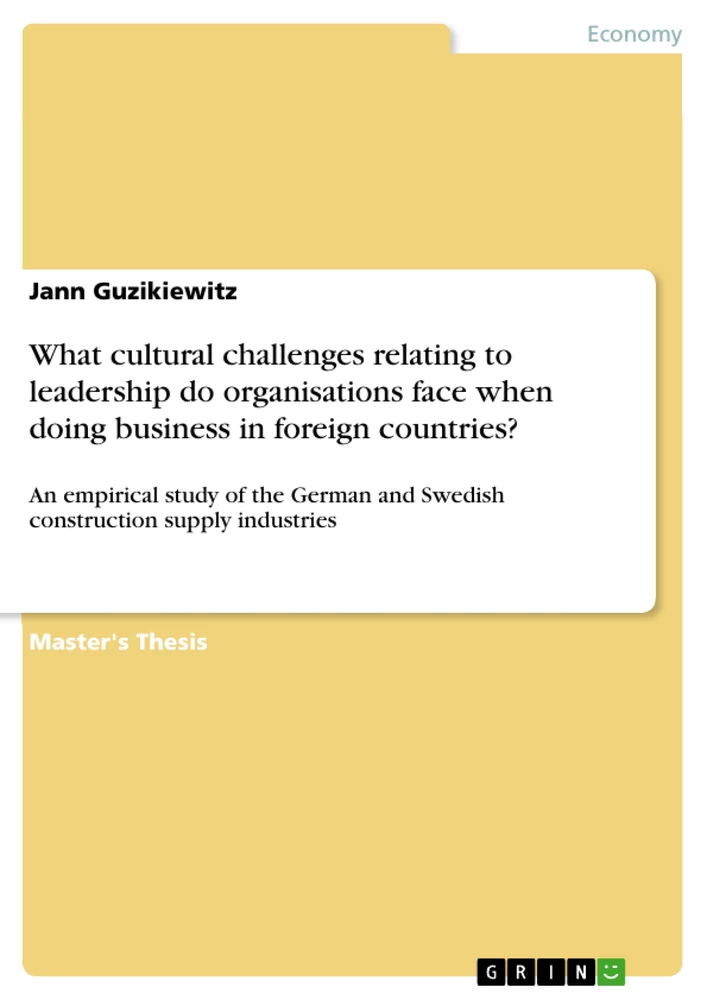
Table of Contents
1. INTRODUCTION
1.1. Definition of the Problem
1.2. Research Gap
1.3. Research Aim and Objectives
1.3.1. Aim
1.3.2. Objectives
1.4. Structure
2. LITERATURE REVIEW
2.1. Definition
2.1.1. Internationalisation
2.1.2. Culture
2.1.2.1. National Culture
2.1.2.2. Organisational Culture
2.1.3. Leadership
2.2. Cross-cultural Leadership within the Internationalisation Process
2.2.1. Models of Culture
2.2.1.1. Hofstede’s Cultural Dimensions
2.2.1.1.1. Power Distance
2.2.1.1.2. Uncertainty Avoidance
2.2.1.1.3. Individualism vs. Collectivism
2.2.1.1.4. Masculinity vs. Femininity
2.2.1.1.5. Long-term Orientation
2.2.1.1.6. Indulgence vs. Restraint
2.2.1.1.7. Hofstede’s Model in Relation to Leadership
2.2.1.1.8. Critical Evaluation of Hofstede’s Model
2.2.1.2. Globe’s Cultural Dimensions
2.2.2. The Leader’s Role
2.3. Germany vs. Sweden
2.3.1. Culture of Germany
2.3.2. Culture of Sweden
2.4. Literature Conclusion
3. RESEARCH METHODOLOGY
3.1. Research Process
3.1.1.1. Philosophy
3.1.1.2. Approach
3.1.1.3. Strategy
3.1.1.4. Choices
3.1.1.5. Time Horizon
3.2. Data Collection Method
3.2.1. Secondary Data Collection
3.2.2. Primary Data Collection
3.2.2.1. Semi-structured Interview Guide Line
3.2.2.2. Sampling of the Research Data
3.2.3. Research Ethics
3.3. Data Validity, Reliability, Generalisability and Limitations
4. ANALYSIS AND FINDINGS
4.1. Construction Supply Industry
4.2. Cultural Dimensions
4.2.1. Germany
4.2.1.1. Power Distance
4.2.1.2. Uncertainty Avoidance
4.2.1.3. Individualism vs. Collectivism
4.2.1.4. Masculinity vs. Femininity
4.2.1.5. Long-term Orientation
4.2.1.6. Indulgence vs. Restraint
4.2.2. Sweden
4.2.2.1. Power Distance
4.2.2.2. Uncertainty Avoidance
4.2.2.3. Individualism vs. Collectivism
4.2.2.4. Masculinity vs. Femininity
4.2.2.5. Long-term Orientation
4.2.2.6. Indulgent vs. Restraint
4.3. Leadership
4.3.1. Germany
4.3.2. Sweden
4.3.3. Germany vs. Sweden
4.4. Discussion
5. CONCLUSION AND RECOMMENDATIONS
5.1. Conclusion
5.2. Future Research Recommendations
6. BIBLOGRAPHY
Objectives and Thematic Focus
The primary aim of this dissertation is to identify and evaluate the cultural challenges that arise within organisational leadership when companies expand their operations into foreign markets. By focusing on the construction supply industries in Germany and Sweden, the research explores how national cultural differences influence leadership approaches and determines whether these industries deviate from established cultural theory, thereby providing actionable recommendations for leaders in international environments.
- Internationalisation processes in business
- Comparative analysis of German and Swedish national culture
- Application of Hofstede’s cultural dimensions to modern leadership
- The impact of national culture on organisational leadership styles
- Strategies for achieving leadership effectiveness across cultural borders
Excerpt from the Book
1.1. Definition of the Problem
Today’s organisations are facing the challenges of the 21st century. Globalisation as well as a radical transformation in structure, resources, and expertise is accelerated by the internet, disruptive technologies, tourism, media and immigration. (Trimble, 2015) As a result, the term of “the global village” has been coined by Hofstede, Hofstede and Minkov (2010). This term refers to the ever-shrinking world and its trade barriers.
Many people fear globalisation and its consequences. Recent global events, such as BREXIT and the election of Donald Trump as the United States of America president show that not everyone supports the consequences of globalisation. (Piketty, 2016). A study by the Bertelsmann Stiftung reveals that almost 45% of all European citizens view globalisation as a threat. (de Vries and Hoffmann, 2016) In 2017, Koch (2017) emphasises that globalisation covers both opportunities and threats for countries, groups, organisations and the individuals.
However, not all developments are directly triggered by globalisation. More often economic effects are only reinforced by globalisation like the increasing global competition of business. (Koch, 2017) Manyika et al. (2016) suggest that the world is more connected than ever before. As a result, growing global interdependence of economy, science and society lead to an increased level of competition in industry. Hence, organisations are forced to leave their domestic market for foreign markets. Baba (2015) depicts that internationalisation of business is crucial for large multinational organisations as well as for smaller sized companies to generate future competitive advantages, sustainable growth and to satisfy the profit expectations of all stakeholders.
It is worth noting that internationalisation of business is associated with various challenges and can lead to failure. Organisations need to develop certain leadership skills and tools to succeed in an international environment. In 2008, Jackson and Parry (2008, p.63) emphasised that “leadership is essentially a cultural activity – it is suffused with values, beliefs, language, rituals and artefacts.” This makes leadership a central aspect within
Summary of Chapters
1. INTRODUCTION: This chapter introduces the research context, defines the problem regarding globalisation and leadership, and outlines the research aims, objectives, and structure of the study.
2. LITERATURE REVIEW: This chapter provides a theoretical foundation by defining internationalisation, culture, and leadership, while critically analysing existing cultural models like Hofstede’s and GLOBE in relation to leadership.
3. RESEARCH METHODOLOGY: This chapter details the research process, explaining the philosophy, strategy, and data collection methods, specifically the use of semi-structured interviews to gather primary data from the construction supply industries.
4. ANALYSIS AND FINDINGS: This chapter presents the empirical findings gathered from expert interviews, mapping them against cultural dimensions to compare German and Swedish industry practices.
5. CONCLUSION AND RECOMMENDATIONS: This chapter synthesises the study's findings, evaluates the research hypotheses, and offers recommendations for future research and successful cross-cultural leadership.
Keywords
Globalisation, Internationalisation, Leadership, National Culture, Organisational Culture, Hofstede, GLOBE, Construction Supply Industry, Germany, Sweden, Cross-cultural Management, Leadership Effectiveness, Cultural Dimensions, Business Strategy, Empirical Study
Frequently Asked Questions
What is the core focus of this dissertation?
The work focuses on identifying and evaluating the cultural challenges that organisations face regarding leadership when conducting business in foreign countries, using the German and Swedish construction supply industries as a comparative case study.
What are the primary thematic areas covered?
The dissertation covers internationalisation strategies, the theoretical frameworks of national and organisational culture, various leadership theories, and the specific empirical application of Hofstede’s cultural dimensions within the construction supply sector.
What is the main objective of the research?
The primary objective is to create an understanding of the relevance of cultural differences in the internationalisation process and to develop recommendations that ensure leaders possess the cultural awareness necessary for sustainable effectiveness.
Which scientific methods are employed?
The research adopts a deductive approach within a pragmatic philosophy, utilising a qualitative research design. Data is gathered through secondary literature review and primary semi-structured expert interviews.
What topics are discussed in the main body?
The main body discusses the definition of key terms, explores contemporary cultural models (Hofstede and GLOBE), contrasts German and Swedish cultures, and provides a detailed analysis of findings regarding leadership styles in both specific industries.
Which keywords characterize this work?
Key terms include Globalisation, Leadership, National Culture, Internationalisation, Hofstede’s Cultural Dimensions, and Cross-cultural Management.
How does the study address the criticism of Hofstede’s model?
The dissertation critically evaluates Hofstede’s model in the literature review, acknowledging criticisms regarding its perceived outdated nature and lack of complexity, yet justifies its continued use as a foundational framework for cultural exploration.
What did the comparative analysis of the industries reveal?
The analysis revealed that while both industries have similarities, there are significant cultural differences between them, and the empirical findings often diverge from the general cultural descriptions provided by existing academic literature.
Ende der Leseprobe aus 134 Seiten
- nach oben
- Arbeit zitieren
- Jann Guzikiewitz (Autor:in), 2017, What cultural challenges relating to leadership do organisations face when doing business in foreign countries?, München, Page::Imprint:: GRINVerlagOHG, https://www.diplomarbeiten24.de/document/373433

neugierig - aktuell - relevant
Entdecken Sie hilfreiche Tipps und Tricks rund ums Studium!

Entdecken Sie hilfreiche Tipps und Tricks rund ums Studium!
Ihre Hausarbeit / Abschlussarbeit:

- - Publikation als E-Book und Buch
- - Hohes Honorar auf die Verkäufe
- - Für Sie komplett kostenlos - mit ISBN
- - Es dauert nur 5 Minuten
- - Jede Arbeit findet Leser

- © GRIN Publishing GmbH.
- Alle Inhalte urheberrechtlich geschützt. Kopieren und verbreiten untersagt.
- info@grin.com
- AGB
- Open Publishing
Der GRIN Verlag hat sich seit 1998 auf die Veröffentlichung akademischer eBooks und Bücher spezialisiert. Der GRIN Verlag steht damit als erstes Unternehmen für User Generated Quality Content. Die Verlagsseiten GRIN.com, Hausarbeiten.de und Diplomarbeiten24 bieten für Hochschullehrer, Absolventen und Studenten die ideale Plattform, wissenschaftliche Texte wie Hausarbeiten, Referate, Bachelorarbeiten, Masterarbeiten, Diplomarbeiten, Dissertationen und wissenschaftliche Aufsätze einem breiten Publikum zu präsentieren.
Kostenfreie Veröffentlichung: Hausarbeit, Bachelorarbeit, Diplomarbeit, Dissertation, Masterarbeit, Interpretation oder Referat jetzt veröffentlichen!
Folgen Sie GRIN auf


- GRIN Verlag GmbH
-
- Nymphenburger Str. 86
- 80636
- Munich, Deutschland
- +49 89-550559-0
- +49 89-550559-10
- info@grin.com
-
