
präsentiert von

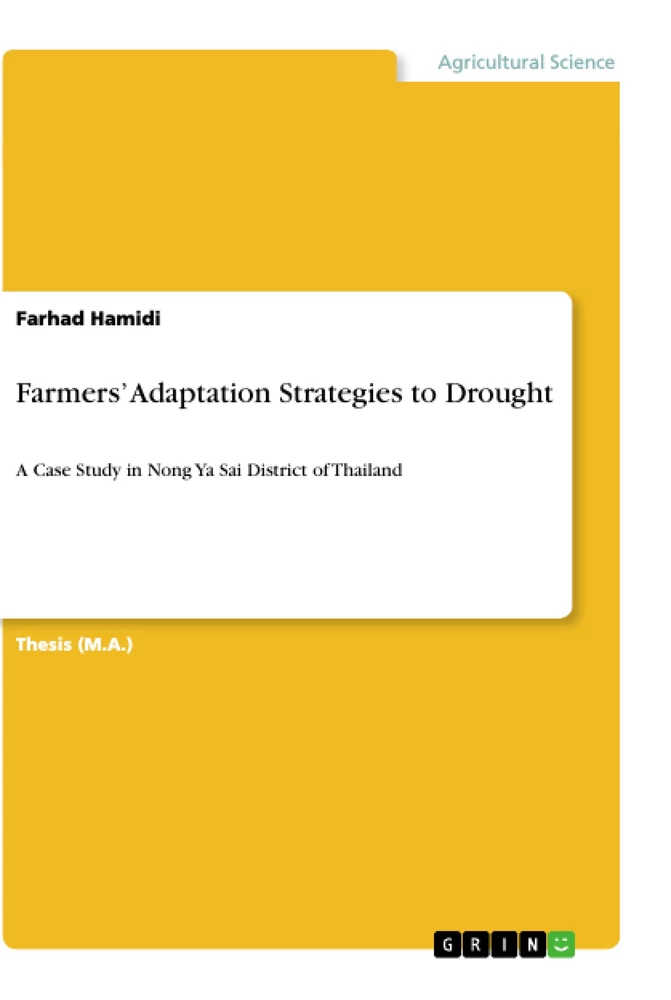
Table of Contents
1. Introduction
1.1 Background of Study
1.2 Rationale
1.3 Problem Statement
1.4 Research Objectives
1.5 Conceptual Framework
1.6 Scope and Limitations
2. Literature Review
2.1 Climate and Drought Information of Suphanburi Province
2.2 Drought Characteristics and Types
2.3 Potential Impacts of Drought
2.4 Drought impacts on Agriculture and Rural Livelihood
2.5 Farmers Adaptation Strategies to Drought
2.6 Policies to Deal with the 2014 – 2016 Drought in Thailand
3. Research Design
3.1 Type of Research and Research Design
3.2 Selection of Study Area
3.3 Sample Design
3.4 Process of Data Collection
3.5 Data Analysis and Techniques Used Profile of the Study Area and Respondents
4. Profile of the Study Area and Respondents
4.1 Physical Settings
4.2 Land Use Pattern
4.3 Demographic Information
4.4 Agriculture
4.5 Socio-economic Profile of Respondents
5. Farmers’ Understanding, Experiences and Interpretation of Drought
5.1 Role of Perception and Understanding in Hazards Risk
5.2 Farmers Perception of Drought
5.3 Farmer’s Understanding of Causes of Drought
5.4 Farmers’ Experience of Drought
6. Impacts of Drought on Agriculture and Farmers’ Livelihoods
6.1 Agricultural Impacts of Drought
6.2 Economic Impacts of Drought
6.3 Social Impacts
7. Identify the Farmers’ Current Adaptation Strategies to Reduce Drought Impacts
7.1 Concept of Adaptation to Drought
7.2 Farmers Adaptation Strategies to Reduce Drought Impacts in the Study Area
7.3 On-Farm Adaptation Strategies to Reduce Drought Impacts
7.4 Off-farm Strategies
7.5 Governmental Supports and Activities During Drought
8. Summary, Conclusion and Recommendation for Managing Drought Impacts
8.1 Summary of Findings
8.2 Conclusions
8.3 Recommendations
Research Objectives and Themes
This study aims to determine the adaptation strategies employed by farmers in the Nong Ya Sai district to mitigate the impact of drought on agricultural productivity and livelihoods. It seeks to assess farmers' perception, experience, and understanding of drought, examine its socio-economic consequences, and formulate recommendations for effective drought management.
- Farmers' perception and interpretation of drought hazards.
- Socio-economic and agricultural impacts of drought in the study area.
- On-farm drought adaptation techniques and practices.
- Off-farm strategies, including income diversification and migration.
- Governmental support and institutional interventions.
Auszug aus dem Buch
1.1 Background of Study
The drought is perhaps a serious natural hazard that mankind have been facingworld widely, mainly in terms of its impacts on agricultural productivity and farmers’ livelihood. The drought is one of the mjor important climate related disasters which climate change is set to exacerbate (ECA, 2007). It is a harmful natural hazard which is related to a deficiency of precipitation over an extended period of time, usually for a season or more. Such a deficiency causes in a water shortage for some activities, environmental sectors, or groups. Also, there are some other climatic factors such as high wind, low relative humidity, and high temperature are often associated with drought.
In opposite to other natural hazards, the drought events evolve slowly in time and their impacts generally span a long period of time (Bacanli et al, 2008). Drought occurs in virtually all climatic zones, but its characteristics vary significantly from one region to another. It is a temporary aberration; it differs from aridity, which is restricted to low rainfall regions and is a permanent feature of climate (Ishaya et al.,2010).It occurs due to some very simple incidences and intervention in the ecosystem of affected regions. If it is not raining often, and there are extended periods of hot temperatures, it can cause reduce water content and high pressure winds. This can avoid from formation of thunderstorms and stop rainfall altogether for a prolonged period of time. However, human activities can contribute to a drought too. This is a fact unless many would not believe it. The reason why this can happen is, because things such as farming, deforestation, a surplus of irrigation and even erosion can lead to drought. All of these things done by human activities can cause the land and earth to dry out which causes drought. Also, climate change can contribute to drought; by an increase in global warming, it can have a wide contribution of impacts on the possibilities of drought.
Summary of Chapters
1. Introduction: Presents the research background, rationale, problem statement, objectives, and the conceptual framework regarding drought impacts and adaptation.
2. Literature Review: Provides a synthesis of existing literature on drought characteristics, types, potential impacts, and various farmer adaptation strategies.
3. Research Design: Describes the methodology, including the selection of the study area, sampling design, and data collection processes.
4. Profile of the Study Area and Respondents: Outlines the geographical, demographic, agricultural, and socio-economic characteristics of the Nong Ya Sai district.
5. Farmers’ Understanding, Experiences and Interpretation of Drought: Analyzes the farmers' perception, level of understanding of causes, and personal experiences with drought.
6. Impacts of Drought on Agriculture and Farmers’ Livelihoods: Details the economic and social consequences of drought on crop production, livestock, and rural community life.
7. Identify the Farmers’ Current Adaptation Strategies to Reduce Drought Impacts: Evaluates the specific on-farm and off-farm strategies adopted by farmers, along with governmental support received.
8. Summary, Conclusion and Recommendation for Managing Drought Impacts: Concludes with key findings and offers policy recommendations to manage future drought challenges.
Keywords
Drought Hazard, Agricultural Production, Farmers’ Livelihood, Adaptation Strategies, Nong Ya Sai District, Climate Change, On-farm Strategies, Off-farm Strategies, Precipitation Deficiency, Risk Management, Rural Development, Water Scarcity, Sustainable Agriculture, Household Income, Drought Mitigation.
Frequently Asked Questions
What is the primary focus of this thesis?
The thesis focuses on identifying and analyzing the adaptation strategies used by farmers in the Nong Ya Sai district of Thailand to reduce the negative impacts of drought on their farming and rural livelihoods.
What are the central thematic areas of the research?
The central themes include drought perception and awareness, the impacts of drought on agriculture (crop and livestock) and household economy, and both on-farm and off-farm adaptation measures.
What is the primary research objective?
The primary objective is to determine the various adaptation strategies adopted by farmers to mitigate the agricultural and economic consequences of drought in the specified study area.
Which scientific methodology is employed?
The research employs a survey design combining exploratory and explanatory approaches, utilizing both qualitative and quantitative data analysis (including SPSS) collected via structured questionnaires, key informant interviews, and field observations.
What is covered in the main body of the work?
The main body covers the theoretical background, the socio-economic profile of the respondents, the analysis of farmers' understanding of drought, its specific impacts on production and income, and a detailed identification of current adaptation practices.
How are the results categorized?
The results are categorized into farmers’ perceptions, agricultural impacts, economic consequences, on-farm adaptation strategies (e.g., changing crops, irrigation techniques), and off-farm strategies (e.g., migration, income diversification).
How does this study contribute to local policy?
It provides empirical data on local adaptation challenges and recommends policy interventions, such as improved pre-warning systems, support for efficient irrigation, and economic diversification to move away from single-crop dependency.
What is the role of the government in these strategies?
The government provides financial support (credits), extension services, and infrastructure projects, such as checking dams, to assist farmers in coping with severe drought conditions and transitioning to more sustainable agricultural practices.
Ende der Leseprobe aus 129 Seiten
- nach oben
- Arbeit zitieren
- Farhad Hamidi (Autor:in), 2017, Farmers’ Adaptation Strategies to Drought, München, Page::Imprint:: GRINVerlagOHG, https://www.diplomarbeiten24.de/document/375850

neugierig - aktuell - relevant
Entdecken Sie hilfreiche Tipps und Tricks rund ums Studium!

Entdecken Sie hilfreiche Tipps und Tricks rund ums Studium!
Ihre Hausarbeit / Abschlussarbeit:

- - Publikation als E-Book und Buch
- - Hohes Honorar auf die Verkäufe
- - Für Sie komplett kostenlos - mit ISBN
- - Es dauert nur 5 Minuten
- - Jede Arbeit findet Leser

- © GRIN Publishing GmbH.
- Alle Inhalte urheberrechtlich geschützt. Kopieren und verbreiten untersagt.
- info@grin.com
- AGB
- Open Publishing
Der GRIN Verlag hat sich seit 1998 auf die Veröffentlichung akademischer eBooks und Bücher spezialisiert. Der GRIN Verlag steht damit als erstes Unternehmen für User Generated Quality Content. Die Verlagsseiten GRIN.com, Hausarbeiten.de und Diplomarbeiten24 bieten für Hochschullehrer, Absolventen und Studenten die ideale Plattform, wissenschaftliche Texte wie Hausarbeiten, Referate, Bachelorarbeiten, Masterarbeiten, Diplomarbeiten, Dissertationen und wissenschaftliche Aufsätze einem breiten Publikum zu präsentieren.
Kostenfreie Veröffentlichung: Hausarbeit, Bachelorarbeit, Diplomarbeit, Dissertation, Masterarbeit, Interpretation oder Referat jetzt veröffentlichen!
Folgen Sie GRIN auf


- GRIN Verlag GmbH
-
- Nymphenburger Str. 86
- 80636
- Munich, Deutschland
- +49 89-550559-0
- +49 89-550559-10
- info@grin.com
-
