
präsentiert von

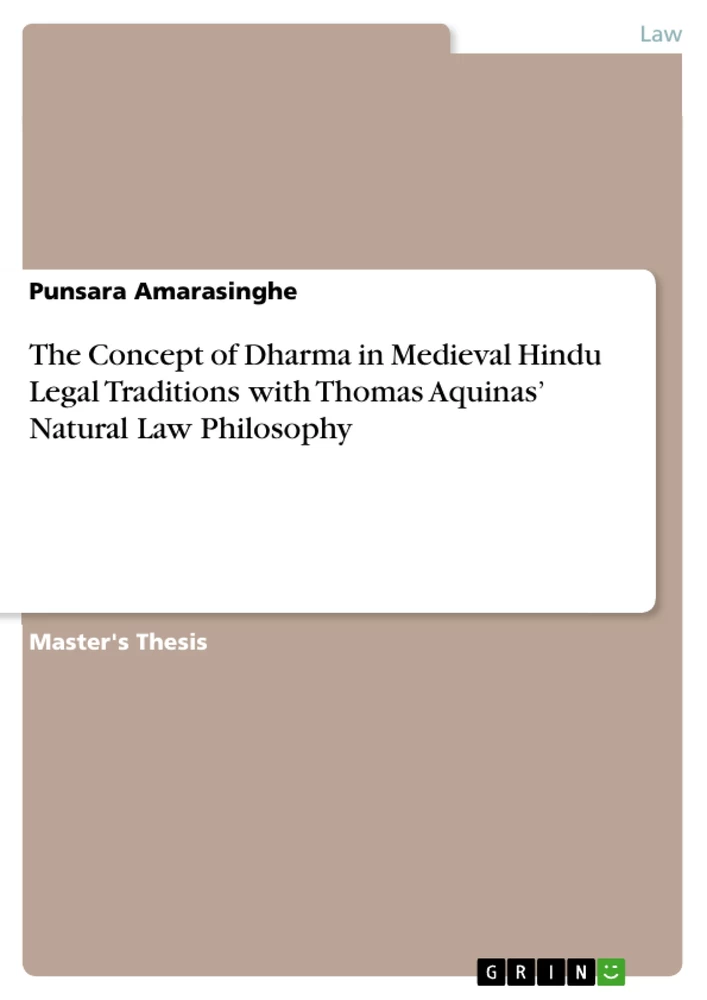
Table of Contents
Chapter 1: Introduction
1.1 Scope of Study
1.2 Literature Review
1.3 Research Methodology
1.4 Research Hypothesis
1.5 Tentative Chapterisation
Chapter 2: Mystery of Natural Law
2.1 Origin of Natural Law
2.2 Pre Christian Understanding of Natural Law
2.3 Christianity and Natural Law
2.4 Development of Natural Law in Post Medieval Period
2.5 Revival of Natural Law and Neo Thomism
2.6 Conclusion
Chapter 3: Thomistic Notion of Natural Law
3.1 World of Aquinas
3.2 Summa Theologiae and Aquinas’ Moral Philosophy
3.3 Thomistic Legal Understanding as Continuation of Old Testament Law
3.4 Types of Laws
3.5 Ideas on Obedience of Aquinas
Chapter 4: Dharma in Medieval Hindu Jurisprudence as a Norm
4.1 Understanding Medieval Hindu Jurisprudence
4.2 Dharmashstra in Medieval Period
4.3 Dharma and Achara
Chapter 5: Conclusion
5.1 Concept of Atmatusti with Thomistic Idea of Conscience
5.2 Idea of Obedience and Divinity in Both Concepts
5.3 Concluding Remarks
Research Objectives and Themes
This study provides a comparative legal analysis between the concept of Dharma in medieval Hindu jurisprudence and the Natural Law theory of Thomas Aquinas, focusing on how these two distinct civilizations defined legal authority and moral obligation during the Middle Ages.
- Comparison of medieval Hindu Dharma and Thomistic Natural Law.
- Evaluation of the legal significance of moral conscience (Atmatusti vs. Conscience).
- Analysis of the role of religious authority in shaping legal frameworks.
- The influence of social customs (Achara) on the practical application of law.
- Historical context of medieval legal development in India and Europe.
Excerpt from the Book
2.1 Origin of Natural Law
Investigating the origin of natural law might be the hardest task for any historian, because of the fact that natural law is something metaphysical which has been interwoven with the annals of human history. The archaic inception of natural law was firmly established in both oriental and occidental religious philosophies. In theistic religions moral standards and the centrality of God had made a tremendous contribution to craft the idea of Natural Law. In Judaeo Christian tradition the union between Abraham and Yahweh was the first testimony of Natural Law, where obedience to God’s commands resembled the Man’s submission to the law of nature. It has been stated in Old Testament “Because that Abraham obeyed my voice, and kept my charge, my commandments, my statutes, and my laws”. In addition to it, the divine supremacy was a pivotal factor which was vividly highlighted from ancient understanding on the origin of natural law. Apart from the understanding of natural law in a more juridical way, it is important to assess how it had used to support every ideology in human history in different times. When theistic religion adopted the name of natural law while connecting it with the omnipotence of creator god and man’s unconditional submission to him, atheistic philosophers like Buddha and Confucius beheld it in a completely different way. Buddha’s philosophy which is essentially based on Karmic effects and non-violence, Buddhist discourse has laid down a new analogy on natural law. It is more akin to the question of morality and goodness. Buddha had pointed out deeds are bad when they go against the general welfare of the community.
Summary of Chapters
Chapter 1: Introduction: Outlines the research scope, literature review, and methodology for comparing Dharma and Thomistic Natural Law.
Chapter 2: Mystery of Natural Law: Traces the evolution of natural law concepts in Western jurisprudence from ancient Greek and Christian traditions to the medieval period.
Chapter 3: Thomistic Notion of Natural Law: Analyzes Thomas Aquinas’s moral philosophy and his categorization of laws within the Summa Theologiae.
Chapter 4: Dharma in Medieval Hindu Jurisprudence as a Norm: Explores the role of Dharma, customs, and Vedic authority in the medieval Indian legal tradition.
Chapter 5: Conclusion: Synthesizes the comparative findings, specifically addressing conscience and divine obedience in both legal systems.
Keywords
Natural Law, Dharma, Thomas Aquinas, Middle Age, Hindu Jurisprudence, Summa Theologiae, Atmatusti, Achara, Conscience, Medieval Law, Moral Philosophy, Legal History, Divinity, Customary Law, Ethics.
Frequently Asked Questions
What is the primary focus of this research?
The work focuses on a comparative analysis of medieval Hindu legal tradition, specifically the concept of Dharma, and the Western Christian Natural Law theory as articulated by Thomas Aquinas.
Which civilizations are being compared?
The dissertation compares the medieval Indian legal tradition and the medieval European legal tradition during the Middle Ages.
What is the central research question?
The research asks how these two distinct civilizations constructed their notions of Natural Law and how they influenced the obedience of subjects to law and order.
What methodology does the author employ?
The author uses a doctrinal approach, relying on primary texts like Aquinas's Summa Theologiae and ancient Indian texts such as the Rig Veda and Dharmashastra, alongside secondary scholarly literature.
What topics are discussed in the main body of the text?
The main body covers the history of Natural Law in the West, the theological foundations of Thomistic law, the structure of Dharma in medieval India, and the relationship between customs (Achara) and law.
Which specific scholars are referenced regarding Dharma?
The author extensively references Donald Davis Jr., Robert Lingat, and Patrick Olivelle regarding their interpretations of Dharma and its practice in medieval India.
How does the author interpret the concept of 'Atmatusti'?
The author explores Atmatusti as a source of Dharma based on inner conscience or 'inner contentment,' drawing parallels between this concept and the Thomistic view of human conscience.
What conclusion does the author reach regarding the two traditions?
The author concludes that despite significant differences, both systems share a foundational belief in the moral force of law as a means to guide human action toward goodness.
Ende der Leseprobe aus 68 Seiten
- nach oben
- Arbeit zitieren
- Punsara Amarasinghe (Autor:in), 2017, The Concept of Dharma in Medieval Hindu Legal Traditions with Thomas Aquinas’ Natural Law Philosophy, München, Page::Imprint:: GRINVerlagOHG, https://www.diplomarbeiten24.de/document/375863

neugierig - aktuell - relevant
Entdecken Sie hilfreiche Tipps und Tricks rund ums Studium!

Entdecken Sie hilfreiche Tipps und Tricks rund ums Studium!
Ihre Hausarbeit / Abschlussarbeit:

- - Publikation als E-Book und Buch
- - Hohes Honorar auf die Verkäufe
- - Für Sie komplett kostenlos - mit ISBN
- - Es dauert nur 5 Minuten
- - Jede Arbeit findet Leser

- © GRIN Publishing GmbH.
- Alle Inhalte urheberrechtlich geschützt. Kopieren und verbreiten untersagt.
- info@grin.com
- AGB
- Open Publishing
Der GRIN Verlag hat sich seit 1998 auf die Veröffentlichung akademischer eBooks und Bücher spezialisiert. Der GRIN Verlag steht damit als erstes Unternehmen für User Generated Quality Content. Die Verlagsseiten GRIN.com, Hausarbeiten.de und Diplomarbeiten24 bieten für Hochschullehrer, Absolventen und Studenten die ideale Plattform, wissenschaftliche Texte wie Hausarbeiten, Referate, Bachelorarbeiten, Masterarbeiten, Diplomarbeiten, Dissertationen und wissenschaftliche Aufsätze einem breiten Publikum zu präsentieren.
Kostenfreie Veröffentlichung: Hausarbeit, Bachelorarbeit, Diplomarbeit, Dissertation, Masterarbeit, Interpretation oder Referat jetzt veröffentlichen!
Folgen Sie GRIN auf


- GRIN Verlag GmbH
-
- Nymphenburger Str. 86
- 80636
- Munich, Deutschland
- +49 89-550559-0
- +49 89-550559-10
- info@grin.com
-
