
präsentiert von

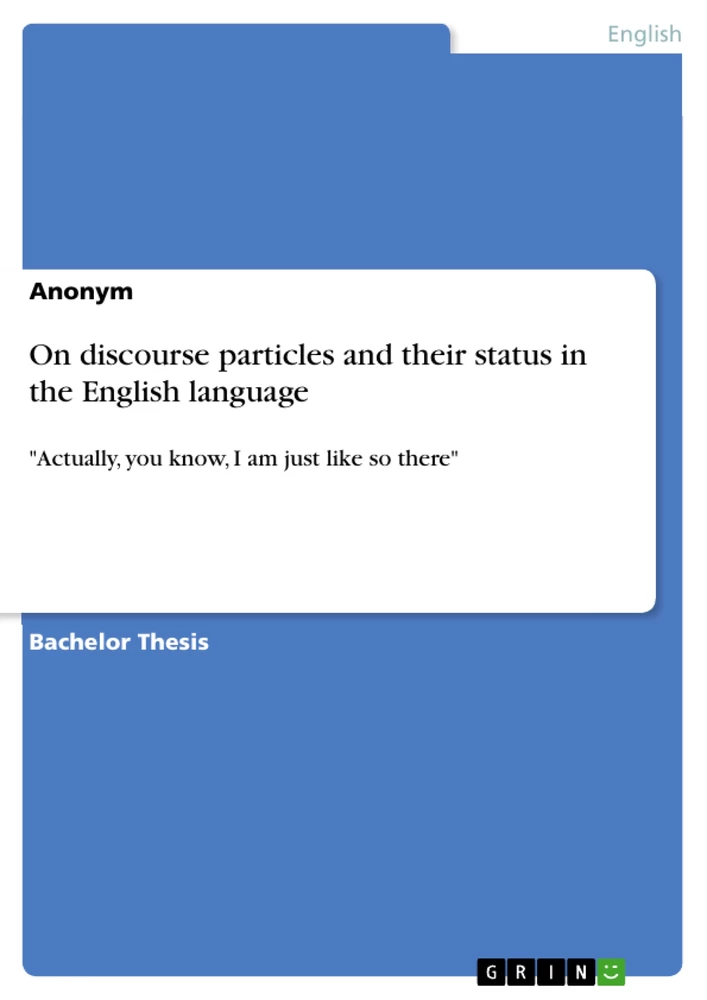
Table of Contents
Introduction
1) How to call them and where to place them
1.1) Terminology
1.1.2) Terminology used for German words like wohl
1.1.2) Terminology used for English words like actually
1.2) Classification
1.2.1) Classification of German modal particles
1.2.2) Classification of English discourse markers
1.3) Comparison
2) How to identify them
2.1) Morphologic characteristics
2.1.1) Morphologic features of German modal particles
2.1.2) Morphologic features of English discourse markers
2.2) Semantic-pragmatic characteristics
2.2.1) Semantic-pragmatic features of German modal particles
2.2.2) Semantic-pragmatic functions of German modal particles
2.2.3) Semantic-pragmatic features of English discourse markers
2.2.4) Semantic-pragmatic functions of English discourse markers
2.2.5) How to account for their multi-functionality
2.3) Syntactic characteristics
2.3.1) Syntactic features of German modal particles
2.3.2) Syntactic features of English discourse markers
3) How to understand them by tracing back their origins
3.1.) Historical development of English discourse markers
3.1.1) Propositional function of actually
3.1.2) Textual function of actually
3.1.3) Interpersonal function of actually
3.2) Historical development of German modal particles
3.3) How can their difference be explained?
3.4) Where are they heading to?
4) Are there also English modal particles and German discourse markers?
Conclusion
Research Objectives and Thematic Focus
The primary objective of this study is to conduct a comparative linguistic analysis of functional pragmatic items in the German and English languages, specifically focusing on German modal particles and English discourse markers. The research addresses the question of how these heterogeneous word groups can be formally categorized, defined, and differentiated, while examining their diachronic development via grammaticalization theory and their synchronic functions in interaction.
- Comparative analysis of German modal particles (e.g., wohl) and English discourse markers (e.g., actually).
- Investigation into morphological, semantic-pragmatic, and syntactic characteristics.
- Examination of the diachronic development and grammaticalization processes of functional items.
- Analysis of the influence of communicative context on the function and distribution of these particles.
- Exploration of similarities and distinctions between German and English in the expression of discourse functions.
Excerpt from the Book
1.2.1) Classification of German modal particles
Having a look at the German words at issue from a morphological perspective, it can be detected that they do not belong to the common word classes. In contrast to emphasized words belonging to the common word classes like verbs (a) nouns (b) and adjectives (c) particles like wohl (d) cannot be inflected:
(4) a) Er konnte niemanden sehen.
b) Sie gingen in Monikas Lieblingsrestaurant.
c) Das Restaurant war nobler als sie erwartet hatten.
d) Alle warteten aber ihr Onkel hatte den Termin wohl vergessen.
e) * Alle warteten aber ihr Onkel hatte den Termin wohler vergessen.
German linguists therefore created a word class for these words that cannot be inflected and called them particles, referring to Latin particular, little parts. However, like the bold words in (5) show, there exist many words in the German language that cannot be assigned to a certain word class and therefore belong to the class particles.
Summary of Chapters
Introduction: Provides the research context by introducing discourse markers in contemporary language and outlining the historical neglect and eventual scholarly recognition of these "indefinable" linguistic items.
1) How to call them and where to place them: Examines the terminology and classification challenges surrounding German modal particles and English discourse markers, establishing the foundational concepts for the comparison.
2) How to identify them: Analyzes the morphological, semantic-pragmatic, and syntactic features that distinguish these particles from traditional word classes and highlights their functional nature.
3) How to understand them by tracing back their origins: Traces the diachronic development and grammaticalization of the markers 'actually' and 'wohl' to explain their poly-functionality and changing roles over time.
4) Are there also English modal particles and German discourse markers?: Investigates cross-linguistic exceptions and overlaps, exploring instances where German particles resemble English markers and vice-versa.
Conclusion: Synthesizes the findings, confirming that while German modal particles and English discourse markers share pragmatic functions, they remain distinct in their syntactic positioning and historical development.
Keywords
Discourse markers, modal particles, grammaticalization, semantics, pragmatics, linguistics, functional items, language change, syntax, poly-functionality, corpus linguistics, communicative context, textual function, interpersonal function, speaker stance.
Frequently Asked Questions
What is the primary focus of this linguistic study?
The study primarily investigates the nature of functional pragmatic items in the German and English languages, specifically comparing German modal particles and English discourse markers to understand their status and functions.
What are the central thematic fields covered in this work?
The work covers terminology, morphological and syntactic classification, semantic-pragmatic functions, and the historical development of functional items through the lens of grammaticalization theory.
What is the core research question of this publication?
The research asks how these heterogeneous groups of particles, which often escape traditional grammatical categorization, can be effectively defined, differentiated, and understood in terms of their pragmatic impact.
Which scientific methodology is employed to analyze these particles?
The author employs a comparative approach, utilizing grammaticalization theory and semantic-pragmatic analysis to evaluate the form-function mappings of prototypical representatives like 'wohl' and 'actually'.
What topics are discussed in the main part of the book?
The main part analyzes the morphological inability of these words to be inflected, their role as textual or interpersonal organizers, their syntactic positioning, and the influence of communicative context on their development.
Which keywords best characterize this research?
Key terms include discourse markers, modal particles, grammaticalization, pragmatics, and poly-functionality, reflecting the focus on linguistic elements that serve functional rather than propositional purposes.
How does the author explain the "Partikelparadoxon"?
The author discusses the "Partikelparadoxon" as the struggle of researchers to account for the multi-functionality and complex, often bleached, semantic nature of discourse particles.
How is the term "grammaticalization" applied to these linguistic items?
Grammaticalization is applied to show how words historically evolve from propositional content words into functional markers that operate on a meta-textual or interactional level, gaining subjectivity and flexibility along the way.
Ende der Leseprobe aus 45 Seiten
- nach oben
- Arbeit zitieren
- Anonym (Autor:in), 2017, On discourse particles and their status in the English language, München, Page::Imprint:: GRINVerlagOHG, https://www.diplomarbeiten24.de/document/376362

neugierig - aktuell - relevant
Entdecken Sie hilfreiche Tipps und Tricks rund ums Studium!

Entdecken Sie hilfreiche Tipps und Tricks rund ums Studium!
Ihre Hausarbeit / Abschlussarbeit:

- - Publikation als E-Book und Buch
- - Hohes Honorar auf die Verkäufe
- - Für Sie komplett kostenlos - mit ISBN
- - Es dauert nur 5 Minuten
- - Jede Arbeit findet Leser

- © GRIN Publishing GmbH.
- Alle Inhalte urheberrechtlich geschützt. Kopieren und verbreiten untersagt.
- info@grin.com
- AGB
- Open Publishing
Der GRIN Verlag hat sich seit 1998 auf die Veröffentlichung akademischer eBooks und Bücher spezialisiert. Der GRIN Verlag steht damit als erstes Unternehmen für User Generated Quality Content. Die Verlagsseiten GRIN.com, Hausarbeiten.de und Diplomarbeiten24 bieten für Hochschullehrer, Absolventen und Studenten die ideale Plattform, wissenschaftliche Texte wie Hausarbeiten, Referate, Bachelorarbeiten, Masterarbeiten, Diplomarbeiten, Dissertationen und wissenschaftliche Aufsätze einem breiten Publikum zu präsentieren.
Kostenfreie Veröffentlichung: Hausarbeit, Bachelorarbeit, Diplomarbeit, Dissertation, Masterarbeit, Interpretation oder Referat jetzt veröffentlichen!
Folgen Sie GRIN auf


- GRIN Verlag GmbH
-
- Nymphenburger Str. 86
- 80636
- Munich, Deutschland
- +49 89-550559-0
- +49 89-550559-10
- info@grin.com
-
