
präsentiert von

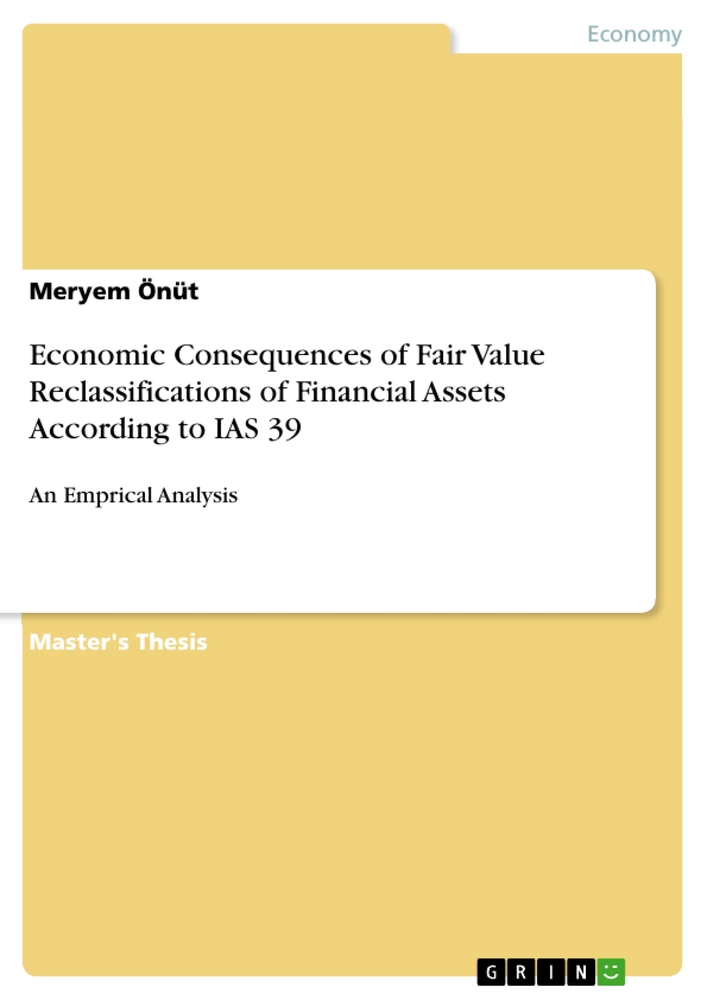
Table of Contents
1. Introduction
2. Theoretical Framework
2.1 IAS 39 – Financial Instruments: Recognition and Measurement
2.2 IAS 39 and IFRS 7 Amendments: The Reclassification Option
2.3 Bank’s Regulatory Capital
2.4 Reclassification Consequences for Bank’s Financial Statements
2.5 Related Literature
2.6 Fair Value Hierarchy of Financial Assets
3. Data and Statistics
3.1 Data Sources and Sample Selection
3.2 Definition of Variables
3.3 Sample Characteristics and Representativeness
3.4 Testing the Theoretical Predictions
3.4.1 Correlation Tests
3.4.2 Causality Tests
3.4.2.1 Theoretical background
3.4.2.2 Logit Model
3.4.2.3 Linear Regression
4. Critical Appraisal
5. Conclusion
Research Objective and Thematic Focus
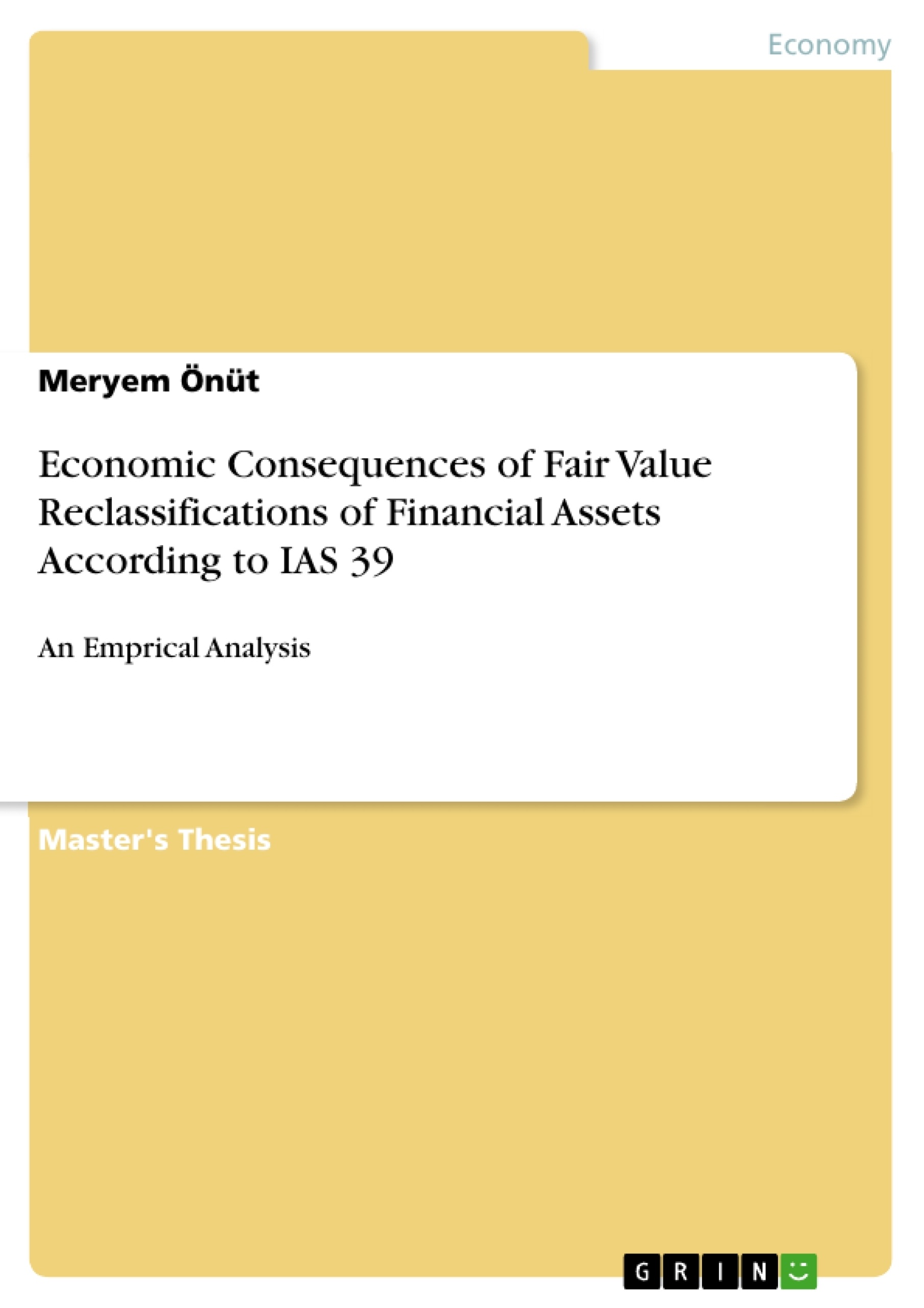
This thesis provides an empirical analysis of the economic consequences of the Amendment to IAS 39, which permitted European banks to reclassify financial instruments from fair value categories to amortized cost categories during the 2008 financial crisis. The primary objective is to investigate the determinants of this reclassification choice and to evaluate its impact on banks' financial reporting and regulatory capital, addressing the trade-off between financial stability and market transparency.
- Impact of the Amendment to IAS 39 on Western European banks during the 2008 financial crisis.
- Relationship between a bank's regulatory capital (Tier 1 ratio) and the decision to reclassify financial assets.
- Evaluation of the influence of fair value hierarchy levels on reclassification behavior.
- Analysis of bank characteristics, including market capitalization, liquidity, and default risk, as determinants for reclassification.
- Assessment of the trade-off between transparency and financial stability created by the accounting policy shift.
Excerpt from the Book
2.3 Bank’s Regulatory Capital
In today’s global marketplace, financial institutions have greatly expanded the scope of their activities. However, banking problems still plague many European countries; moreover, hundreds of systemic banking crises have devastated economies around the world since 1970. In response to the global financial market’s growing complexity and the lack of transparency, the regulation and supervision of banks has had to change and has improved over the years.
The purpose of regulation is to ensure that the equity capital a bank retains is sufficient to cover the risk it takes. The purpose is not to eliminate risk altogether, as this is impossible given the nature of the banking business; rather, governments want to minimize the probability of default and thereby increase confidence in the banking system, which is essential for a stable economy. A prime concern of governments is systemic risk, which is the risk that a default by one bank could create a ‘domino effect’ that affects other banks and leads to defaults, thereby threatening the stability of the whole financial system. If governments allow one bank to fail, they thus put the financial sector at risk; however a bank bailout could also send incorrect signals to the investors, removing their incentives to control their own risks. Large banks will take on risk without proper insurance, thinking that the government will always bail them out because they are too big to fail. As was observed during the market turmoil of 2007 and 2008, allowing Lehman Brothers to fail made the credit crisis worse, but it simultaneously led to banks becoming more cautious in their lending and to regulatory bodies being more careful in their monitoring.
Summary of Chapters
1. Introduction: Discusses the introduction of IFRS in the EU, the fair value accounting regime, and the regulatory reaction to the 2008 financial crisis via the Amendment to IAS 39.
2. Theoretical Framework: Outlines the IAS 39 standard, the 2008 reclassification option, the role of regulatory capital, and the relevance of the fair value hierarchy.
3. Data and Statistics: Details the sample selection of 255 Western European banks, the definition of the 22 variables used, and the methodology for correlation and causality testing.
4. Critical Appraisal: Critically evaluates the political pressure behind the ad-hoc IAS 39 changes and the resulting trade-off between accounting transparency and bank solvency.
5. Conclusion: Summarizes the findings, noting that while larger banks with higher regulatory capital needs utilized the option, the overall impact on market comparability remains contested.
Key Keywords
Fair Value Accounting, IAS 39, IFRS 7, Reclassification Option, Regulatory Capital, Tier 1 Capital, Financial Crisis 2008, Western European Banks, Credit Default Swap, Impairment Rules, Fair Value Hierarchy, Market Transparency, Financial Stability, Empirical Analysis, Amortized Cost
Frequently Asked Questions
What is the core focus of this thesis?
The thesis examines the economic consequences of the Amendment to IAS 39 during the 2008 financial crisis, specifically how Western European banks used the newly granted option to reclassify financial assets from fair value to amortized cost categories.
Which indicators determine a bank's likelihood to reclassify?
The research suggests that firm size, the necessity to protect regulatory capital (low Tier 1 capital ratios), and credit market conditions are primary factors influencing the decision to reclassify assets.
What is the main research question regarding regulatory capital?
The research investigates whether banks with lower regulatory capital ratios were more likely to utilize the reclassification option to avoid recognizing fair value losses that would have otherwise depleted their Tier 1 capital.
Which methodology is applied to the data?
The thesis utilizes a mix of descriptive statistics, Bravais-Pearson correlation analysis, Logit models for binary classification choices, and linear regression for the metric reclassification amounts, using Stata as the analytical tool.
What does the main body of the work cover?
The main body provides the theoretical background of accounting standards (IAS 39, IFRS 7), defines the variables and sample characteristics, and presents detailed statistical models to test the impact of bank characteristics on reclassification behavior.
Which keywords best characterize this work?
The most important keywords include Fair Value Accounting, IAS 39, Reclassification Option, Regulatory Capital, Tier 1 Capital, and Financial Crisis 2008.
How does the author evaluate the "rare circumstances" clause?
The author questions the consistency of the "rare circumstances" justification, noting that during the Eurozone crisis, banks often used vague reasons like "change in intention to hold" rather than transparent reporting, which potentially harms market efficiency.
What role does the fair value hierarchy play in the analysis?
The thesis tests whether the distribution of assets across the three levels of the fair value hierarchy influences the reclassification decision, concluding that while correlation exists, the hierarchy itself is not a direct causal determinant of the amount reclassified.
How is the transparency versus stability trade-off described?
The author argues that the reclassification option functioned as a trade-off, where immediate balance sheet relief for banks (financial stability) was prioritized over the transparency of market-based asset valuations, ultimately impeding comparability for investors.
Ende der Leseprobe aus 106 Seiten
- nach oben
- Arbeit zitieren
- Meryem Önüt (Autor:in), 2015, Economic Consequences of Fair Value Reclassifications of Financial Assets According to IAS 39, München, Page::Imprint:: GRINVerlagOHG, https://www.diplomarbeiten24.de/document/376869

neugierig - aktuell - relevant
Entdecken Sie hilfreiche Tipps und Tricks rund ums Studium!

Entdecken Sie hilfreiche Tipps und Tricks rund ums Studium!
Ihre Hausarbeit / Abschlussarbeit:

- - Publikation als E-Book und Buch
- - Hohes Honorar auf die Verkäufe
- - Für Sie komplett kostenlos - mit ISBN
- - Es dauert nur 5 Minuten
- - Jede Arbeit findet Leser

- © GRIN Publishing GmbH.
- Alle Inhalte urheberrechtlich geschützt. Kopieren und verbreiten untersagt.
- info@grin.com
- AGB
- Open Publishing
Der GRIN Verlag hat sich seit 1998 auf die Veröffentlichung akademischer eBooks und Bücher spezialisiert. Der GRIN Verlag steht damit als erstes Unternehmen für User Generated Quality Content. Die Verlagsseiten GRIN.com, Hausarbeiten.de und Diplomarbeiten24 bieten für Hochschullehrer, Absolventen und Studenten die ideale Plattform, wissenschaftliche Texte wie Hausarbeiten, Referate, Bachelorarbeiten, Masterarbeiten, Diplomarbeiten, Dissertationen und wissenschaftliche Aufsätze einem breiten Publikum zu präsentieren.
Kostenfreie Veröffentlichung: Hausarbeit, Bachelorarbeit, Diplomarbeit, Dissertation, Masterarbeit, Interpretation oder Referat jetzt veröffentlichen!
Folgen Sie GRIN auf


- GRIN Verlag GmbH
-
- Nymphenburger Str. 86
- 80636
- Munich, Deutschland
- +49 89-550559-0
- +49 89-550559-10
- info@grin.com
-
