
präsentiert von

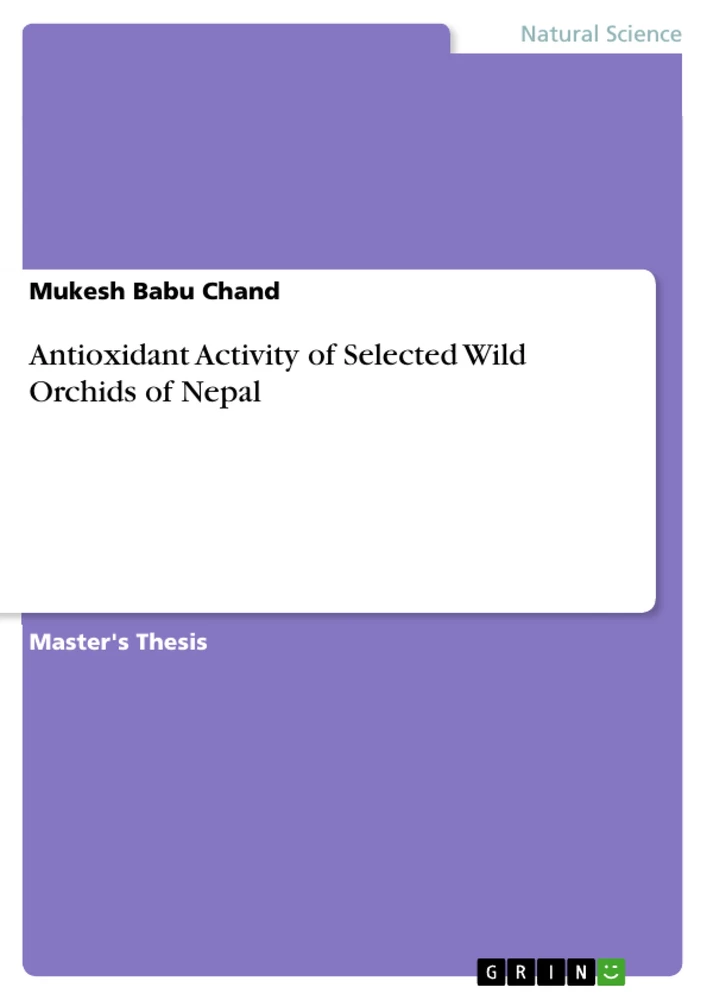
Table of Contents
CHAPTER ONE: INTRODUCTION
1.1. Background
1.1.1. Antioxidants and antioxidant activity
1.1.2. Preliminary phytochemical screening
1.1.3. Determining plant phenolics content and antioxidant activity
1.2. Wild Orchids and their medicinal properties
1.3. Hypothesis
1.4. Objectives
A. General objective
B. Specific objectives
1.5. Rationale of the study
1.6. Limitations of the study
CHAPTER TWO: LITERATURE REVIEW
2. 1. Phytochemical constituents
2. 2. Total polyphenols and total flavonoids contents
2. 3. Antioxidant activity by DPPH assay
CHAPTER THREE: MATERIALS AND METHODS
3.1. Materials
3.1.1. Selected wild orchids
3.1.2. Chemicals used
3.1.3. Orchid samples
3.1.4. Glassware and instruments
3.2. Methods
3.2.1. Collection and identification of plant materials
3.2.2. Drying and extraction
3.2.3. Estimation of dry powder yield
3.2.4. Estimation of extract yield
3.2.5. Reagent preparation
3.2.6. Preliminary phytochemical screening
A. Test for tannins
B. Test for saponins
C. Test for steroids and terpenoids
D. Test for flavonoids
E. Test for alkaloids
3.2.7. Estimation of total flavonoid content
3.2.8. Estimation of total polyphenols content
3.2.9. Antioxidant activity
3.2.10. Statistical analysis
CHAPTER FOUR: RESULTS
4.1. Estimation of dry powder yield
4.2. Extract yield from powdered materials
4.3. Dry extract yield in comparison to fresh material
4.4. Preliminary phytochemical screening
A. Alkaloids
B. Flavonoids
C. Saponins
D. Steroids and terpenoids
E. Tannis
4.5. Total flavonoids content
4.6. Total polyphenols content
4.7. Antioxidant activity
4.8. Relationship of antioxidant activity with total polyphenolics and flavonoids content
CHAPTER FIVE: DISCUSSION
5.1. Preliminary phytochemical screening
5.2. Total flavonoids content
5.3. Total polyphenols content
5.4. Antioxidant activity
5.5. Relationship of antioxidant activity with total polyphenolics and flavonoids content
CHAPTER SIX: CONCLUSION
CHAPTER SEVEN: RECOMMENDATIONS
Research Objectives and Themes
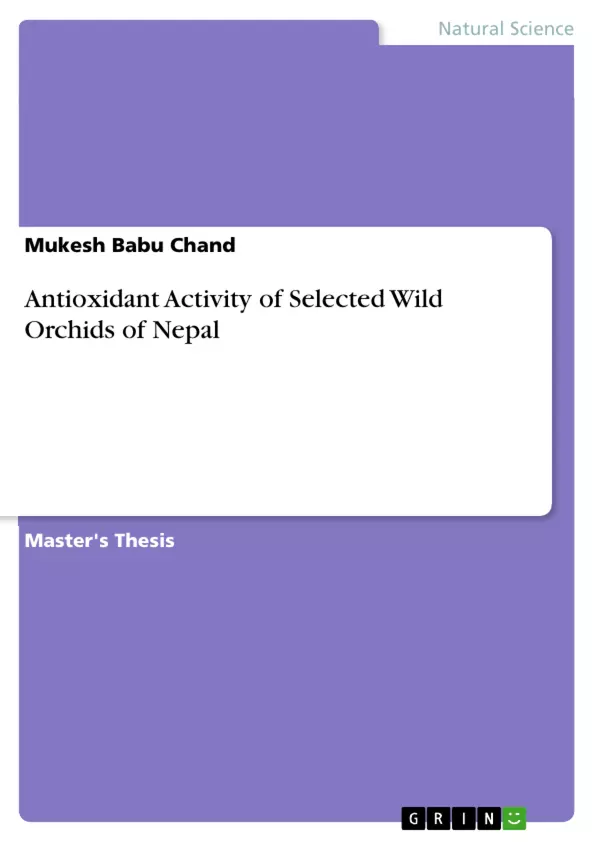
The primary research objective of this dissertation is to evaluate the antioxidant activity of selected wild orchids found in Nepal. By examining their biochemical properties, the study aims to correlate their phytochemical composition, specifically total polyphenolics and flavonoids content, with their free radical scavenging capabilities. The research explores the medicinal potential of these species, many of which have been used in traditional folklore for treating various ailments, while providing a scientific basis for their pharmacological utility.
- Phytochemical screening of various orchid species to detect presence of alkaloids, tannins, flavonoids, saponins, and steroids.
- Estimation of total flavonoids and total polyphenolics content in various orchid parts (leaf, stem, root, pseudobulbs).
- Assessment of antioxidant activity using DPPH (2, 2-diphenyl-1-picryl hydrazyl) radical scavenging assay.
- Statistical correlation between antioxidant capacity and phenolic/flavonoid concentration in the tested extracts.
Excerpt from the Book
1.1. Background
Some chemicals inhibit or delay the oxidizing activity of free radicals generated in biological system of living organism as by-products viz. superoxide anion, hydroxyl radicals and hydrogen peroxide on biomolecules. Such chemicals are known as antioxidants and their inhibitory or delaying action against oxidative damage to tissues is known as antioxidant activity. Basically, antioxidants are of two categories i.e., synthetic and natural. Generally, synthetic antioxidants are compounds with phenolic structures of alkyl substitution while natural antioxidants are phenolic compounds such as tocopherols, flavonoids, phenolic acids etc., (Velioglu et al. 1998; Zhao et al. 2006).
Plants produce a diverse array of phytochemicals which are grouped as terpenoids, alkaloids, steroids, glycosides and phenolics on the basis of biosynthetic origin. Among these phytochemicals, plant phenolics often said as polyphenols that possess one or more acidic phenolic hydroxyl groups protect biological system from oxidative stress and function as antioxidants. The major classes of plant phenolics are the hydroxycinnamic acids, flavonoids, anthocyanins and tannins. These are found in all higher plants, often at high levels (Grace 2005).
Summary of Chapters
CHAPTER ONE: INTRODUCTION: This chapter provides the theoretical foundation regarding antioxidants and their function in plants, specifically focusing on the medicinal properties of wild orchids in Nepal.
CHAPTER TWO: LITERATURE REVIEW: This section surveys existing knowledge on phytochemical constituents in orchids and evaluates previous studies regarding the measurement of polyphenols, flavonoids, and DPPH-based antioxidant activities.
CHAPTER THREE: MATERIALS AND METHODS: This chapter details the plant sample collection sites, specific laboratory protocols for extraction, and the analytical methods used for qualitative and quantitative biochemical assessment.
CHAPTER FOUR: RESULTS: This section presents the empirical data derived from dry powder yield calculations, phytochemical screening, and the concentration-dependent measurements of flavonoids, polyphenols, and antioxidant activity.
CHAPTER FIVE: DISCUSSION: This chapter interprets the experimental findings, comparing the antioxidant efficiency and phytochemical content of the studied orchids against known medicinal standards and prior research.
CHAPTER SIX: CONCLUSION: The study concludes that the selected Nepalese orchids exhibit significant antioxidant potential, which is positively associated with their phenolic and flavonoid content, suggesting future pharmacognostical relevance.
CHAPTER SEVEN: RECOMMENDATIONS: This chapter suggests that future research should focus on isolating biologically active compounds from the most promising species and conducting clinical studies to validate their medicinal claims.
Keywords
Antioxidant activity, Wild orchids, Nepal, DPPH assay, Total flavonoids content, Total polyphenolics content, Phytochemical screening, Ethanolic extract, Radical scavenging, Pharmacognosy, Trudelia cristata, Gastrochilus acutifolius, Medicinal plants, Secondary metabolites, Biochemical evaluation
Frequently Asked Questions
What is the core focus of this research?
The research focuses on assessing the antioxidant activity and phytochemical profile of nine wild orchid species native to Nepal, aiming to understand their potential medicinal value.
What are the primary themes of the study?
The themes include the identification of phytochemical classes (like alkaloids and tannins), the quantification of total phenolic and flavonoid contents, and the evaluation of the free radical scavenging capacity of ethanol-based extracts.
What is the primary objective of this dissertation?
The primary objective is to evaluate the antioxidant activity of selected wild orchids and to determine if there is a correlation between this activity and the concentration of total polyphenols and flavonoids.
Which scientific method is employed for testing?
The study utilizes Soxhlet extraction for obtaining crude extracts, the aluminium chloride method for flavonoid estimation, the Folin-Ciocalteu method for polyphenolic estimation, and the DPPH free radical scavenging assay for antioxidant evaluation.
What does the main body of the work cover?
The main body covers the detailed materials and methods, the analytical results for different orchid parts, and a comprehensive discussion comparing these findings with existing literature on medicinal plants.
Which keywords characterize this work?
Key terms include antioxidant activity, wild orchids, total flavonoids content, total polyphenolics content, DPPH assay, and ethnobotanical studies of Nepalese flora.
How do the results from this study compare to the reference compound?
The study notes that while the orchid extracts show significant radical scavenging activity, none of the tested extracts were as effective as the reference compound, Quercetin.
What relationship was found between total polyphenols and antioxidant activity?
The study found a negative association between IC50 values and phenolic/flavonoid content, indicating that higher concentrations of these phytochemicals lead to a lower IC50 value, which corresponds to higher antioxidant activity.
Ende der Leseprobe aus 74 Seiten
- nach oben
- Arbeit zitieren
- Mukesh Babu Chand (Autor:in), 2015, Antioxidant Activity of Selected Wild Orchids of Nepal, München, Page::Imprint:: GRINVerlagOHG, https://www.diplomarbeiten24.de/document/379531

neugierig - aktuell - relevant
Entdecken Sie hilfreiche Tipps und Tricks rund ums Studium!

Entdecken Sie hilfreiche Tipps und Tricks rund ums Studium!
Ihre Hausarbeit / Abschlussarbeit:

- - Publikation als E-Book und Buch
- - Hohes Honorar auf die Verkäufe
- - Für Sie komplett kostenlos - mit ISBN
- - Es dauert nur 5 Minuten
- - Jede Arbeit findet Leser

- © GRIN Publishing GmbH.
- Alle Inhalte urheberrechtlich geschützt. Kopieren und verbreiten untersagt.
- info@grin.com
- AGB
- Open Publishing
Der GRIN Verlag hat sich seit 1998 auf die Veröffentlichung akademischer eBooks und Bücher spezialisiert. Der GRIN Verlag steht damit als erstes Unternehmen für User Generated Quality Content. Die Verlagsseiten GRIN.com, Hausarbeiten.de und Diplomarbeiten24 bieten für Hochschullehrer, Absolventen und Studenten die ideale Plattform, wissenschaftliche Texte wie Hausarbeiten, Referate, Bachelorarbeiten, Masterarbeiten, Diplomarbeiten, Dissertationen und wissenschaftliche Aufsätze einem breiten Publikum zu präsentieren.
Kostenfreie Veröffentlichung: Hausarbeit, Bachelorarbeit, Diplomarbeit, Dissertation, Masterarbeit, Interpretation oder Referat jetzt veröffentlichen!
Folgen Sie GRIN auf


- GRIN Verlag GmbH
-
- Nymphenburger Str. 86
- 80636
- Munich, Deutschland
- +49 89-550559-0
- +49 89-550559-10
- info@grin.com
-
