
präsentiert von

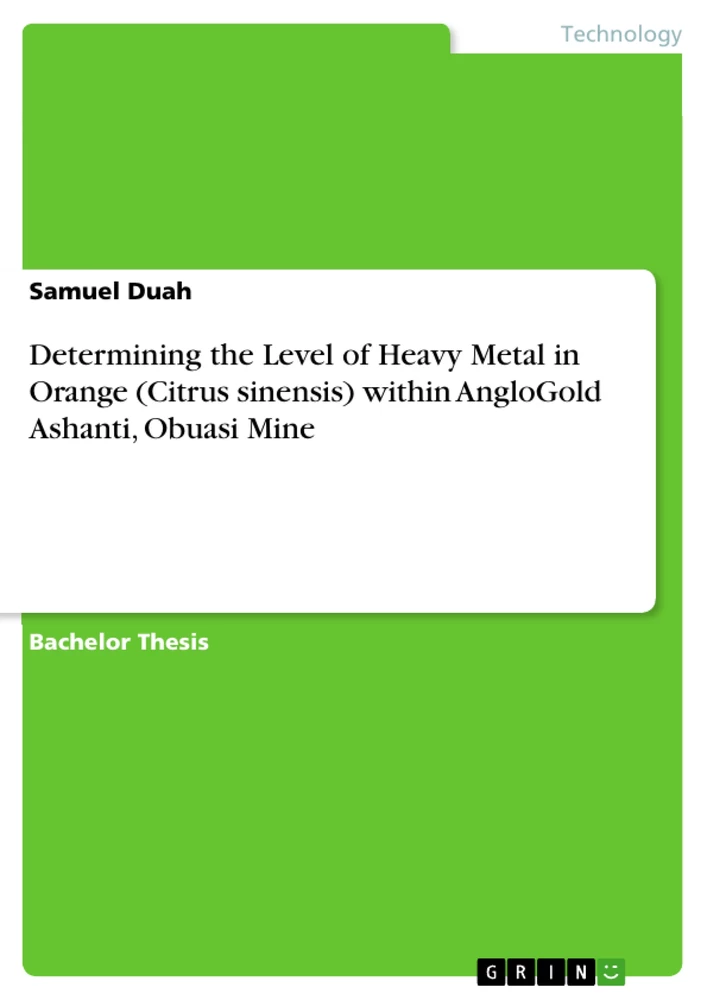
Table of Contents
1.0 INTRODUCTION
1.1 Research Background
1.2 The Problem Statement
1.3 Justification
1.4 The Research Objectives
1.5 The Structure of the Thesis
2.0 LITERATURE REVIEW
2.1 Introduction
2.2.1 Taxonomic Classification and Physiology of Orange
2.2.2 Nutritional Benefits of Orange
2.2.3 Definition of Heavy Metals
2.2.4 Bio-accumulation of Heavy Metals
2.2.5 Heavy Metal Tolerance
2.2.6 Heavy Metal Remediation
2.2.7 Factors Affecting Metal Availability
2.2.8 Plant Uptake and Transport of Metals
2.2.9 Uptake Mechanisms of Plants
2.2.10 Transport within the Plant
2.2.11 Xylem Transport
2.2.12 Phloem Transport
2.2.13 Sources and Uses of Copper
2.2.14 Lead Poisoning
2.2.15 Natural Sources of Lead
2.2.16 Mining Operations as a Source of Lead
2.2.17 Transport and Bioaccumulation of Lead
2.2.18 Chemistry of Arsenic
2.2.19 Arsenic in the Environment
2.2.20 Health Effects of Arsenic
2.2.21 Environmental Effects of Arsenic
2.2.22 Chemistry of Zinc
2.2.23 Occurrence of Zinc
2.2.24 Environmental Impacts of Zinc
2.2.25 Tailings Composition and Storage
2.2.26 Phytoremediation
3.0 MATERIALS AND METHODS
3.1 Introduction
3.2 Study Area
3.2.1 Location
3.2.2 Climate
3.3 Materials
3.4 Experimental Design
3.5 Methods
3.5.1 Acid Digestion
3.6 Limitations of the Study
4.0 RESULTS
4.1 Introduction
4.2 Results for Heavy Metal Concentration
4.2.1 Concentration of Zinc in Orange Samples
4.2.2 Concentration of Arsenic in Orange Samples
4.2.3 Concentration of Copper in Orange Samples
4.2.4 Concentration of Lead in Orange Samples
5.0 DISCUSSION
5.1 Introduction
5.2 Concentration of Zinc
5.3 Concentration of Arsenic
5.2 Concentration of Copper
5.3 Concentration of Lead
6.0 CONCLUSION AND RECOMMENDATION
6.1 Introduction
6.3 Contribution to Knowledge
6.4 Recommendations
6.5 Issues for Future Research
Research Objectives and Key Topics
This study aims to investigate whether the cultivation of oranges on soils adjacent to the tailings dam of the AngloGold Ashanti Obuasi mine results in hazardous levels of heavy metal contamination, specifically Arsenic, Copper, Lead, and Zinc, compared to international health standards.
- Impact of mining activities on local soil and food safety.
- Analysis of heavy metal concentrations in Citrus sinensis (sweet orange).
- Comparative study between tailings-site produce and control-site produce.
- Assessment of environmental and human health risks related to heavy metal ingestion.
- Evaluation of potential remediation strategies such as phytoremediation.
Excerpt from the Book
2.2.3 Definition of Heavy Metals
A heavy metal is a member of an ill-defined subset of elements that exhibit metallic properties, which would mainly include the transition metals, some metalloids, lanthanides, and actinides. Many different definitions have been proposed some based on density, some on atomic number or atomic weight, and some on chemical properties or toxicity (Morel &Lane, 1998). Its contamination issue in human dietary has elicited significant responses and worldwide concerns pivotally entailing fruits consumption. The contamination of fruits with heavy metals possess a critical threat to the society and the environment as regards to increasing concerns of food safety issues potential health risks and detrimental effects upon soil ecosystem (McLaughlin et al., 2000). It is this health concern that has necessitated this research since food safety is one of the greatest threats to food security.
Summary of Chapters
1.0 INTRODUCTION: This chapter introduces the research context, focusing on the environmental impacts of mining in Obuasi, the specific problem of heavy metal contamination in oranges, and the study's objectives.
2.0 LITERATURE REVIEW: This chapter covers the taxonomic classification of oranges, the biological mechanisms of heavy metal uptake in plants, and the chemical properties and health effects of Arsenic, Copper, Lead, and Zinc.
3.0 MATERIALS AND METHODS: This chapter describes the study area in Dokyiwaa, the experimental design for collecting orange samples, and the laboratory processes used to determine heavy metal concentrations.
4.0 RESULTS: This chapter presents the measured data for Zinc, Arsenic, Copper, and Lead concentrations in both tailings-site and control-site samples using statistical summaries and graphs.
5.0 DISCUSSION: This chapter interprets the analytical results, comparing them against World Health Organization (WHO) safety standards and discussing their implications for human health and environmental remediation.
6.0 CONCLUSION AND RECOMMENDATION: This chapter summarizes the research findings, confirms the health risks associated with the tailings site, and provides recommendations for future agricultural safety and potential phytoremediation practices.
Keywords
Heavy metals, Arsenic, Zinc, Lead, Copper, AngloGold Ashanti, Obuasi, Citrus sinensis, Tailings dam, Phytoremediation, Food safety, Soil contamination, Environmental toxicology, Bioaccumulation, Mining.
Frequently Asked Questions
What is the primary focus of this study?
The study investigates the impact of gold mining activities at the AngloGold Ashanti Obuasi mine on the level of heavy metal contamination in oranges grown on nearby soils.
Which heavy metals were analyzed in the research?
The research specifically analyzed the concentrations of four heavy metals: Arsenic (As), Zinc (Zn), Lead (Pb), and Copper (Cu).
What is the core objective of this research?
The primary objective is to determine the concentration of heavy metals in oranges grown near the tailings dam and to compare these levels with the maximum permissible levels set by the World Health Organization (WHO).
What scientific methods were employed to conduct the study?
The study used acid digestion to process samples, followed by analysis using an atomic absorption spectrometer to quantify the trace elements in the fruit.
What is the main finding regarding the safety of the oranges?
The study concludes that oranges grown at the tailings site contain heavy metal concentrations exceeding WHO limits, posing a significant health risk for human consumption.
Which concepts define this research?
The research is characterized by key concepts such as environmental pollution, heavy metal toxicity, plant uptake mechanisms, food safety, and gold mine tailings management.
Why are tailing dams a specific point of concern in this thesis?
Tailings dams are identified as a major source of environmental contamination because liquid waste can seep into the soil and, in solid form, be transported by wind, affecting nearby farmland.
What role does phytoremediation play in the author's recommendations?
The author suggests using specific plants, such as Chromolaena odorata and Lantana camara, for phytoremediation to help reduce heavy metal levels in the soil around the contaminated areas.
Ende der Leseprobe aus 60 Seiten
- nach oben
- Arbeit zitieren
- Samuel Duah (Autor:in), 2012, Determining the Level of Heavy Metal in Orange (Citrus sinensis) within AngloGold Ashanti, Obuasi Mine, München, Page::Imprint:: GRINVerlagOHG, https://www.diplomarbeiten24.de/document/379576

neugierig - aktuell - relevant
Entdecken Sie hilfreiche Tipps und Tricks rund ums Studium!

Entdecken Sie hilfreiche Tipps und Tricks rund ums Studium!
Ihre Hausarbeit / Abschlussarbeit:

- - Publikation als E-Book und Buch
- - Hohes Honorar auf die Verkäufe
- - Für Sie komplett kostenlos - mit ISBN
- - Es dauert nur 5 Minuten
- - Jede Arbeit findet Leser

- © GRIN Publishing GmbH.
- Alle Inhalte urheberrechtlich geschützt. Kopieren und verbreiten untersagt.
- info@grin.com
- AGB
- Open Publishing
Der GRIN Verlag hat sich seit 1998 auf die Veröffentlichung akademischer eBooks und Bücher spezialisiert. Der GRIN Verlag steht damit als erstes Unternehmen für User Generated Quality Content. Die Verlagsseiten GRIN.com, Hausarbeiten.de und Diplomarbeiten24 bieten für Hochschullehrer, Absolventen und Studenten die ideale Plattform, wissenschaftliche Texte wie Hausarbeiten, Referate, Bachelorarbeiten, Masterarbeiten, Diplomarbeiten, Dissertationen und wissenschaftliche Aufsätze einem breiten Publikum zu präsentieren.
Kostenfreie Veröffentlichung: Hausarbeit, Bachelorarbeit, Diplomarbeit, Dissertation, Masterarbeit, Interpretation oder Referat jetzt veröffentlichen!
Folgen Sie GRIN auf


- GRIN Verlag GmbH
-
- Nymphenburger Str. 86
- 80636
- Munich, Deutschland
- +49 89-550559-0
- +49 89-550559-10
- info@grin.com
-
