
präsentiert von

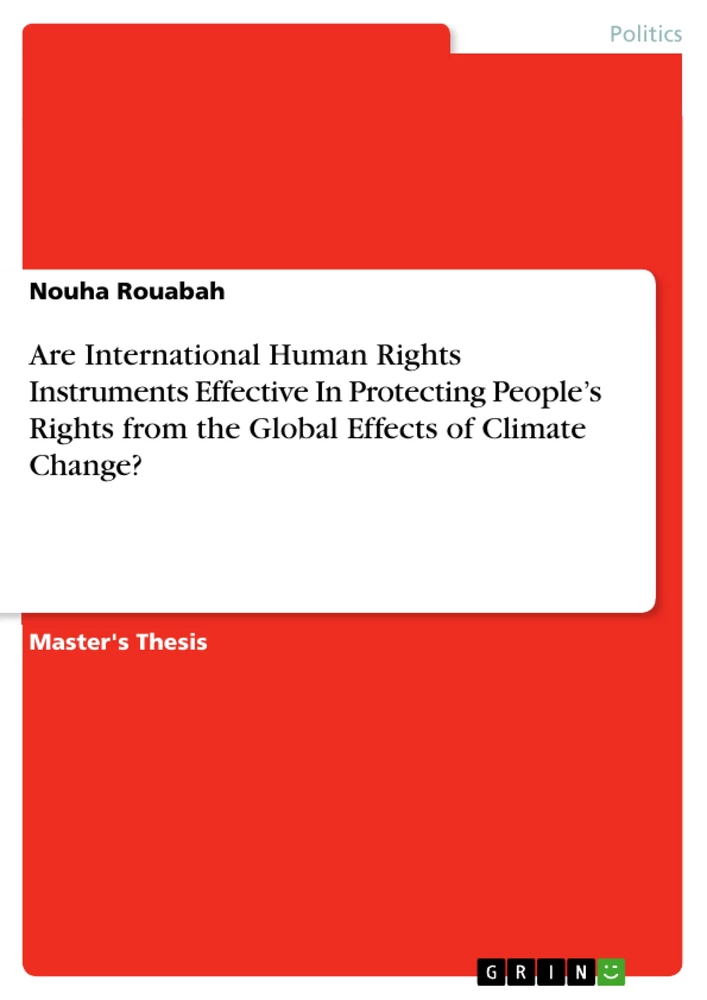
Table of Contents
Chapter One: Theoretical Framework of Climate Change
I- What is Climate Change: Causes and Consequences
A- Climate change defined
B- The Causes of Climate change
C- Consequences of Climate Change
II- Climate change and Capitalism
Chapter Two: Human Rights Implications of Climate Change
I-The Linkage between Climate Change and Human Rights
II-The Impact of Climate Change on Specific Rights
A- The Right to Life
B- The right to health
C- The right to food
D- The right to water and sanitation
E- The Right to Adequate housing
F- Right to Self-Determination
Chapter Three: International Human Rights Duties Regarding the Global Effects of Climate Change
I- International Human Rights Duties of States in the ICCPR
II- International Human Rights Duties in the ICESCR
A- Duties to respect
B- Duties to protect
C- Duties to fulfill
III- Practical Difficulties to the Application of Human Rights Duties Extraterritorially
Chapter Four: Additional Suggestions to the Human Rights Approach to the Global Impacts of Climate Change
I- Basing International Human Rights Law Approach on International Cooperation
II- The Creation of “A Right to a Healthy Environment” As a Human Right
III- Creation of an International Treaty relating to the status of environmental refugees
Research Objectives and Themes
This research evaluates the efficacy of international human rights mechanisms—specifically the ICCPR and the ICESCR—in protecting individuals against the global adverse effects of climate change, while exploring the inherent challenges in extraterritorial duty enforcement.
- The causal relationship between capitalist industrialization and environmental degradation.
- The negative impacts of climate change on specific fundamental human rights.
- The scope and limitations of state obligations under international human rights law regarding transboundary climate harm.
- Potential policy reforms, including the institutionalization of a "right to a healthy environment" and legal frameworks for climate-induced migrants.
Excerpt from the Book
II- Climate change and Capitalism
The historical occurrence of the global capitalism and the transformation of the earth’s climate is no coincidence. Capitalism lies at the root of climate change, challenge and any serious effort to confront climate change must deal with global capitalism. It is well known that the capitalist system is based on the principle of production and selling of commodities in order to get the surplus value and accumulate money. To accumulate money the capitalist should own the means of production and purchase labor force to produce commodities that will be later sold for consumption, and the returned money will be then reinvested into the same process to encourage more accumulation. The incessant drive for capital accumulation makes capitalism a growth oriented system; a system that transforms the world into commodities by treating nature as an immense collection of resources and converting the planet into means of production. All this has negative ramifications on climate change; the best example is the growing concentration of CO2 in the planetary atmosphere which implies that our planet has limits to capitalism growth drive.
The commodification of nature has created what John Bellamy Foster called “the metabolic rift.” This term refers to a concept developed by Karl Marx on the basis of the German chemist Justus on Liebig’s argument that in 1859, the intensive capitalist agriculture in Britain, depleted the soil of its essential nutrients through the transport of food and nutrients from the country to the cities where they end up as waste, reducing the productive power of the land. For Marx, a vital “metabolic interaction” exists between humans and the earth. He believes that there is a dependent relationship between man and nature in which humans interact with nature through the process of labor where they exchange organic matter. Capitalism created an irreversible rift in the metabolic relationship between humans and the earth through the intensification of large scale agriculture and the increasing use of chemical fertilizers in the soil. The quest to maximize profit caused land degradation by despoiling the soil if its basic nutrients and creating pollution through the accumulation of waste in the cities.
Summary of Chapters
Chapter One: Theoretical Framework of Climate Change: Provides an overview of climate change causes—both natural and anthropogenic—and explores the systemic link between capitalist economic growth and environmental degradation.
Chapter Two: Human Rights Implications of Climate Change: Examines how environmental damage threatens specific rights, such as the rights to life, health, food, water, and self-determination, citing international legal precedents.
Chapter Three: International Human Rights Duties Regarding the Global Effects of Climate Change: Analyzes the obligations of states under the ICCPR and ICESCR, discussing the legal and practical difficulties of applying these duties extraterritorially.
Chapter Four: Additional Suggestions to the Human Rights Approach to the Global Impacts of Climate Change: Proposes global solutions, including reinforced international cooperation, a universally recognized right to a healthy environment, and a dedicated treaty for environmental refugees.
Keywords
Climate Change, Human Rights, Capitalism, ICCPR, ICESCR, Environmental Degradation, Extraterritorial Obligations, Metabolic Rift, Right to a Healthy Environment, Environmental Refugees, Global Warming, International Cooperation, State Responsibility, Carbon Emissions, Sustainability.
Frequently Asked Questions
What is the core focus of this research paper?
This paper examines whether existing international human rights instruments, such as the ICCPR and the ICESCR, are effective in protecting individuals from the global impacts of climate change.
Which specific human rights are most threatened by climate change?
The research identifies the rights to life, health, food, water, sanitation, adequate housing, and self-determination as the primary rights endangered by environmental degradation.
What is the author's primary research goal?
The goal is to determine if current international law imposes obligations on states to prevent climate-related human rights violations and to assess how these duties can be enforced, especially across borders.
What methodology does the research utilize?
The paper employs a legal and theoretical analysis, applying a human rights lens to climate change and evaluating current international covenants and their limitations in addressing global environmental harm.
What is discussed in the main body of the work?
The main body covers the theoretical framework of climate change, its link to capitalism, the specific rights affected, the legal duties of states under international covenants, and potential future policy solutions.
Which keywords define the scope of this study?
Key terms include climate change, human rights, international covenants (ICCPR, ICESCR), capitalist industrialization, environmental degradation, and extraterritorial state obligations.
What is the "metabolic rift" as referenced in the paper?
Drawing on Marx, the author uses this term to describe how capitalist systems create an unsustainable, irreversible divide between humanity and nature, leading to environmental exhaustion.
Why does the author argue that current human rights law is inadequate?
The author concludes that current laws are insufficient due to the lack of a universally recognized "right to a healthy environment" and the political reluctance of states to accept responsibility for transboundary harm.
What approach does the author suggest for the issue of climate-induced migration?
The author suggests that since climate refugees do not fit the criteria of the 1951 Refugee Convention, a new international treaty is necessary to provide legal protection and resettlement mechanisms.
What role do multinational corporations play in the author's analysis?
The author argues that non-state actors, specifically multinational corporations, must be included as duty-holders under international human rights law to ensure accountability for their environmental impact.
Ende der Leseprobe aus 43 Seiten
- nach oben
- Arbeit zitieren
- Nouha Rouabah (Autor:in), 2017, Are International Human Rights Instruments Effective In Protecting People’s Rights from the Global Effects of Climate Change?, München, Page::Imprint:: GRINVerlagOHG, https://www.diplomarbeiten24.de/document/385722

neugierig - aktuell - relevant
Entdecken Sie hilfreiche Tipps und Tricks rund ums Studium!

Entdecken Sie hilfreiche Tipps und Tricks rund ums Studium!
Ihre Hausarbeit / Abschlussarbeit:

- - Publikation als E-Book und Buch
- - Hohes Honorar auf die Verkäufe
- - Für Sie komplett kostenlos - mit ISBN
- - Es dauert nur 5 Minuten
- - Jede Arbeit findet Leser

- © GRIN Publishing GmbH.
- Alle Inhalte urheberrechtlich geschützt. Kopieren und verbreiten untersagt.
- info@grin.com
- AGB
- Open Publishing
Der GRIN Verlag hat sich seit 1998 auf die Veröffentlichung akademischer eBooks und Bücher spezialisiert. Der GRIN Verlag steht damit als erstes Unternehmen für User Generated Quality Content. Die Verlagsseiten GRIN.com, Hausarbeiten.de und Diplomarbeiten24 bieten für Hochschullehrer, Absolventen und Studenten die ideale Plattform, wissenschaftliche Texte wie Hausarbeiten, Referate, Bachelorarbeiten, Masterarbeiten, Diplomarbeiten, Dissertationen und wissenschaftliche Aufsätze einem breiten Publikum zu präsentieren.
Kostenfreie Veröffentlichung: Hausarbeit, Bachelorarbeit, Diplomarbeit, Dissertation, Masterarbeit, Interpretation oder Referat jetzt veröffentlichen!
Folgen Sie GRIN auf


- GRIN Verlag GmbH
-
- Nymphenburger Str. 86
- 80636
- Munich, Deutschland
- +49 89-550559-0
- +49 89-550559-10
- info@grin.com
-
