
präsentiert von

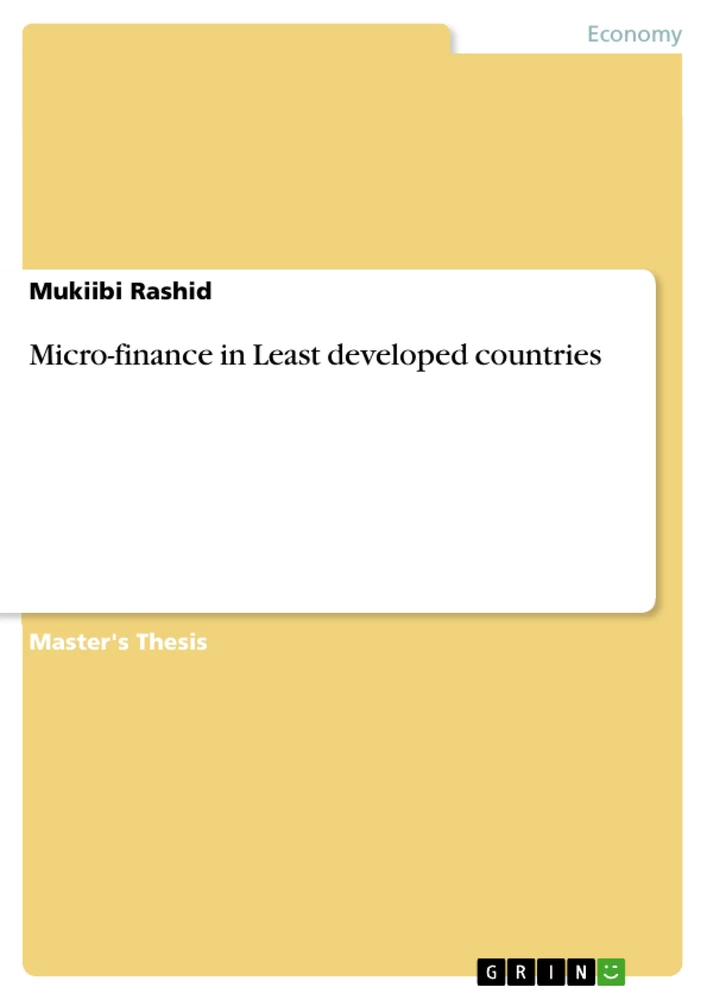
Table of Contents
CHAPTER I
CHAPTER II
CHAPTER III
Chapter IV
Chapter V
Chapter VI
Research Objective and Focus
The primary objective of this dissertation is to examine the recurring failures of microfinance systems in nations with mature market levels, such as India, Morocco, and Bolivia, to identify the systemic causes and derive strategies to prevent similar crises in emerging environments like Burkina Faso.
- Analysis of microfinance failure patterns in developing economies.
- Evaluation of the relationship between socioeconomic variables (literacy, population, poverty rates) and micro-loan performance.
- Comparative assessment of microfinance institutional stability across different regions.
- Development of preventative measures to ensure sustainable financial service delivery for impoverished populations.
Excerpt from the Book
Causes of Micro finance crisis
To understand the failure of micro finance in some societies, it is important to understand the reasons that led to this failure. It is true that microfinance still have a long way to go to show that it is a good tool to fight poverty. But for now in some countries, populations do not want to hear from micro finance, just for the simple reason that simple loans turned into series of nightmares. In India micro finance crisis has received the most attention with the media, but unfortunately it was not the only economy that was struggling from micro lenders .It was the same situation in Morocco, Bolivia, Bosnia and Pakistan. What have these countries have in common that led to MFI bubbles?
Too much credit and investment goals
At the beginning, loans were given to the people that really needed the money to start up a lucrative activity or to expand their businesses. But the problem started when microfinance became more popular and successful. Other financial institutions saw micro finance as an opportunity to be more profitable. This led to an oversupply of credits to fill the large demand of loans. Therefore , loans where given easily without selection , to borrowers that used the loans for personal needs such as paying for a weeding or to repay a previous loan .Most of the time , loans were made at an higher interest rate than the normal financial lenders .“I took out four loans,” said Asmita, a woman from Zareen’s village. “I had to marry off my daughter and repair my house, so I had to raise funds for that. When I could not pay the loans back, the lenders asked me to mortgage the house to raise money. They used to come and sit at my home asking for dues.”(International Business Times, 2013).
Summary of Chapters
CHAPTER I: Provides an introduction to the evolution of microfinance, stating the research purpose of analyzing system failures in mature markets to support development in Burkina Faso.
CHAPTER II: Defines various types of poverty and discusses the barriers to effective microfinance, including high interest rates and political instability.
CHAPTER III: Reviews existing literature regarding the controversy of microfinance effectiveness and its impact on the poor in regions like South Africa and India.
Chapter IV: Outlines the research methodology, specifically the use of quantitative regression analysis on secondary data from 17 selected countries.
Chapter V: Presents the data analysis and interpretation, utilizing scatter plots and regression models to determine correlations between loans, literacy, and poverty.
Chapter VI: Concludes the study by summarizing findings and reinforcing the necessity for better regulatory frameworks and background checks in microfinance institutions.
Keywords
Microfinance, Poverty Eradication, Loan Repayment, Burkina Faso, Financial Institutions, Regression Analysis, Economic Growth, Literacy Rate, Debt Accumulation, Market Economy, Subsistence Economy, Emerging Markets, Socioeconomic Variables, Interest Rates, Poverty Line
Frequently Asked Questions
What is the core focus of this dissertation?
This research evaluates the systemic reasons behind microfinance failures in countries with mature markets to provide insights that help improve the sustainability of financial inclusion in developing countries like Burkina Faso.
What are the primary thematic areas covered?
The study covers the definitions of poverty, the barriers to microfinance success, the causes of MFI crises, and the statistical relationship between credit provision and economic indicators.
What is the primary goal of this research?
The goal is to determine if microfinance truly serves its purpose of poverty reduction or if, due to poor management and high interest rates, it actually worsens the financial situation of the target populations.
Which scientific methods were employed?
The author conducted a quantitative study using secondary data, applying regression analysis to examine the correlation between independent variables like literacy and population and the dependent variable, which is the loan per person.
What does the main body of the work address?
The main sections contrast market and subsistence economies, analyze specific microfinance crises in countries like India and Morocco, and present a detailed regression model comparing various socioeconomic factors.
Which keywords define this study?
Key concepts include Microfinance, Poverty Eradication, Financial Institutions, Regression Analysis, Economic Growth, and Debt Accumulation.
Why did the author choose Burkina Faso as a focal point for the application of findings?
Burkina Faso is highlighted because the nation is at an elementary level of microfinance and currently struggles with high poverty and low literacy rates, making it a critical environment where the lessons from past global failures could prevent future disasters.
How does the research handle the "MFI bubble" in India and Morocco?
The paper analyzes the Indian and Moroccan cases as clear examples of how aggressive lending, lack of transparency, and oversupply of credit can lead to crises, ultimately identifying them as "nightmares" that other nations must avoid.
Ende der Leseprobe aus 69 Seiten
- nach oben
- Arbeit zitieren
- Mukiibi Rashid (Autor:in), 2016, Micro-finance in Least developed countries, München, Page::Imprint:: GRINVerlagOHG, https://www.diplomarbeiten24.de/document/386933

neugierig - aktuell - relevant
Entdecken Sie hilfreiche Tipps und Tricks rund ums Studium!

Entdecken Sie hilfreiche Tipps und Tricks rund ums Studium!
Ihre Hausarbeit / Abschlussarbeit:

- - Publikation als E-Book und Buch
- - Hohes Honorar auf die Verkäufe
- - Für Sie komplett kostenlos - mit ISBN
- - Es dauert nur 5 Minuten
- - Jede Arbeit findet Leser

- © GRIN Publishing GmbH.
- Alle Inhalte urheberrechtlich geschützt. Kopieren und verbreiten untersagt.
- info@grin.com
- AGB
- Open Publishing
Der GRIN Verlag hat sich seit 1998 auf die Veröffentlichung akademischer eBooks und Bücher spezialisiert. Der GRIN Verlag steht damit als erstes Unternehmen für User Generated Quality Content. Die Verlagsseiten GRIN.com, Hausarbeiten.de und Diplomarbeiten24 bieten für Hochschullehrer, Absolventen und Studenten die ideale Plattform, wissenschaftliche Texte wie Hausarbeiten, Referate, Bachelorarbeiten, Masterarbeiten, Diplomarbeiten, Dissertationen und wissenschaftliche Aufsätze einem breiten Publikum zu präsentieren.
Kostenfreie Veröffentlichung: Hausarbeit, Bachelorarbeit, Diplomarbeit, Dissertation, Masterarbeit, Interpretation oder Referat jetzt veröffentlichen!
Folgen Sie GRIN auf


- GRIN Verlag GmbH
-
- Nymphenburger Str. 86
- 80636
- Munich, Deutschland
- +49 89-550559-0
- +49 89-550559-10
- info@grin.com
-
