
präsentiert von

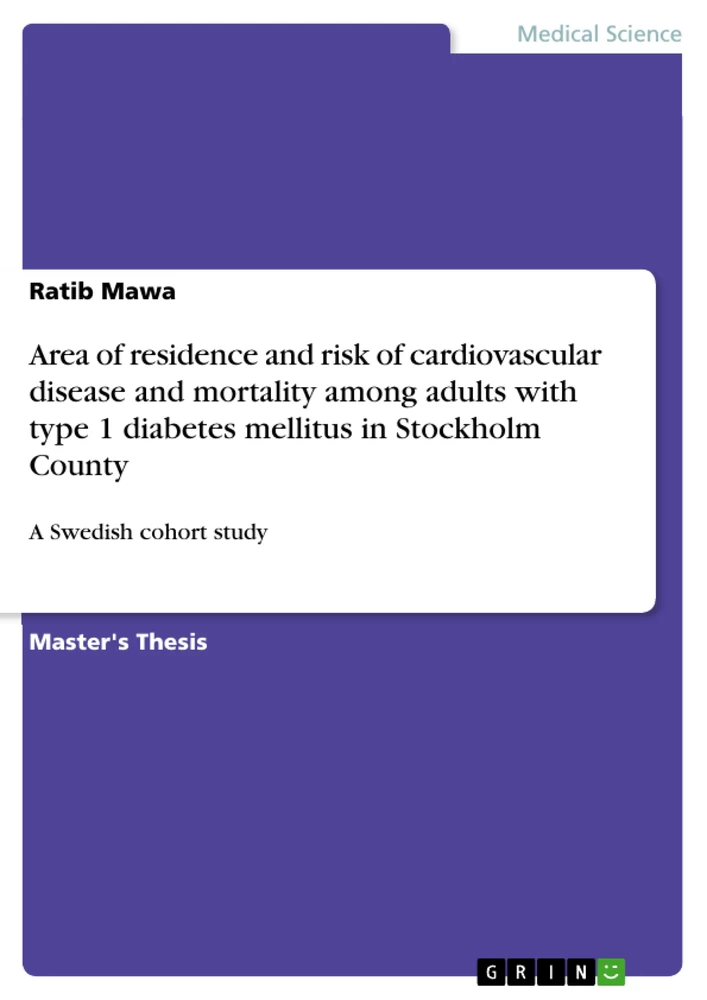
Table of Contents
1 Background
1.1 Area of residence
1.2 Area of residence and risk of CVD in adults with T1DM
1.3 Area of residence and risk of cardiovascular disease specific mortality in adults with T1DM
2 Aim and research questions
2.1 Aim
2.2 Research Questions
3 Materials and methods
3.1 Study design and population
3.2 Data Sources
3.3 Study setting
3.4 Exposure
3.5 Covariates
3.6 Outcomes
4 Statistical analysis
5 Ethical Considerations
6 Results
6.1 Socio-demographic characteristics of adults with type 1 diabetes mellitus
6.2 Risk of incident CVD, stroke, myocardial infarction and peripheral vascular disease according to area of residence.
6.3 Risk of CVD specific mortality according to area of residence
7. Discussion
8 Strengths and limitations
9 Conclusion and implications
Research Objectives and Focus
The study aims to investigate potential health inequalities related to residential area by examining whether the risk of incident cardiovascular disease (CVD) and CVD-specific mortality differs for adults with type 1 diabetes mellitus (T1DM) living in disadvantaged areas compared to those in other areas of Stockholm County.
- Impact of residential area environment on CVD risk for T1DM patients.
- Comparative analysis of CVD incidence in disadvantaged versus other urban areas.
- Assessment of myocardial infarction, stroke, and peripheral vascular disease risk.
- Evaluation of socio-economic and environmental factors as determinants of health outcomes.
- Utilization of longitudinal register-based data to inform public health policy.
Excerpt from the Book
1.1 Area of residence
Area of residence intrinsically embodies components of the social and physical environment that influence health as described earlier on [38, 43]. Area disadvantage commonly referred to as area deprivation is a widely used concept with no single definition [68]. Some social epidemiologists claimed that it summarizes an area`s health risk potential based on geographical clustering of unemployment, poverty, social disorganization and economic divesture [69]. The choice of area of residence is influenced by several factors among which socio-economic status and culture play key role [40, 70]. A number of countries developed indices of area deprivation/disadvantage that suits the ecological characteristics of their populations. These indices remain the most widely used measures for assessing residential area inequalities in health and disease [71, 72]. Examples include the Swedish Care Need Index [73] and the English Index of Multiple Deprivation [74]. However in this study, we did not use deprivation index but rather dichotomised individuals into either disadvantaged or other areas of Stockholm County based on classification of residential areas in Stockholm County in 1998 for metropolitan development initiative[75]
Summary of Chapters
1 Background: Reviews the global burden of cardiovascular disease and its specific relevance to patients with type 1 diabetes mellitus in Sweden.
2 Aim and research questions: Defines the core objective of the study and the specific research questions regarding CVD risk and area of residence.
3 Materials and methods: Describes the register-based cohort study design, data sources, and the categorization of disadvantaged versus other residential areas.
4 Statistical analysis: Details the methodologies used, including Cox proportional hazard regression and adjustment for confounding variables.
5 Ethical Considerations: Outlines the measures taken to ensure data privacy and the ethical approval obtained for the research.
6 Results: Presents the findings regarding socio-demographic characteristics and hazard ratios for various cardiovascular outcomes.
7. Discussion: Interprets the findings, compares them with previous studies, and discusses possible explanations for the observed results.
8 Strengths and limitations: Analyzes the methodology, acknowledging potential biases and the robustness of the data used.
9 Conclusion and implications: Summarizes the key findings, specifically the association with myocardial infarction, and provides recommendations for public health policy.
Keywords
Area of residence, cardiovascular disease, stroke, myocardial infarction, peripheral vascular disorders, mortality, morbidity, type 1 diabetes mellitus, social determinants, health inequalities, Stockholm County, register-based study, public health, socio-economic status, epidemiology.
Frequently Asked Questions
What is the primary focus of this research?
The research investigates whether living in disadvantaged residential areas in Stockholm County increases the risk of cardiovascular disease (CVD) and CVD-related mortality among adults with type 1 diabetes mellitus.
What are the central thematic fields covered?
The study covers public health epidemiology, the social determinants of health, cardiovascular health outcomes, and the specific vulnerabilities of patients with type 1 diabetes.
What is the main objective of the thesis?
The primary aim is to deepen existing knowledge on health inequalities at an area level to determine if residential location affects the health outcomes of individuals with T1DM.
Which scientific methodology was applied?
It is a register-based cohort study using data from 7,544 adults, applying Cox proportional hazard regression to calculate crude and adjusted hazard ratios.
What topics are explored in the main body?
The main body covers the background of CVD, the study design and data sources, demographic characteristics, statistical analysis of hazard ratios, and a discussion of the observed findings.
Which keywords characterize this work?
Key terms include area of residence, cardiovascular disease, myocardial infarction, T1DM, social determinants, and health inequalities.
Was an association found between area of residence and CVD in general?
The study found no significant association between area of residence and the composite CVD endpoint, stroke, or peripheral vascular disease in T1DM patients.
What specific finding emerged regarding myocardial infarction?
A statistically significant association was observed between living in disadvantaged areas and an increased risk of incident myocardial infarction in adults with T1DM.
Ende der Leseprobe aus 31 Seiten
- nach oben
- Arbeit zitieren
- Ratib Mawa (Autor:in), 2016, Area of residence and risk of cardiovascular disease and mortality among adults with type 1 diabetes mellitus in Stockholm County, München, Page::Imprint:: GRINVerlagOHG, https://www.diplomarbeiten24.de/document/387175

neugierig - aktuell - relevant
Entdecken Sie hilfreiche Tipps und Tricks rund ums Studium!

Entdecken Sie hilfreiche Tipps und Tricks rund ums Studium!
Ihre Hausarbeit / Abschlussarbeit:

- - Publikation als E-Book und Buch
- - Hohes Honorar auf die Verkäufe
- - Für Sie komplett kostenlos - mit ISBN
- - Es dauert nur 5 Minuten
- - Jede Arbeit findet Leser

- © GRIN Publishing GmbH.
- Alle Inhalte urheberrechtlich geschützt. Kopieren und verbreiten untersagt.
- info@grin.com
- AGB
- Open Publishing
Der GRIN Verlag hat sich seit 1998 auf die Veröffentlichung akademischer eBooks und Bücher spezialisiert. Der GRIN Verlag steht damit als erstes Unternehmen für User Generated Quality Content. Die Verlagsseiten GRIN.com, Hausarbeiten.de und Diplomarbeiten24 bieten für Hochschullehrer, Absolventen und Studenten die ideale Plattform, wissenschaftliche Texte wie Hausarbeiten, Referate, Bachelorarbeiten, Masterarbeiten, Diplomarbeiten, Dissertationen und wissenschaftliche Aufsätze einem breiten Publikum zu präsentieren.
Kostenfreie Veröffentlichung: Hausarbeit, Bachelorarbeit, Diplomarbeit, Dissertation, Masterarbeit, Interpretation oder Referat jetzt veröffentlichen!
Folgen Sie GRIN auf


- GRIN Verlag GmbH
-
- Nymphenburger Str. 86
- 80636
- Munich, Deutschland
- +49 89-550559-0
- +49 89-550559-10
- info@grin.com
-
