
präsentiert von

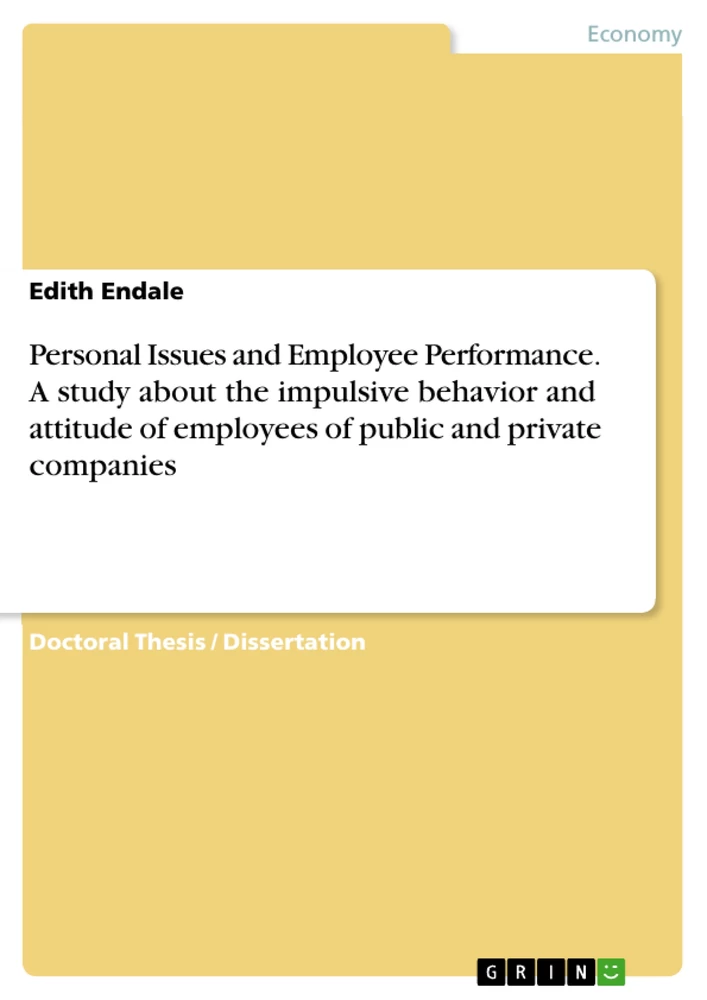
Table of Contents
1 INTRODUCTION
1.1 OBJECTIVES OF THE STUDY
1.2 BACKGROUND OF THE STUDY
1.3 RATIONALE
1.4 RESEARCH QUESTIONS
1.5 HYPOTHESIS
1.6 SCOPE OF STUDY
1.7 SIGNIFICANCE OF the STUDY
1.8 METHODOLOGY
2 LITERATURE REVIEW
2.1 introduction
2.2 Employee attitude/behavior
2.3 Performance management
2.4 Personal issues
2.4.1 ANGER
2.4.2 Trauma
2.4.2.1 Childhood Trauma
2.4.3 STRESS
2.4.3.1 Work Stress
2.4.3.2 Health Stress
2.4.3.3 Non-work related stress
2.4.4 Depression
2.4.5 Low self-esteem
2.4.5.1 THE CONSEQUENCES OF IMPOVERISHED SELF-ESTEEM.
2.4.5.2 PROMOTING POSITIVE SELF-ESTEEM
2.4.6 Problems and Setbacks
2.4.6.1 DEVELOPING PROBLEM SOLVING SKILLS
2.4.7 Lack of self-control
2.4.7.1 Measures to build self-control
2.4.7.2 Impact of Self-control
2.4.8 Poor communication process
2.4.8.1 Interpersonal communication:
2.4.8.2 Intrapersonal communication
2.4.8.3 Organizational communication
2.4.8.4 FORMS OF COMMUNICATION
2.4.8.5 OTHER ASPECTS OF COMMUNICATION
2.4.9 NEGATIVE THINKING
2.4.9.1 PRACTISING POSITIVE THINKING
2.5 relationship between personal issues, employee attitude and performance
2.5 Managerial tool to assist with employees’ personal issues
2.6.1 Implementing Counseling
2.6.1.1 Why study counseling skills
2.6.1.2 Types of Counseling
2.7 Managerial tools and techniques to boost employee performance
2.7.1 Communicate clear goals and expectations
2.7.2 Encourage open communication
2.7.3 Offer Incentives
2.7.4 Provide constant feedback on the positives
2.7.5 Adopt a culture of training
2.8 Managing reprehensive and disruptive behaviors
2.8.1 Identify the behavior
2.8.2 Attack the problem, not the employee.
2.8.3 Establish disciplinary procedures
2.8.4 Follow up with the employee
3 METHODOLOGY
3.1 INTRODUCTION
3.2 RESEARCH METHOD
3.3 METHOD OF DATA COLLECTION
3.3.1 Primary Sources
3.3.1.1 Interviews
3.3.1.2 Questionnaires
3.3.2 Secondary Source
3.4 PROCEDURES
3.5 DATA ANALYSIS
3.6 LIMITATION OF THE STUDY
4 STRATEGY AND TECHNIQUES
4.0 INTRODUCTION
4.1 Public companies
4.1.1 Analysis of section I:
4.1.1.1 Distribution of respondents according to demographic information
4.1.2 Analysis of section II:
4.1.3 Analysis of section III:
4.1.4 Analysis of section IV:
QUESTION 23 E
4.1.5 Analysis of section V:
4.4 Private companies
4.2.1 Analysis of section I:
4.4.1.1 Distribution of respondents according to demographic information
4.4.2 Analysis of section II:
4.4.3 Analysis of section III:
4.4.4 Analysis of section IV:
QUESTION 22 E
QUESTION 23 E
4.4.5 Analysis of section V:
5 ANALYSIS AND INTERPRETATION OF RESULTS
5.1 INTRODUCTION
5.2 INTERPRETATION OF FINDINGS
5.2.1 PUBLIC AND PRIVATE COMPANIES
5.3 Testing OF the hypothesis
6 CONCLUSION AND RECOMMENDATIONS
6.1 INTRODUCTION
6.2 CONCLUSION
6.3 Recommendations for Future Research
6.3.1 Inclusion of counseling practices
6.1.1 Employee and family assistance programmes:
6.3.3 Improved Communication–
6.3.4 Educational programs
6.3.5 Management commitment
6.4 Future Research
Objectives and Thematic Focus
The primary objective of this study is to determine whether reprehensive behaviors in the public and private sectors in Cameroon are driven by personal issues, and to evaluate how these issues negatively affect employee performance. The research investigates the relationship between employee struggles—such as family difficulties, stress, and trauma—and their workplace attitudes and output. It specifically aims to identify how organizations can implement effective support structures, such as counseling, to mitigate the impact of these personal challenges on workforce efficiency.
- Impact of personal issues on employee behavior and performance.
- Investigation of reprehensive behavior in public vs. private sectors.
- The effectiveness of counseling and workplace intervention techniques.
- Managing employee attitude to enhance organizational productivity.
- Correlation between childhood experiences, mental well-being, and work behavior.
Book Excerpt
2.4 PERSONAL ISSUES
Goewey (2014) admits that if an employee has a personal problem or issue, that’s a different ball game altogether but if it is affecting their performance in the work environment and affecting other employees, that’s where the organization needs to get interested and get involved. However, for an organization to intervene or get involved, management needs to understand what some of these personal issues are in the first place. Personal issues are wide and extensive ranging from internal and external factors but for the sake of feasibility, the list of personal issues for this study would be exclusively narrowed down.
2.4.1 ANGER
Different people feel and show anger in various and different ways. Anger is a feeling that is sequel when we are not happy about something, when we are disappointed, when we are experiencing failure or seeing something that is not fair or someone not treated fairly (Carter & Minirth 2004).In modern society, anger is seen as an immature or uncivilized response to frustration, threat, violation, or loss. The norm is to keep calm and to be coolheaded. These are considered more socially acceptable and of good conduct. Furthermore, anger that is constantly entrapped can lead to persistent violent thoughts or actions. So the question is how much of anger should be tolerated. Everyone gets angry over something; however the anger the researcher will be discussing is the anger that is destructive; that which can hurt or harm people. Put forward by Tafrate & Kassinove (2009), the anger that affects our health, lives and relationship with people or that which occurs very often and is destructive to even property and must therefore be managed adequately so as to live a happy life. Edmiston & Scheff (2010) allege that anger is said to be destructive when the following signs are present in employees:
Summary of Chapters
1 INTRODUCTION: This chapter provides an overview of how employee wellbeing directly correlates with organizational performance, establishing the study's scope in the context of the Cameroonian public and private sectors.
2 LITERATURE REVIEW: This chapter examines theoretical and academic perspectives on employee behavior, the impact of personal struggles like stress and trauma, and the role of counseling in the workplace.
3 METHODOLOGY: This section details the research design, which utilized a stratified random sampling technique to survey employees and conduct structured interviews across seven organizations.
4 STRATEGY AND TECHNIQUES: This chapter presents the data analysis gathered from questionnaires and interviews, categorizing findings from public and private companies regarding their demographic backgrounds and personal challenges.
5 ANALYSIS AND INTERPRETATION OF RESULTS: This chapter evaluates the relationship between personal variables and employee performance, testing the formulated hypotheses against the empirical data collected.
6 CONCLUSION AND RECOMMENDATIONS: This final chapter synthesizes the findings and provides strategic recommendations, such as the implementation of employee assistance programs and counseling, to improve workplace performance.
Keywords
Personal issues, Employee performance, Reprehensive behavior, Counseling, Workplace stress, Trauma, Mental wellbeing, Organizational management, Human resource management, Employee attitude, Cameroon, Job satisfaction, Behavioral patterns, Conflict management, Productivity
Frequently Asked Questions
What is the core focus of this research?
The research explores how personal issues, such as stress, family problems, and trauma, influence the behavior and performance of employees in both public and private sectors in Cameroon.
What are the primary thematic areas covered?
The study covers employee attitudes and behaviors, performance management, the impact of personal struggles (anger, stress, trauma, depression), the role of counseling, and managerial strategies for workplace improvement.
What is the main objective of the thesis?
The primary goal is to establish a link between personal issues and reprehensive employee behaviors and to recommend effective management intervention techniques, specifically counseling, to improve overall performance.
What methodology does the author use?
The study employs a descriptive research design with a stratified random sampling method, collecting primary data via online questionnaires and structured interviews, supplemented by secondary data from academic literature.
What is addressed in the main body of the work?
The main body covers the theoretical background regarding workplace behaviors, detailed analysis of specific stressors, the importance of communication, and the practical application of counseling as a management tool.
Which keywords characterize this work?
The work is characterized by terms such as personal issues, employee performance, reprehensive behavior, workplace counseling, mental wellbeing, and organizational human resource management.
How do personal issues specifically impact public sector employees in Cameroon?
Findings suggest that public sector employees in Cameroon exhibit more irrational behaviors compared to their private sector counterparts, primarily because they struggle to manage their personal issues in the absence of adequate organizational support structures.
Why is counseling considered an essential management tool?
Counseling is identified as a distinct tool to help employees process emotional difficulties and personal stressors, which in turn reduces unproductive behaviors and improves workplace morale and performance.
Ende der Leseprobe aus 213 Seiten
- nach oben
- Arbeit zitieren
- Edith Endale (Autor:in), 2017, Personal Issues and Employee Performance. A study about the impulsive behavior and attitude of employees of public and private companies, München, Page::Imprint:: GRINVerlagOHG, https://www.diplomarbeiten24.de/document/387558

neugierig - aktuell - relevant
Entdecken Sie hilfreiche Tipps und Tricks rund ums Studium!

Entdecken Sie hilfreiche Tipps und Tricks rund ums Studium!
Ihre Hausarbeit / Abschlussarbeit:

- - Publikation als E-Book und Buch
- - Hohes Honorar auf die Verkäufe
- - Für Sie komplett kostenlos - mit ISBN
- - Es dauert nur 5 Minuten
- - Jede Arbeit findet Leser

- © GRIN Publishing GmbH.
- Alle Inhalte urheberrechtlich geschützt. Kopieren und verbreiten untersagt.
- info@grin.com
- AGB
- Open Publishing
Der GRIN Verlag hat sich seit 1998 auf die Veröffentlichung akademischer eBooks und Bücher spezialisiert. Der GRIN Verlag steht damit als erstes Unternehmen für User Generated Quality Content. Die Verlagsseiten GRIN.com, Hausarbeiten.de und Diplomarbeiten24 bieten für Hochschullehrer, Absolventen und Studenten die ideale Plattform, wissenschaftliche Texte wie Hausarbeiten, Referate, Bachelorarbeiten, Masterarbeiten, Diplomarbeiten, Dissertationen und wissenschaftliche Aufsätze einem breiten Publikum zu präsentieren.
Kostenfreie Veröffentlichung: Hausarbeit, Bachelorarbeit, Diplomarbeit, Dissertation, Masterarbeit, Interpretation oder Referat jetzt veröffentlichen!
Folgen Sie GRIN auf


- GRIN Verlag GmbH
-
- Nymphenburger Str. 86
- 80636
- Munich, Deutschland
- +49 89-550559-0
- +49 89-550559-10
- info@grin.com
-
