
präsentiert von

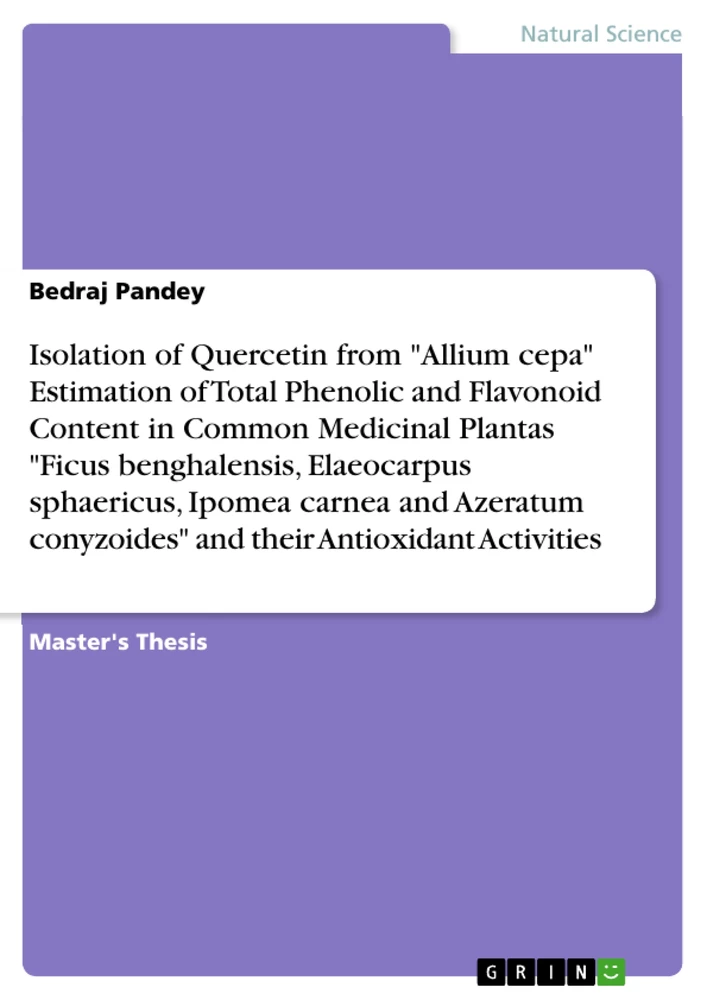
Table of Contents
1. Introduction
1.1. Introduction
1.2. Objectives of study
1.3. Literature Survey
2. Experimental Section
2.1 Materials
2.2 Methods
3. Result and Discussion
3.1. Sohxlet Extraction of Outer Scale of Allium cepa
3.2. Test for Phenolic and Flavonoid Compounds
3.3. Liquid- liquid Extraction
3.4. Isolation of Quercetin
3.5. Characterization of Quercetin
3.6. Preparation of Extracts for the Estimation of Total Phenolic and Flavonoid Contents
3.7. Estimation of Total Phenolic Content (TPC)
3.8. Estimation of Total Flavonoid Content (TFC)
3.9. Determination of Antioxidant Activity
3.10. Correlation between DPPH Free Radical Scavenging Activity (IC50) and TPC
4. Conclusion
Research Objectives and Focus
This dissertation focuses on the isolation of quercetin from the outer scales of Allium cepa and the subsequent evaluation of total phenolic and flavonoid contents, alongside antioxidant activities, in four medicinal plants (Ficus benghalensis, Elaeocarpus sphaericus, Ipomea carnea, and Ageratum conyzoides) from Nepal, aiming to establish the correlation between phenolic concentration and antioxidant potential.
- Isolation and characterization of quercetin from Allium cepa.
- Comparative analysis of total phenolic and flavonoid content in selected medicinal plants.
- Evaluation of antioxidant activity using DPPH radical scavenging assays.
- Correlation studies between chemical composition and antioxidant efficacy.
- Investigation of extraction methods (methanol, 50% methanol, 70% acetone) on yield and antioxidant activity.
Excerpt from the Book
1.1.1. Introduction and Rationale of study
Natural products are chemical compounds or substances produced by living organisms found in nature that usually has a pharmacological or biological activity. They have restricted distribution being found mostly in plants and micro-organisms. However, animals have also been a source of some interesting compounds.
Plants provide a large bank of rich, complex and highly varied structures which are unlikely to be synthesized in laboratories. Further, these potent compounds are synthesized in plants partly as a response to ecological and physiological pressures such as pathogen and insect attack, UV radiation and wounding.
Even today, the number of plants that have been extensively studied is relatively very few and the vast majorities have not been studied at all. Major classes of natural products found in plants include terpenoids, phytosterols, alkaloids, natural phenols and polyphenols.
The term phenolic compound embraces a wide range of plant substances which posses in common an aromatic ring bearing one or more hydroxyl substituents. It encompasses approximately 8000 naturally occurring compounds, all of which
Summary of Chapters
1. Introduction: This chapter introduces natural products, specifically phenolic compounds and flavonoids, and outlines the objectives of the study including the isolation of quercetin and the screening of medicinal plants.
2. Experimental Section: Provides a detailed account of the materials, instruments, and methodological procedures used for plant extraction, phytochemical testing, and quantitative analysis.
3. Result and Discussion: Presents the findings regarding the isolation of quercetin from Allium cepa and discusses the quantitative results of phenolic/flavonoid contents and antioxidant assays for the selected plant species.
4. Conclusion: Summarizes the key findings of the research, confirming the presence of phenolic compounds and their correlation with antioxidant activities in the studied medicinal plants.
Keywords
Quercetin, Allium cepa, Ficus benghalensis, Elaeocarpus sphaericus, Ipomea carnea, Ageratum conyzoides, Antioxidant Activity, DPPH Assay, Total Phenolic Content, Total Flavonoid Content, Natural Products, Phytochemicals, Medicinal Plants, Solvent Extraction, Radical Scavenging.
Frequently Asked Questions
What is the primary scope of this dissertation?
The research primarily investigates the isolation of quercetin from onion scales and the quantitative assessment of phenolic and flavonoid content, as well as the antioxidant potential, of four specific medicinal plants from Nepal.
Which medicinal plants were studied in this research?
The study examines Ficus benghalensis, Elaeocarpus sphaericus, Ipomea carnea, and Ageratum conyzoides.
What is the main objective regarding quercetin?
The goal is to isolate and identify quercetin from Allium cepa to serve as a standard for calibration curves in the determination of flavonoid content in other plant extracts.
What analytical methods are utilized for the antioxidant assay?
The research employs the 2,2-diphenyl-1-picrylhydrazyl (DPPH) radical scavenging assay to evaluate the antioxidant activity of the plant extracts.
How is the total phenolic content determined?
Total phenolic content is estimated spectrophotometrically using the Folin-Ciocalteu reagent and is reported as Gallic Acid Equivalents (GAE).
What is the significance of the correlation study?
The correlation study links IC50 values (antioxidant capacity) to total phenolic content, indicating whether phenolic compounds are the primary contributors to the observed antioxidant activity.
What was the result of the quercetin isolation?
The isolation process yielded 51.6 mg of yellow powder, which was characterized through melting point determination and spectral analysis (UV and IR) as quercetin.
How do different extraction solvents affect the results?
The study found that the extraction yield and the content of phenolics and flavonoids varied significantly depending on the solvent used (methanol, 50% aqueous methanol, or 70% aqueous acetone).
Which plant showed the highest total phenolic content?
The 70% aqueous acetone extract of Elaeocarpus sphaericus exhibited the highest detected amount of phenolic compounds.
What is the conclusion regarding the correlation coefficient?
The research found a strong linear correlation between total phenolic content and antioxidant activity, yielding an R² value of 0.931.
Ende der Leseprobe aus 79 Seiten
- nach oben
- Arbeit zitieren
- Bedraj Pandey (Autor:in), 2013, Isolation of Quercetin from "Allium cepa" Estimation of Total Phenolic and Flavonoid Content in Common Medicinal Plantas "Ficus benghalensis, Elaeocarpus sphaericus, Ipomea carnea and Azeratum conyzoides" and their Antioxidant Activities, München, Page::Imprint:: GRINVerlagOHG, https://www.diplomarbeiten24.de/document/412710

neugierig - aktuell - relevant
Entdecken Sie hilfreiche Tipps und Tricks rund ums Studium!

Entdecken Sie hilfreiche Tipps und Tricks rund ums Studium!
Ihre Hausarbeit / Abschlussarbeit:

- - Publikation als E-Book und Buch
- - Hohes Honorar auf die Verkäufe
- - Für Sie komplett kostenlos - mit ISBN
- - Es dauert nur 5 Minuten
- - Jede Arbeit findet Leser

- © GRIN Publishing GmbH.
- Alle Inhalte urheberrechtlich geschützt. Kopieren und verbreiten untersagt.
- info@grin.com
- AGB
- Open Publishing
Der GRIN Verlag hat sich seit 1998 auf die Veröffentlichung akademischer eBooks und Bücher spezialisiert. Der GRIN Verlag steht damit als erstes Unternehmen für User Generated Quality Content. Die Verlagsseiten GRIN.com, Hausarbeiten.de und Diplomarbeiten24 bieten für Hochschullehrer, Absolventen und Studenten die ideale Plattform, wissenschaftliche Texte wie Hausarbeiten, Referate, Bachelorarbeiten, Masterarbeiten, Diplomarbeiten, Dissertationen und wissenschaftliche Aufsätze einem breiten Publikum zu präsentieren.
Kostenfreie Veröffentlichung: Hausarbeit, Bachelorarbeit, Diplomarbeit, Dissertation, Masterarbeit, Interpretation oder Referat jetzt veröffentlichen!
Folgen Sie GRIN auf


- GRIN Verlag GmbH
-
- Nymphenburger Str. 86
- 80636
- Munich, Deutschland
- +49 89-550559-0
- +49 89-550559-10
- info@grin.com
-
