
präsentiert von

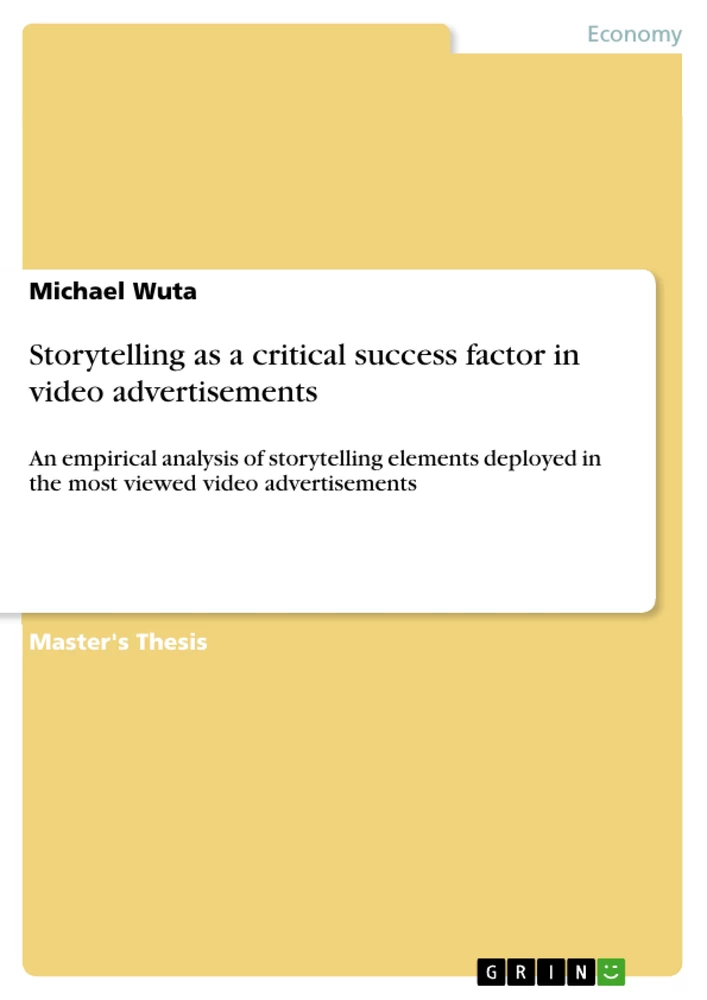
Table of Contents
1 Introduction
1.1 Background
1.2 Research Purpose
1.3 Significance of and Justification for the Study
1.4 Research Question and Objective
1.5 Structure of the Dissertation
2 Literature Review
2.1 Overview
2.2 The Nature and Scope of Advertising
2.2.1 Definition of Advertising
2.2.2 The Role of Advertising within Marketing
2.3 Storytelling in the Context of Advertising
2.3.1 Definition of Storytelling
2.3.2 Why Is Storytelling Used in Advertising?
2.3.3 Positive Effects of Storytelling
2.4 The Elements of Storytelling
2.4.1 The Essence of a Good Story
2.4.2 The Basic Plots
2.4.3 Archetypes
2.4.4 Fictional Stories vs. Real Stories
2.4.5 Further Elements
2.4.5.1 High and Low Arousal Emotions
2.4.5.2 Surprise and Joy
2.4.5.3 Music
2.5 Conceptual Framework
2.6 Conclusion
3 Methodology and Research Design
3.1 Overview
3.2 Research Philosophy
3.3 Research Approach
3.4 Methodological Choice
3.5 Research Strategy
3.6 Data Collection Technique
3.7 Data Analysis Procedure
3.8 Access and Ethical Issues
3.9 Reliability of Qualitative Data
3.10 Conclusion
4 Presentation and Discussion of the Findings
4.1 Overview
4.2 Presentation of Findings
4.2.1 The Essence of a Good Story
4.2.2 The Basic Plots
4.2.3 Archetypes
4.2.4 Fictional Stories vs. Real Stories
4.2.5 Further Elements
4.2.5.1 High and Low Arousal Emotions
4.2.5.2 Surprise and Joy
4.2.5.3 Music
4.3 Discussion and Conclusion
4.3.1 The Essence of a Good Story
4.3.2 The Basic Plots
4.3.3 Archetypes
4.3.4 Fictional Stories vs. Real Stories
4.3.5 Further Elements
4.3.5.1 High and Low Arousal Emotions
4.3.5.2 Surprise and Joy
4.3.5.3 Music
5 Concluding Thoughts on the Contribution of this Research, its Limitations, and Suggestions for Further Research
5.1 Implications of the Findings for the Research Questions
5.2 Contributions and Limitations of the Research
5.3 Recommendations for Practice
5.4 Recommendations for Future Research
5.5 Final Conclusion and Reflections
Research Objectives and Themes
This dissertation explores the critical role of storytelling as a success factor in video advertising by identifying and empirically analyzing the specific narrative elements used in highly successful campaigns.
- Analysis of storytelling elements in the 30 most viewed YouTube advertisements.
- Exploration of theoretical frameworks including archetypes and plot structures in marketing.
- Evaluation of the impact of emotions (high/low arousal, surprise, joy) and music.
- Development of practical guidance for marketers to improve consumer engagement.
- Addressing the challenge of advertising avoidance through compelling narrative content.
Auszug aus dem Buch
2.3.3 Positive Effects of Storytelling
Stories and storytelling are a fundamental means by which humans structure and therefore make sense of our lives (Shankar et al. 2001). According to Schiffrin (1996: 167 cited in Shankar et al. 2001), “the stories that we tell about our own and others’ lives are a pervasive form of text through which we construct, interpret and share experience: we dream in narrative, remember, anticipate, hope, despair, believe, plan, revise […] and love by narrative.”
The positive effects of storytelling on the consumer behaviour have been widely researched, according to Schank (1999 cited in Woodside 2010), the human memory is story-based, and information is indexed, stored, and retrieved in the form of stories. The author further explains that stories are useful because they come with many touchpoints such as location, decisions, actions, and quandaries regarding the lives of the viewers, and result in awareness and emotional connection in their minds. The more touchpoints the viewer has within a story, the more places the story can reside in the human memory and the likelier the viewer will be to remember and emotionally relate to that story (Schank 1999 cited in Woodside 2010). Thus, stories are easier for the viewer to memorise: the viewer relates to the touchpoints and is emotionally affected by stories.
Summary of Chapters
1 Introduction: This chapter introduces the background of the research, the research purpose, and justifies the study, while presenting the central research question and objectives.
2 Literature Review: This chapter covers relevant theories regarding advertising, the context of storytelling, and identifies key storytelling elements to form a conceptual framework.
3 Methodology and Research Design: This chapter justifies the interpretivist research philosophy and the qualitative case study approach used to collect and analyze data from YouTube advertisements.
4 Presentation and Discussion of the Findings: This chapter presents the empirical data from the 30 analyzed video advertisements and discusses these findings in relation to existing storytelling literature.
5 Concluding Thoughts on the Contribution of this Research, its Limitations, and Suggestions for Further Research: This final chapter synthesizes the research findings, offers practical recommendations for marketers, and acknowledges the study's limitations while proposing paths for future exploration.
Keywords
storytelling, narratives, video advertisements, YouTube Ads Leaderboard, storytelling elements, online advertising, rich media, consumer behaviour, brand management, qualitative analysis, archetypes, plot structures, emotions, consumer engagement, ad avoidance
Frequently Asked Questions
What is the core focus of this research?
The research focuses on investigating storytelling as a critical success factor in video advertisements and empirically identifying the elements that contribute to the success of highly viewed videos.
What are the primary themes examined?
The study examines the nature of advertising, the role of storytelling in a marketing context, and specific narrative components such as plot structures, archetypes, emotions, and music.
What is the main research question?
The primary research question is: "What elements of storytelling theory are deployed in the most viewed video advertisements?"
What methodology was applied?
The author employed an interpretivist research philosophy using a qualitative case study strategy to analyze a sample of the 30 most viewed video advertisements on the YouTube Ads Leaderboard.
What does the main body of the work cover?
The main body covers a comprehensive literature review, the methodological justification for the study, a detailed presentation of findings from the video analysis, and a discussion of these results.
Which keywords characterize this work?
Key terms include storytelling, narratives, video advertisements, YouTube Ads Leaderboard, storytelling elements, and online advertising.
How were the "vital elements" of storytelling defined?
Elements were considered "vital" if they were present in more than 50% of the analyzed successful video advertisements.
How did the author ensure the reliability of the qualitative findings?
The author used a quasi-judicial approach, where findings and the research process were presented to and cross-examined by an expert panel.
What role does the "Hero" archetype play in these advertisements?
The Hero archetype was found to be the most predominant among the 12 analyzed archetypes, indicating that marketers frequently use this narrative structure to cast the customer as the hero.
Does the study suggest that advertisements must be based on real stories?
No, the findings reveal that a majority of the successful advertisements used fictional stories, suggesting that authenticity in storytelling is more important than the literal truth of the narrative.
Ende der Leseprobe aus 75 Seiten
- nach oben
- Arbeit zitieren
- Michael Wuta (Autor:in), 2018, Storytelling as a critical success factor in video advertisements, München, Page::Imprint:: GRINVerlagOHG, https://www.diplomarbeiten24.de/document/414656

neugierig - aktuell - relevant
Entdecken Sie hilfreiche Tipps und Tricks rund ums Studium!

Entdecken Sie hilfreiche Tipps und Tricks rund ums Studium!
Ihre Hausarbeit / Abschlussarbeit:

- - Publikation als E-Book und Buch
- - Hohes Honorar auf die Verkäufe
- - Für Sie komplett kostenlos - mit ISBN
- - Es dauert nur 5 Minuten
- - Jede Arbeit findet Leser

- © GRIN Publishing GmbH.
- Alle Inhalte urheberrechtlich geschützt. Kopieren und verbreiten untersagt.
- info@grin.com
- AGB
- Open Publishing
Der GRIN Verlag hat sich seit 1998 auf die Veröffentlichung akademischer eBooks und Bücher spezialisiert. Der GRIN Verlag steht damit als erstes Unternehmen für User Generated Quality Content. Die Verlagsseiten GRIN.com, Hausarbeiten.de und Diplomarbeiten24 bieten für Hochschullehrer, Absolventen und Studenten die ideale Plattform, wissenschaftliche Texte wie Hausarbeiten, Referate, Bachelorarbeiten, Masterarbeiten, Diplomarbeiten, Dissertationen und wissenschaftliche Aufsätze einem breiten Publikum zu präsentieren.
Kostenfreie Veröffentlichung: Hausarbeit, Bachelorarbeit, Diplomarbeit, Dissertation, Masterarbeit, Interpretation oder Referat jetzt veröffentlichen!
Folgen Sie GRIN auf


- GRIN Verlag GmbH
-
- Nymphenburger Str. 86
- 80636
- Munich, Deutschland
- +49 89-550559-0
- +49 89-550559-10
- info@grin.com
-
