
präsentiert von

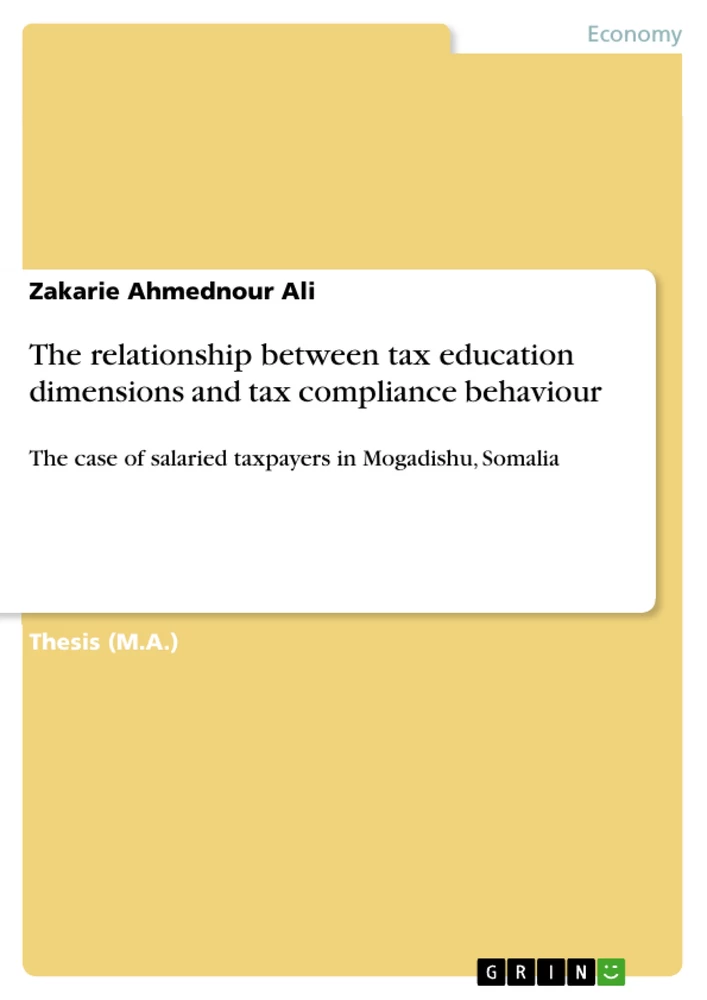
Table of Contents
1. Introduction
1.1 Background of the Study
1.2 Problem Statement
1.2.1 Practical Problem Statement
1.2.2 Theoretical Problem Statement
1.3 Research Questions
1.4 Research Objectives
1.5 Significance of the Study
1.6 Scope and Limitations of the Study
1.7 Definition of Key Terms
1.8 Structure of the Thesis
2. Literature Review
2.1 Introduction
2.2 Overview of the Tax System in Somalia
2.3 Tax Compliance
2.4 Determinants of Tax Compliance
2.5 Tax Education
2.5.1 Efforts for Tax learning
2.5.2 Awareness of tax laws
2.5.3 Understanding of Tax laws
2.6 Studies on Tax Education and Tax Compliance
2.7 Theoretical Model on Tax Education
2.8 Summary of the Chapter
3. Methodology
3.1 Introduction
3.2 Research Framework
3.3 Hypothesis Development
3.3.1 Efforts for Tax Learning and Tax Compliance Behaviour
3.3.2 Awareness of Tax Laws and Tax Compliance Behaviour
3.3.3 Understanding of Tax laws and Tax Compliance Behaviour
3.4 Operational Definitions and Measurement of Variables.
3.4.1 Tax Compliance Behaviour
3.4.2 Efforts for Tax Learning
3.4.3 Awareness of tax laws
3.4.4 Understanding of Tax laws
3.5 Research Design
3.6 Population of the Study
3.7 Samples and Sampling Techniques
3.8 Method of Data Collection
3.8.1 Data Collection Procedures
3.8.2 Questionnaire Design
3.8.3 Pilot Test
3.9 Techniques of Data Analysis
3.10 Summary of the Chapter
4. Research Findings
4.1 Introduction
4.2 Response Rate
4.3 Pre-Analysis Test
4.3.1 Factor Analysis
4.3.2 Reliability Analysis
4.3.3 Multicollinearity
4.3.4 Normality test
4.4 Demographic Information of the Respondents
4.5 Descriptive Statistics
4.5.1 Tax Compliance Behaviour
4.5.2 Efforts for Tax Learning
4.5.3 Awareness of Tax Laws
4.5.4 Understanding of Tax laws
4.6 Correlation Analysis
4.7 Multiple Regression Analysis
4.8 Summary of the Chapter
5. Discussion, Recommendations and Conclusion
5.1 Introduction
5.2 Discussion of Results
5.2.1 Relationship between Tax Education and Tax Compliance Behaviour
5.2.2 Summary of Results
5.3 Implication of the Study
5.3.1 Theoretical Implication
5.3.2 Practical Implementation
5.4 Limitation of the Study
5.5 Recommendation for Further Research
5.6 Conclusion
Research Objectives & Key Themes
This research aims to analyze the relationship between various dimensions of tax education and the tax compliance behavior of salaried taxpayers in Mogadishu, Somalia, in order to address the local problem of low tax compliance and limited tax-related knowledge.
- Impact of efforts for tax learning on compliance behavior.
- Influence of tax law awareness on voluntary tax compliance.
- Role of tax law understanding in fostering taxpayer compliance.
- Evaluation of the Somali tax system and current compliance challenges.
- Development of recommendations for policy improvement through enhanced tax education.
Excerpt from the Book
1.1 Background of the Study
Tax education is considered as one of the variables that can influence on tax compliance behaviour (Murphy, 2004). Tax education has been seen as a way to increase a citizen’s capability to grasp taxation laws and to increase their readiness to follow those laws (Kasipillai et al., 2003). Different researchers have studied the impact of tax education on tax compliance behaviour globally. For instance, Berhane (2011), observed that tax education enhances the tax compliance behaviour of the citizens, as they would be aware of their obligations and punishments for not following tax laws in Ethiopia. In Somalia, however, no studies have been conducted about tax education and tax compliance behaviour.
For many countries, taxes are the major source of income to finance the countries expenses such as providing the basic services for the country like building roads, railways, airports, and seaports and promoting the general welfare (Wonders, 2014). In the case of Somalia, the government is highly dependent on external grants as a source of income in additional to tax revenue because international grants represent 43% of the revenue of Somalia, which makes the government of Somalia highly vulnerable to foreign intervention (MOF, 2015).
The main sources of tax revenue are derived from the Mogadishu port and airport and the Bakara market, which is the biggest market in Somalia (Uluso, 2015). Taxes are imposed on: 1) imports and exports such as food, fuel, pharmaceutical products, petroleum products, livestock and agricultural products; 2) companies, for example Telecommunication and Remittance companies; and 3) the income of individuals (FGS Act 0005, 2014). Reports have indicated that the level of compliance among taxpayers is very low, and the actual amounts of taxes due have not been collected completely (MOF, 2015). In 2015, The Ministry of Finance of Somalia, MOF reported that the tax gap was 58.4% of the total estimated tax revenues, which indicates the level of compliance is very low. Although many factors that can affect compliance behaviour, tax education is probably the most significant in Somalia (Hussien, 2014).
Summary of Chapters
CHAPTER ONE INTRODUCTION: Provides the research background, defines the problem regarding low tax compliance in Somalia, and outlines the research questions and objectives.
CHAPTER TWO LITERATURE REVIEW: Examines existing theories and empirical studies regarding the relationship between tax education, tax law awareness, and tax compliance behavior.
CHAPTER THREE METHODOLOGY: Details the quantitative research design, sampling techniques, and data collection procedures used to gather responses from salaried taxpayers.
CHAPTER FOUR RESEARCH FINDINGS: Presents the analysis of the survey data, including descriptive statistics, correlation, and multiple regression results.
CHAPTER FIVE DISCUSSION, RECOMMENDATIONS AND CONCLUSION: Discusses the research findings, offers practical implications for policy makers in Somalia, and provides recommendations for future study.
Keywords
Tax Compliance Behaviour, Tax Education, Efforts for Tax Learning, Awareness of Tax Laws, Understanding of Tax Laws, Somalia, Tax Revenue, Compliance Factors, Quantitative Research, Multiple Regression, Tax Policy, Fiscal Administration, Tax Evasion, Tax Gap, Salaried Taxpayers.
Frequently Asked Questions
What is the primary focus of this study?
This research investigates the relationship between tax education (comprising efforts for learning, awareness of laws, and understanding of laws) and tax compliance behavior among salaried taxpayers in Mogadishu, Somalia.
What are the central themes of the research?
The central themes include the impact of tax knowledge on voluntary compliance, the identification of determinants for tax behavior, and the role of education in mitigating tax evasion in developing economies.
What is the core objective of this work?
The primary objective is to examine how different tax education variables influence the tax compliance behavior of salaried individuals and to determine which factors contribute most significantly to tax compliance in Somalia.
Which methodology was employed for the research?
The study utilized a quantitative research approach, employing survey questionnaires distributed to 400 taxpayers in Mogadishu, with data analyzed using multiple regression, descriptive statistics, and correlation analysis.
What topics are covered in the main body?
The main body covers the literature review on tax compliance models, the detailed research methodology, empirical data findings, and a final discussion that links the results to theoretical and practical implications for the Somali tax system.
Which keywords best characterize the study?
The key terms include Tax Compliance Behaviour, Tax Education, Efforts for Learning, Awareness of Tax Laws, Understanding of Tax Laws, and Somalia.
Why are "Efforts for Tax Learning" significant in this study?
The findings indicate that this variable had the most significant relationship with tax compliance behavior, highlighting that targeted educational efforts are critical for enhancing compliance in the Somali context.
How does the Somali government rely on tax revenue?
According to the research, the Somali government is highly dependent on international grants (43% of revenue), which makes tax revenue collection essential for economic independence and sustainable public service delivery.
What does the study suggest for policymakers?
Policymakers are advised to focus on comprehensive tax education programs and improving the government's image by reducing corruption to foster a better environment for voluntary tax compliance.
Are the findings in this study universally applicable?
While the study provides vital insights for Somalia, the author notes that local cultural, political, and economic factors are unique; therefore, results should be applied with caution in other regional contexts.
Ende der Leseprobe aus 100 Seiten
- nach oben
- Arbeit zitieren
- Zakarie Ahmednour Ali (Autor:in), 2017, The relationship between tax education dimensions and tax compliance behaviour, München, Page::Imprint:: GRINVerlagOHG, https://www.diplomarbeiten24.de/document/416801

neugierig - aktuell - relevant
Entdecken Sie hilfreiche Tipps und Tricks rund ums Studium!

Entdecken Sie hilfreiche Tipps und Tricks rund ums Studium!
Ihre Hausarbeit / Abschlussarbeit:

- - Publikation als E-Book und Buch
- - Hohes Honorar auf die Verkäufe
- - Für Sie komplett kostenlos - mit ISBN
- - Es dauert nur 5 Minuten
- - Jede Arbeit findet Leser

- © GRIN Publishing GmbH.
- Alle Inhalte urheberrechtlich geschützt. Kopieren und verbreiten untersagt.
- info@grin.com
- AGB
- Open Publishing
Der GRIN Verlag hat sich seit 1998 auf die Veröffentlichung akademischer eBooks und Bücher spezialisiert. Der GRIN Verlag steht damit als erstes Unternehmen für User Generated Quality Content. Die Verlagsseiten GRIN.com, Hausarbeiten.de und Diplomarbeiten24 bieten für Hochschullehrer, Absolventen und Studenten die ideale Plattform, wissenschaftliche Texte wie Hausarbeiten, Referate, Bachelorarbeiten, Masterarbeiten, Diplomarbeiten, Dissertationen und wissenschaftliche Aufsätze einem breiten Publikum zu präsentieren.
Kostenfreie Veröffentlichung: Hausarbeit, Bachelorarbeit, Diplomarbeit, Dissertation, Masterarbeit, Interpretation oder Referat jetzt veröffentlichen!
Folgen Sie GRIN auf


- GRIN Verlag GmbH
-
- Nymphenburger Str. 86
- 80636
- Munich, Deutschland
- +49 89-550559-0
- +49 89-550559-10
- info@grin.com
-
