
präsentiert von

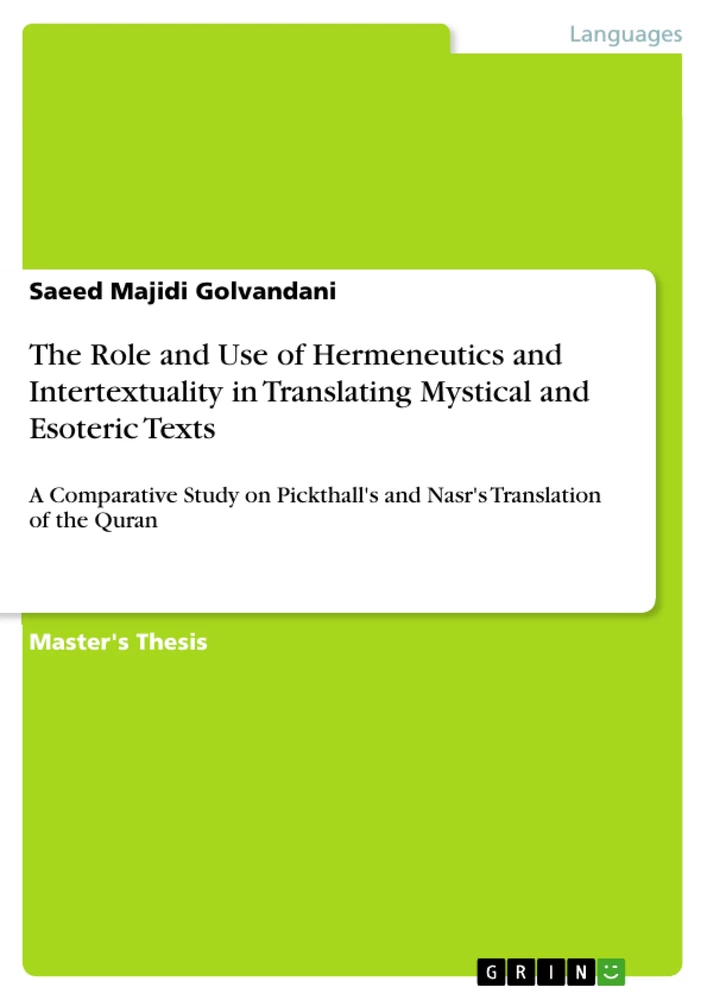
Table of Contents
Chapter 1: Introduction
1.1 Objectives and Significance of the Study
1.2 Scope and Area of the Study
1.3 Method and Instrument
1.4 Case Studies and Expected Outcome
1.5 Definition of Keywords
Chapter 2: Literature Review
2.1 Introduction
2.2 Origin of Hermeneutics
2.3 Hermeneutics: A Historical Instrument of Interpretation
2.4 Ancient Greek Hermeneutics
2.4.1 Aristotle
2.4.2 Poetry
2.5 Jewish Hermeneutics
2.5.1 Torah
2.5.2 Tanakh (Written Torah)
2.5.3 The Talmud (Oral Torah)
2.5.4 Midrash
2.5.5 Early Practices of Jewish Hermeneutics
2.5.5.1 Sadducee
2.5.5.2 Pharisees
2.5.5.3 Essenes
2.5.5.4 Hillel
2.6 Christian Hermeneutics
2.6.1 The Gospel
2.6.2 Early Christian Hermeneutics
2.6.3 Middle Ages
2.6.3.1 Eriugena
2.6.3.2 Anselm
2.6.3.3 Glossing
2.7 Quranic Hermeneutics
2.7.1 Early Islamic Hermeneutics
2.7.2 Important Figures and Approaches
2.7.3 Esoteric Interpretation
2.7.4 After the Prophet
2.7.4.1 Sunni View
2.7.4.2 Shiite View
2.8 Contemporary Hermeneutics
2.9 Hermeneutics and Quranic Translation
Chapter 3: Method
3.1. Introduction
3.2 A Philosophical Perspective
3.3 Steiner’s hermeneutic motion
3.3.1 Initial Trust
3.3.1.1 Pickthall
3.3.1.2 The Study Quran
3.3.2 Post-trust Motions
3.4 Case Studies
Chapter 4: Case Studies
4.1 Introduction
4.2 Case Study 1: Quranic Hermeneutics
4.2.1 Ta’wil
4.2.2 Send Down: Exclusivity of Meaning
4.2.3 The Mother of the Book
4.2.4 Knowledge of Mutashabihat
4.3 Case Study 2: Oral Tradition/Transition
4.3.1 Read & Recite
4.3.2 A Revival of Authentic Recitation
4.3.3 Translation and Original Message
4.3.4 Spiritual Touch
4.4 Case Study 3: Intertextuality in the Quran
4.4.1 Ruh al-Qudus: The Holy Spirit
4.4.2 The Inheritors of Earth
4.4.3 Names and Terminologies
4.4.4 Hapax Legomenon
4.5 Case Study 4: Quranic Imagery and Translation
4.5.1 Throne and Pedestal
4.5.2 The Light
4.5.3 Nazi’at: Angelic Mythos
Chapter 5: Conclusion
5.1 Introduction
5.2 Overview
5.3 Suggestions for Further Research
Objectives and Research Focus
This study investigates the translation of esoteric and mystical verses of the Quran, arguing that a deep understanding of hermeneutics and intertextuality is essential for producing accurate, functional, and natural translations for Western audiences. The research aims to bridge the gap between hermeneutical studies and translation studies by applying George Steiner's four-fold hermeneutic motion to provide a comparative analysis of the translations by Pickthall and Nasr.
- The role of intertextual hermeneutics in translating esoteric Quranic texts.
- A comparative analysis of the scholarly translations by Pickthall (1930) and Nasr (2015).
- The impact of translator background, belief, and culture on interpretation.
- The application of George Steiner's four-fold hermeneutic motion in Quranic translation.
- Challenges in maintaining the spiritual "theophany" of the Quran for Western readers.
Auszug aus dem Buch
3.3 Steiner’s Hermeneutic Motion
Steiner’s hermeneutic motion comprises of four major steps taken by the translator. The first stage of hermeneutic motions is the initial trust where all the aspects and motivation behind choosing a specific work for translation is investigated. The second stage is the aggression where there are an incursive, extractive, and invasive efforts for capturing the meaning and attaining a deep comprehension. The third stage is the incorporation where the translator tries to recreate the meaning in the realm of the target language while oscillating between two extremes of complete domestication that is closer to the target language and culture, and permanent strangeness that is turned toward the source language. The last stage of hermeneutic motion is compensation where the translator should correct the incomplete motion via bringing back the balance between two texts and languages that has happened as a result of disturbing the meaning in another language. This last stage is so important that without observing it the whole motion will be incomplete. According to Steiner, hermeneutic motion can be completed by taking heed of fidelity to the force, energy and function of the meaning, though he is rather equivocal in defining what fidelity practically means.
Summary of Chapters
Chapter 1: Introduction: Introduces the connection between hermeneutics and translation, setting the study's objective to examine the translation of esoteric Quranic verses through an intertextual lens.
Chapter 2: Literature Review: Provides a historical overview of hermeneutics in ancient Greek, Jewish, Christian, and Islamic traditions to establish the theoretical foundation.
Chapter 3: Method: Details the application of George Steiner’s four-fold hermeneutic motion as the primary research instrument for evaluating translations.
Chapter 4: Case Studies: Examines specific Quranic themes—including Ta’wil, oral tradition, intertextuality, and imagery—to demonstrate the practical application of the hermeneutical framework.
Chapter 5: Conclusion: Synthesizes the findings, confirming that intertextual hermeneutics enhances the functionality and naturalness of translations of religious texts.
Keywords
Hermeneutics, Intertextuality, Quranic Translation, Esoteric Interpretation, Mystical Texts, Comparative Study, Steiner’s Hermeneutic Motion, Pickthall, Seyyed Hossein Nasr, Exegesis, Oral Tradition, Ta’wil, Linguistic Fidelity, Functional Translation, Abrahamic Faiths.
Frequently Asked Questions
What is the primary focus of this research?
The work explores the pragmatic role of hermeneutics and intertextuality in the translation of esoteric and mystical verses of the Quran, aiming to improve the functionality and naturalness of these translations for Western readers.
What are the central themes addressed in the book?
Key themes include the comparative study of Pickthall’s and Nasr’s translations, the application of Steiner's hermeneutic motion, the role of oral tradition in Quranic revelation, and the use of intertextuality to preserve the original message's depth.
What is the main objective of the study?
The study seeks to demonstrate how a deep knowledge of hermeneutics and intertextuality facilitates a translator’s comprehension, resulting in more accurate and natural translations that respect the spiritual message of the Quran.
Which scientific methods are employed?
The research uses a comparative and descriptive analysis, applying George Steiner’s four-fold hermeneutic motion (initial trust, aggression, incorporation, and compensation) to analyze selected Quranic verses.
What content is covered in the main body?
The main body includes a thorough literature review of hermeneutical traditions across faiths, a methodological framework based on Steiner, and four detailed case studies focusing on specific Quranic themes like Ta’wil, oral transmission, intertextual links, and imagery.
How would you characterize this work through keywords?
The work is defined by terms such as Hermeneutics, Intertextuality, Quranic Translation, Esoteric Interpretation, and Steiner’s Hermeneutic Motion.
Why is the role of the translator's "habitus" significant in this study?
The study emphasizes that a translator's personal background, education, and spiritual mindset are inseparable from their interpretation, affecting how they translate sensitive theological concepts.
How does the book address the differences between "Tafsir" and "Ta'wil"?
It distinguishes "Tafsir" as literal or exoteric interpretation and "Ta'wil" as the allegorical or esoteric interpretation, arguing that both are essential for a complete understanding of the Quranic message.
Ende der Leseprobe aus 180 Seiten
- nach oben
- Arbeit zitieren
- Saeed Majidi Golvandani (Autor:in), 2017, The Role and Use of Hermeneutics and Intertextuality in Translating Mystical and Esoteric Texts, München, Page::Imprint:: GRINVerlagOHG, https://www.diplomarbeiten24.de/document/416976

neugierig - aktuell - relevant
Entdecken Sie hilfreiche Tipps und Tricks rund ums Studium!

Entdecken Sie hilfreiche Tipps und Tricks rund ums Studium!
Ihre Hausarbeit / Abschlussarbeit:

- - Publikation als E-Book und Buch
- - Hohes Honorar auf die Verkäufe
- - Für Sie komplett kostenlos - mit ISBN
- - Es dauert nur 5 Minuten
- - Jede Arbeit findet Leser

- © GRIN Publishing GmbH.
- Alle Inhalte urheberrechtlich geschützt. Kopieren und verbreiten untersagt.
- info@grin.com
- AGB
- Open Publishing
Der GRIN Verlag hat sich seit 1998 auf die Veröffentlichung akademischer eBooks und Bücher spezialisiert. Der GRIN Verlag steht damit als erstes Unternehmen für User Generated Quality Content. Die Verlagsseiten GRIN.com, Hausarbeiten.de und Diplomarbeiten24 bieten für Hochschullehrer, Absolventen und Studenten die ideale Plattform, wissenschaftliche Texte wie Hausarbeiten, Referate, Bachelorarbeiten, Masterarbeiten, Diplomarbeiten, Dissertationen und wissenschaftliche Aufsätze einem breiten Publikum zu präsentieren.
Kostenfreie Veröffentlichung: Hausarbeit, Bachelorarbeit, Diplomarbeit, Dissertation, Masterarbeit, Interpretation oder Referat jetzt veröffentlichen!
Folgen Sie GRIN auf


- GRIN Verlag GmbH
-
- Nymphenburger Str. 86
- 80636
- Munich, Deutschland
- +49 89-550559-0
- +49 89-550559-10
- info@grin.com
-
