
präsentiert von

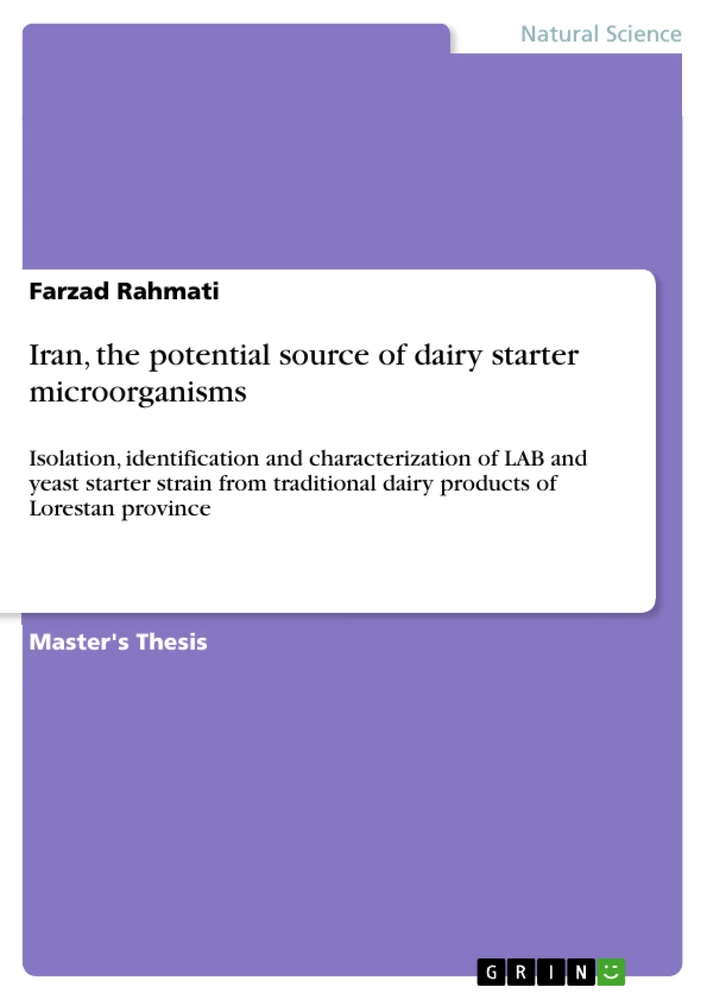
Table of Contents
1. Foundation and Backgrounds
1.1 Introduction
1.2 History
1.3 Dairy starter cultures
1.4 The reaction between dairy yeasts and LAB
1.5 Ecology of dairy starter bacteria
1.5.1 Lactic Starter cultures
1.5.1.1 Mesophilic starter cultures
1.5.1.2 Thermophilic starter cultures
1.5.2 Non-lactic starter cultures
1.6 Classification of starter microorganism
1.6.1 Dairy starter bacteria
1.6.1.1 Lactobacillus genus
1.6.1.2 Streptococcus genus
1.6.1.3 Leuconostoc genus
1.6.1.4 Lactococcus genus
1.6.1.5 Enterococcus genus
1.6.1.6 Brevibacterium genus
1.6.1.7 Pediococcus genus
1.6.2 Dairy starter yeasts
1.6.2.1 Saccharomyces genus
1.6.2.2 Candida genus
1.6.2.3 Schizosaccharomyces genus
1.6.2.4 Kluyveromyces genus
1.6.3 Dairy starter molds
1.6.3.1 Penicillium genus
1.6.3.2 Geotrichum genus
1.7 Starter cultures function
1.8 Grow starter bacteria in milk
1.9 Treating starter cultures in dairy products
1.10 Bacteriophages in the dairy industries
1.10.1 Control the number of phages
1.11 Factors affecting the performance of starter cultures
1.11.1 Internal factors
1.11.2 External factors
1.11.3 Subsidiary factors
2. Materials and methods
2.1 Appliance
2.2 Mediums
2.3 Antibiotics
2.4 Chemical solutions and organic materials
2.5 Carbohydrates
2.6 Dairy samples
2.7 Collection and coding of samples
2.8 Preparation, enrichment and isolation of the strains
2.9 Carbohydrate fermentation and hydrolysis of L-arginine, starch, casein and nitrate reduction
2.10 Investigating antibiotic resistance
2.11 Assessment of proteolytic and lipolytic activity
2.12 Evaluation of acid production
3. Results and discussion
3.1 Isolation and identification of strains
3.2 Antibiotic susceptibility of strains
3.3 Investigating proteolytic and lipolytic activities
3.4 Investigating acidification activity
4. Conclusion
Research Objectives and Focus
The research primarily aims to isolate, identify, and analyze the technological attributes of various starter strains, specifically Lactococcus, Lactobacillus, Bacillus, and Saccharomyces cerevisiae, from traditional dairy products produced in Iran's Lorestan province. The central goal is to establish a local, sustainable source of starter cultures to reduce dependence on expensive imports, optimize local dairy production, and preserve indigenous microbial biodiversity.
- Isolation and identification of native starter strains from traditional Iranian dairy samples.
- Evaluation of technological characteristics, including acid production, and proteolytic and lipolytic activity.
- Assessment of antibiotic susceptibility profiles to ensure safety and suitability for dairy industrial applications.
- Comparative analysis of physiological and biochemical traits to support the use of indigenous strains as commercial starter cultures.
Excerpt from the Book
1.1 Introduction
Milk and its products are valuable sources of water (87%), proteins (3.5%), fat (3.5%), carbohydrates (5% lactose) vitamins A ،D ،K ،E, B1 ،B2 ،B6 ،B12, elements such as calcium, phosphorus and energy [1]. Milk is a white liquid which produced from the mammalian. It`s the only source of mammalian foods of birth, and can even be a valuable source of food for adults, especially the elderly, and also plays an important role in nutrition due to calcium and protein. This product is the most valuable food ingredient and has almost all the ingredients necessary for human growth and survival; it is the only food that can balance more humanly nutritional needs and is considered as one of the most important sources of animal proteins.
It contains a variety of valuable vitamins and minerals, most notably calcium, which plays an essential role in the formation and strengthening of the bones, the health of teeth, hair and reducing cardiovascular diseases and is the enemy of cancer and type II diabetes [2]. Proteins are one of the most important components of milk and play an important role in the production of milk products. The nutritional, physiological and functional effects of proteins are one of the things that can be mentioned. Among the functional properties of proteins, including thermal stability for products requiring a thermal process, gel formation, especially for products such as cheese and fermented products, rheological properties, surface activity, and water absorption. Some bacteria that are cultivated in milk and convert lactose to lactic acid, which changes the flavor and milk texture. By converting lactose to lactic acid, the pH of the milk is reduced, thus preventing the growth and survival of pathogenic bacteria. On the other hand, reducing the amount of lactose allows the use of these products for people with lactose intolerance. In the fermentation industry, lactose is decomposed by the starter and new fermentation products such as yogurt and cheese are produced. Raw milk is a good environment for many microorganisms due to its sufficient moisture, near-neutral pH, and richness of the food.
Summary of Chapters
1. Foundation and Backgrounds: This chapter provides an overview of milk's nutritional importance, the history of starter culture usage in dairy production, and the ecological roles of specific bacteria, yeasts, and molds in fermentation.
2. Materials and methods: This section details the equipment, culture media, antibiotics, and specific protocols used for the isolation, identification, and biochemical characterization of the microbial strains.
3. Results and discussion: This chapter presents the experimental findings regarding the isolated strains' identification, antibiotic susceptibility, enzymatic activities (proteolytic and lipolytic), and acidification potential in various dairy substrates.
4. Conclusion: This chapter synthesizes the study's results, highlighting the potential of indigenous Iranian strains to serve as effective, locally-sourced alternatives to imported starter cultures for the domestic dairy industry.
Keywords
Dairy starter cultures, Lactic Acid Bacteria, Lactococcus, Lactobacillus, Saccharomyces, Bacillus, fermentation, proteolytic activity, lipolytic activity, acidification, antibiotic resistance, Lorestan province, traditional dairy products, indigenous strains, industrial application.
Frequently Asked Questions
What is the core focus of this thesis?
The thesis focuses on the isolation, identification, and characterization of indigenous starter microorganism strains, including bacteria and yeasts, obtained from traditional dairy products in Lorestan province, Iran.
What are the central thematic areas?
The main themes include microbial ecology, the technological properties of starter cultures (such as acid production and enzyme activity), and the industrial sustainability of using local versus imported starter cultures.
What is the primary goal of the research?
The primary goal is to identify and characterize local microbial strains to reduce the Iranian dairy industry's heavy dependence on expensive, imported industrial starter cultures.
What scientific methods were employed?
The study used phenotypic identification, biochemical tests (including carbohydrate fermentation, protease, and lipase activity assessment), antibiotic susceptibility testing via diffusion disks, and acidification tests in skim milk.
What does the main body cover?
The main body covers the theoretical foundation of starter cultures, the comprehensive materials and methods used for laboratory analysis, and a detailed discussion of the results obtained from the isolated strains.
Which keywords best describe the research?
Key terms include dairy starter cultures, Lactic Acid Bacteria, Lactococcus, Lactobacillus, Saccharomyces, Bacillus, fermentation, proteolytic activity, and acidification.
Why is antibiotic susceptibility tested in these starter strains?
It is tested to confirm that the strains do not carry or transfer antibiotic resistance genes, ensuring they are safe for use as dairy starter cultures and do not pose risks within the food chain.
How is lipolytic activity measured?
Lipolytic activity is measured by qualitative methods using a Nile blue indicator on media containing butter and other extracts, observing the formation of blue or green-blue fat colonies.
What are the specific roles of Lactobacillus in cheese production?
Lactobacillus species contribute to acid production, which is essential for texture formation, enhancing sensory attributes, and ensuring the safety of the final product by inhibiting pathogenic microbes.
What were the main findings regarding the performance of the chosen strains?
The research identified several strains of Lc. garvieae and Lc. lactis that demonstrated low antibiotic resistance and high enzymatic activity, suggesting their suitability for use as domestic starter or adjunct cultures in the dairy industry.
Ende der Leseprobe aus 73 Seiten
- nach oben
- Arbeit zitieren
- Farzad Rahmati (Autor:in), 2013, Iran, the potential source of dairy starter microorganisms, München, Page::Imprint:: GRINVerlagOHG, https://www.diplomarbeiten24.de/document/417153

neugierig - aktuell - relevant
Entdecken Sie hilfreiche Tipps und Tricks rund ums Studium!

Entdecken Sie hilfreiche Tipps und Tricks rund ums Studium!
Ihre Hausarbeit / Abschlussarbeit:

- - Publikation als E-Book und Buch
- - Hohes Honorar auf die Verkäufe
- - Für Sie komplett kostenlos - mit ISBN
- - Es dauert nur 5 Minuten
- - Jede Arbeit findet Leser

- © GRIN Publishing GmbH.
- Alle Inhalte urheberrechtlich geschützt. Kopieren und verbreiten untersagt.
- info@grin.com
- AGB
- Open Publishing
Der GRIN Verlag hat sich seit 1998 auf die Veröffentlichung akademischer eBooks und Bücher spezialisiert. Der GRIN Verlag steht damit als erstes Unternehmen für User Generated Quality Content. Die Verlagsseiten GRIN.com, Hausarbeiten.de und Diplomarbeiten24 bieten für Hochschullehrer, Absolventen und Studenten die ideale Plattform, wissenschaftliche Texte wie Hausarbeiten, Referate, Bachelorarbeiten, Masterarbeiten, Diplomarbeiten, Dissertationen und wissenschaftliche Aufsätze einem breiten Publikum zu präsentieren.
Kostenfreie Veröffentlichung: Hausarbeit, Bachelorarbeit, Diplomarbeit, Dissertation, Masterarbeit, Interpretation oder Referat jetzt veröffentlichen!
Folgen Sie GRIN auf


- GRIN Verlag GmbH
-
- Nymphenburger Str. 86
- 80636
- Munich, Deutschland
- +49 89-550559-0
- +49 89-550559-10
- info@grin.com
-
