
präsentiert von

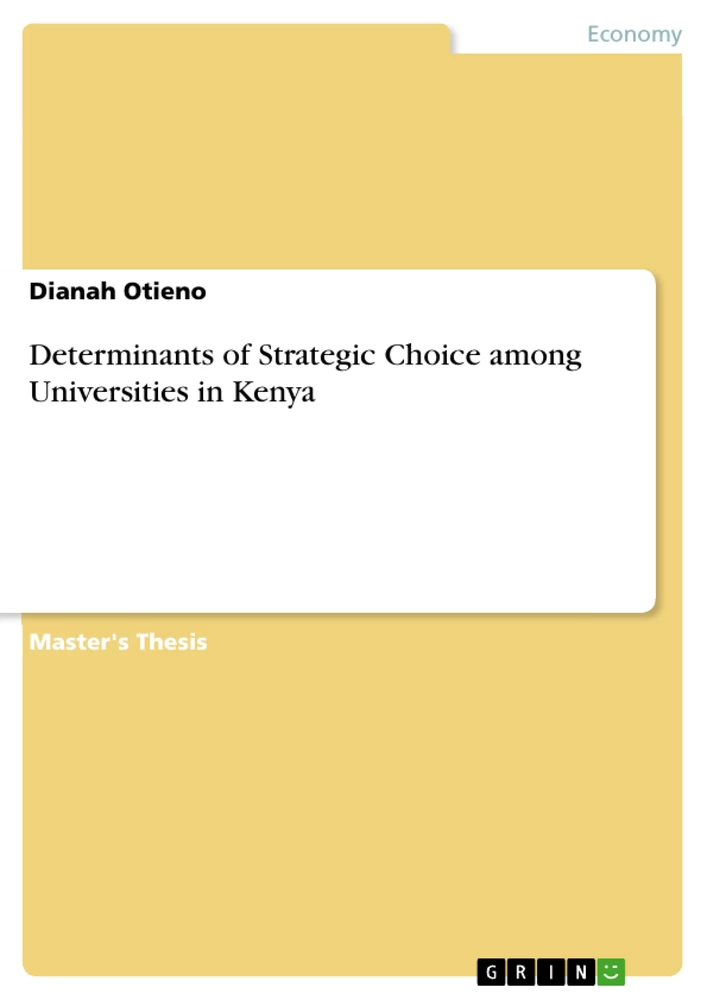
Table of Contents
1. Introduction
1.1 Background to the Study
1.1.1 Strategic Choice
1.1.2 Universities in Kenya
1.2 Research Problem
1.3 Research Objective
1.4 Value of the Study
2. Literature Review
2.1 Introduction
2.2 Theoretical foundation of the study
2.2.1 Contingency Theory
2.2.2 Resource Dependency Theory
2.3 Determinants of Strategic Choice
2.3.1 Resources Allocation
2.3.2 Organization Culture
2.3.3 Competitive Environment
2.3.4 Vision and Mission
2.4 Empirical Literature Review
2.5 Summary of Literature and Knowledge gap
3. Research Methodology
3.1 Introduction
3.2 Research Design
3.3 Population of the Study
3.4 Data Collection
3.5 Data Analysis
4. Data Analysis, Findings and Discussion
4.1 Introduction
4.2 Response Rate
4.3 Demographic Details
4.3.1 Description of the University
4.3.2 Number of Years the University has been in Existence
4.3.3 Level of Education
4.3.4 Length of service
4.4 Reliability Results
4.5 Responses to the Variables of the Study
4.5.1 Strategic Choice
4.5.2 Resources Allocation
4.5.3 Organization Culture
4.5.4 Competitive Environment
4.5.5 Vision and Mission
4.6 Factor Analysis of the Variables of the Study
4.6.1 Factor Analysis for Strategic Choice
4.6.2 Factor Analysis for Resources Allocation
4.6.3 Factor Analysis for Organization Culture
4.6.4 Factor Analysis for Competitive Environment
4.6.5 Factor Analysis for Vision and Mission
4.7 Correlation between the Study Variables
4.8 Regression Analysis
4.9 Discussion of Findings
5. Summary, Conclusion and Recommendations
5.1 Introduction
5.2 Summary of findings
5.3 Conclusion
5.4 Recommendations of the study
5.5 Limitations of the study
5.6 Suggestions For further Research
Research Objectives and Themes
The primary objective of this research is to identify the determinants of strategic choice among universities in Kenya. The study addresses how factors such as resource allocation, organizational culture, competitive environment, and institutional vision and mission influence the strategic direction of these educational institutions in a dynamic and increasingly competitive sector.
- Strategic choice and formulation in higher education institutions.
- Influence of resource dependency and contingency factors on strategic decisions.
- Analysis of organizational culture, specifically the prevalence of clan culture in Kenyan universities.
- The impact of competitive environmental forces and internal vision/mission alignment.
- Methodological application of cross-sectional survey design and quantitative regression analysis.
Excerpt from the Book
1.1 Background to the Study
Strategic choice is a fundamental element in any decision-making process of an organization. Organizations operate in a complex, dynamic and unpredictable environment and face the challenge of choosing which strategy to adopt to cope with this fast paced scenario. Therefore, organizations need to evaluate the existing options available to them before making a choice on the best strategy to implement. Strategic choice concerns the decisions regarding organizations future and their response to the dynamic environment (Macmillan & Tampoe, 2000). Selection of the best strategy that enables an organization to achieve its objectives is however not as easy as it sounds. Some strategies are often more appropriate than others since no single strategy can relate to all conditions all the times. Nutt (2010) observes that nearly six of ten choices are unsuccessful apparently because managers fail to acknowledge the demands posed. The choices made therefore will determine the success or failure of an organization. Successful organizations are therefore, those that consider their strategic positions and carefully select relevant strategies (Johnson, Whittington & Scholes, 2008).
The study adopted the contingency theory and resource dependency theory. These theories present the argument that organizations can interpret their environment, make suitable choices and strategically respond. The contingency theory explains how contingent factors like tasks, environment and culture affect the organizations function and design (Islam & Hu, 2012). This theory allows analysis of a situation and determination of what variables influence the decision with which organizations are concerned. It predicts that the degree of an organization’s efficiency will depend on the degree to which its strategies match the contingencies it faces (Islam & Hu, 2012). On the other hand, the resource dependency theory asserts that organizations depend on other stakeholders within its environment to acquire limited resources for survival. It provides powerful explanation of organizational actions and outcomes by conceptualizing strategic choice as an organizational action to align it with the environment (Casciaro & Piskorski, 2005).
Summary of Chapters
CHAPTER ONE: INTRODUCTION: Introduces the concept of strategic choice within the context of the dynamic and competitive higher education sector in Kenya and outlines the study's research objectives.
CHAPTER TWO: LITERATURE REVIEW: Explores theoretical foundations including contingency and resource dependency theories, while reviewing factors like resource allocation, culture, and competitive environments.
CHAPTER THREE: RESEARCH METHODOLOGY: Describes the cross-sectional survey research design, population identification, data collection instruments, and the analytical techniques used in the study.
CHAPTER FOUR: DATA ANALYSIS, FINDINGS AND DISCUSSION: Details the demographic profiles, reliability statistics, and the results of the factor and regression analyses conducted on the primary data.
CHAPTER FIVE: SUMMARY, CONCLUSION AND RECOMMENDATIONS: Synthesizes the study's findings, provides conclusions regarding the determinants of strategic choice, and offers recommendations for policy and further research.
Keywords
Strategic Choice, Kenyan Universities, Resource Allocation, Organization Culture, Competitive Environment, Vision and Mission, Contingency Theory, Resource Dependency Theory, Higher Education, Strategy Formulation, Management, Organizational Performance, Clan Culture, Quantitative Analysis, SPSS.
Frequently Asked Questions
What is the core focus of this research project?
The study examines the fundamental determinants that influence how universities in Kenya make strategic choices, particularly given the dynamic and competitive nature of the modern education environment.
What are the central thematic areas covered in this work?
The research explores four key pillars: resource allocation, organizational culture, the competitive environment, and the institutional vision and mission.
What is the primary research objective?
The primary goal is to identify and analyze the determinants of strategic choice among the 71 accredited universities in Kenya.
What methodology was utilized to conduct this research?
The study employed a cross-sectional survey research design, gathering primary data via structured questionnaires, which was then analyzed using descriptive statistics, factor analysis, and multiple regression models in SPSS.
What does the main body of the work analyze?
The main body investigates the relationship between independent variables (resources, culture, competition, vision/mission) and the dependent variable (strategic choice) to determine their statistical significance in the decision-making process.
Which keywords best describe this study?
Key terms include Strategic Choice, Kenyan Universities, Organization Culture, Resource Allocation, and Competitive Environment.
What did the study reveal about the organizational culture of Kenyan universities?
The findings revealed that these institutions predominantly adopt a 'clan culture,' which emphasizes teamwork, cohesiveness of values, and long-term human resource development.
Are all hypothesized determinants statistically significant?
The regression analysis indicated that while organizational culture and vision/mission are statistically significant in explaining strategic choice, resource allocation and the competitive environment were found to be less significant predictors in the specific context of this study.
Ende der Leseprobe aus 62 Seiten
- nach oben
- Arbeit zitieren
- Dianah Otieno (Autor:in), 2017, Determinants of Strategic Choice among Universities in Kenya, München, Page::Imprint:: GRINVerlagOHG, https://www.diplomarbeiten24.de/document/419811

neugierig - aktuell - relevant
Entdecken Sie hilfreiche Tipps und Tricks rund ums Studium!

Entdecken Sie hilfreiche Tipps und Tricks rund ums Studium!
Ihre Hausarbeit / Abschlussarbeit:

- - Publikation als E-Book und Buch
- - Hohes Honorar auf die Verkäufe
- - Für Sie komplett kostenlos - mit ISBN
- - Es dauert nur 5 Minuten
- - Jede Arbeit findet Leser

- © GRIN Publishing GmbH.
- Alle Inhalte urheberrechtlich geschützt. Kopieren und verbreiten untersagt.
- info@grin.com
- AGB
- Open Publishing
Der GRIN Verlag hat sich seit 1998 auf die Veröffentlichung akademischer eBooks und Bücher spezialisiert. Der GRIN Verlag steht damit als erstes Unternehmen für User Generated Quality Content. Die Verlagsseiten GRIN.com, Hausarbeiten.de und Diplomarbeiten24 bieten für Hochschullehrer, Absolventen und Studenten die ideale Plattform, wissenschaftliche Texte wie Hausarbeiten, Referate, Bachelorarbeiten, Masterarbeiten, Diplomarbeiten, Dissertationen und wissenschaftliche Aufsätze einem breiten Publikum zu präsentieren.
Kostenfreie Veröffentlichung: Hausarbeit, Bachelorarbeit, Diplomarbeit, Dissertation, Masterarbeit, Interpretation oder Referat jetzt veröffentlichen!
Folgen Sie GRIN auf


- GRIN Verlag GmbH
-
- Nymphenburger Str. 86
- 80636
- Munich, Deutschland
- +49 89-550559-0
- +49 89-550559-10
- info@grin.com
-
