
präsentiert von

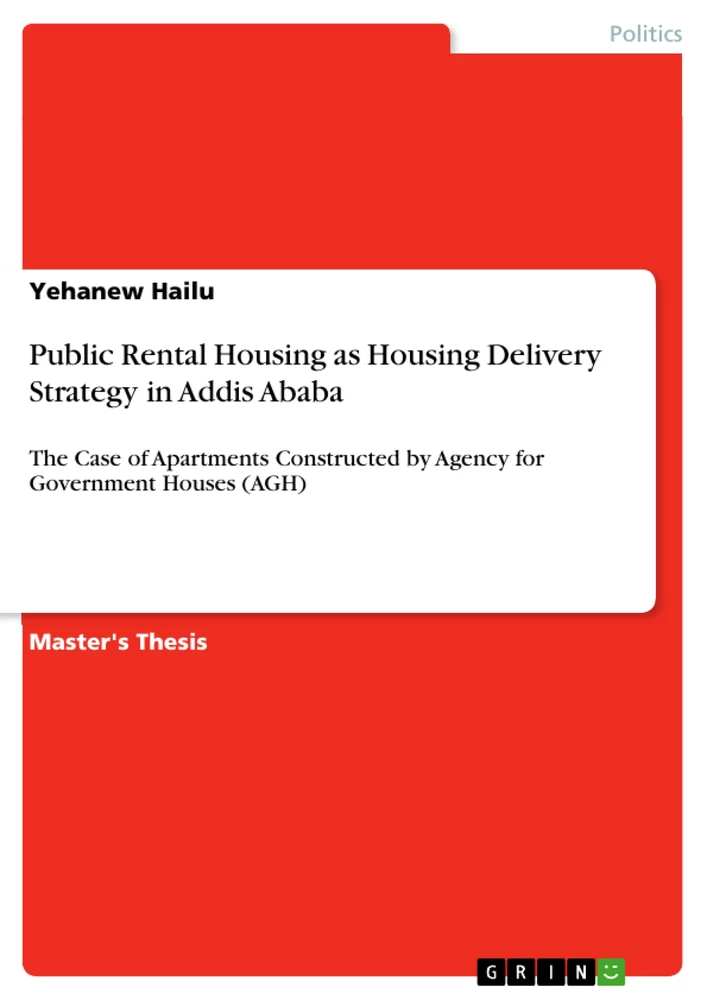
Table of Contents
Chapter One
BACKGROUND
1.1 Motivation and Relevance
1.2 The Research Approach
1.3 Scope of the Study
1.4 Research Questions
1.5 Organization of the Research
Chapter Two
RESEARCH METHODOLOGY
2.1 Research Design
2.2 Choice of Methods
2.3 Selection of Cases
2.4 Purpose of Data Collection
2.4.1 Development of rental housing sector in Addis Ababa
2.4.2 Development process of AGH apartments
2.4.3 Tenants socio-economic profile
2.4.4 Management performance
2.5 Type of Data
2.5.1 Primary data
2.5.2 Secondary data
2.6 Sources of Data
2.6.1 Primary data sources
2.6.2 Secondary data sources
2.7 Data Collection Techniques
2.7.1 Primary data
2.7.2 Secondary data
2.8 Data Analysis Technique
2.9 Validity and Reliability
2.9.1 Construct validity
2.9.2 External validity
2.9.3 Reliability
Chapter Three
LITERATURE REVIEW
3.1 Home Ownership and Rental Housing
3.1.1 Housing ownership and tenure
3.1.2 Rental housing
3.2 Public Rental Housing (PRH)
3.2.1 What is Public Rental Housing (PRH)?
3.2.2 Global development of PRH
3.2.3 Who are the target group of PRH?
3.2.4 Financing mechanisms for PRH
3.2.5 Management of PRH
3.2.6 Purpose of PRH
3.2.7 Advantages of PRH
3.2.8 Disadvantages of PRH
3.3 Measuring Public Rental Housing Management
3.3.1 Measuring management performance
3.3.2 Measuring management performance through tenant satisfaction
3.3.3 Approaches to conducting tenant satisfaction survey
3.4 Global Experiences of PRH
3.4.1 Public Rental Housing Provisions in Honk Kong
3.4.2 South Korea ‘National Public Rental Housing program’
Chapter Four
CONTEXTUAL BACKGROUND
4.1 Introducing Ethiopia and its Capital; Addis Ababa
4.2 Rental Housing in the Context of Housing Development of Ethiopia
4.2.1 The rental housing sector before 1974 (imperial period)
4.2.2 The rental housing sector from 1974-1991(socialist oriented military government (Derg) period
4.2.3 The rental housing sector from 1991 to current day
4.3 Current Rental Housing Market in Addis Ababa
4.3.1 The private rental sector
4.3.2 The public rental sector
4.4 Current Public Housing Programs
4.4.1 Financing Mechanisms
4.4.2 Land provision
Chapter Five
CASE STUDY
5.1 Agency for Government Houses (AGH)
5.1.1 Establishment of AGH
5.1.2 Current organizational structure
5.1.3 Housing Management
5.1.4 Basic resources (land and finance)
5.1.5 Rent setting
5.1.6 Tenant selection criteria and target group
5.1.7 Condition of AGH houses
5.1.8 Current power and duties of AGH
5.1.9 Current government policies and strategies regarding PRH and AGH specifically
5.2 Case Studies
5.2.1 Apartments constructed by AGH
5.2.2 Apartment 16 (Case for development process)
5.2.3 7 apartments (Case for tenants socio-economic profile and measuring tenants satisfaction)
Chapter Six
FINDINGS AND IMPLICATIONS
6.1 Analysing the Context
6.1.1 Current government housing policy as a challenge
6.1.2 Existing resources as a potential
6.1.3 Why Public Rental Housing?
6.2 Development Process of Apartments Constructed by AGH
6.2.1 Actors and their roles
6.2.2 Program and target group
6.2.3 Financing mechanism
6.2.4 Land acquisition
6.2.5 Program evaluation
6.3 Current Tenants of the Apartments
6.3.1 Tenants and target group of the agency
6.3.2 Socio-Economic profile of current tenants
6.3.3 Should current tenants continue renting?
6.4 Management Performance of AGH
6.4.1 Housing and services provided by AGH
6.4.2 Repair and Maintenance
6.4.3 Should the management continue?
Chapter Seven
PROPOSED STRATEGY
7.1 The Way Forward
7.2 Background
7.3 Program Design
7.3.1 Type of programs
7.4 Development Process
7.4.1 Actors involved
7.4.2 Land preparation
7.4.3 Financing mechanism
7.4.4 Target group
7.4.5 Occupation period
7.5 Management
7.6 Further Research Issues
Objectives and Topics
The primary objective of this research is to evaluate the existing Public Rental Housing (PRH) stock under the Agency for Government Houses (AGH) in Addis Ababa to identify potentials and challenges. The study aims to propose a new, workable development strategy for the sector by analyzing its historical development, management performance, and the socio-economic profile of current tenants, ultimately addressing the housing shortage in the city.
- Historical context of Public Rental Housing in Ethiopia and Addis Ababa.
- Evaluation of AGH management performance and tenant satisfaction.
- Analysis of the development process and financing mechanisms for PRH.
- Investigation of socio-economic characteristics of current apartment tenants.
- Strategic recommendations for the future development and management of the PRH sector.
Excerpt from the Book
4.3.1 The private rental sector
In general, the rental market constitutes the biggest housing market in the city with a share of 58.77% of the total. Within this, the private rental market accounted for 268,779 units or 37%. The response of the private rental sector is purely market driven. As a result of the serious shortage of housing in the city and the increasing cost of life, individual house owners had to respond to the opportunity by renting part of their house, their service quarters or building new rooms within their premise. The flexibility of the units, going from a single room with shared facilities to full-fledged independent multi-story houses, has made houses in this sector the most preferable by many mainly households (Abraham W.et.al, 2015). Such a dramatic increase from 62,528 units in 1994 to 222,384 units in 2007 is seen in 4.1.
Summary of Chapters
Chapter One: BACKGROUND: This chapter introduces the motivation for studying Public Rental Housing in Addis Ababa, outlining the research approach, objectives, and specific research questions.
Chapter Two: RESEARCH METHODOLOGY: This section details the research design and methodology, emphasizing the case study approach used to investigate the AGH apartments and data collection techniques.
Chapter Three: LITERATURE REVIEW: This chapter covers theoretical frameworks regarding home ownership, rental housing definitions, global development of PRH, and methodologies for measuring management performance through tenant satisfaction.
Chapter Four: CONTEXTUAL BACKGROUND: This chapter provides an overview of Ethiopia and Addis Ababa, tracing the history of the rental housing sector through three distinct administrative periods.
Chapter Five: CASE STUDY: This chapter focuses on the Agency for Government Houses (AGH), providing a deep dive into its establishment, organizational structure, management, and detailed analysis of selected case study apartment blocks.
Chapter Six: FINDINGS AND IMPLICATIONS: This chapter presents the research findings regarding current policies, the potential of existing resources, and an analysis of why PRH is a necessary housing strategy for Addis Ababa.
Chapter Seven: PROPOSED STRATEGY: The final chapter synthesizes the study's findings to propose a future strategy for the development of the PRH sector, including recommendations for program design, financing, and management.
Keywords
Public rental housing, Addis Ababa, Agency for Government Houses, housing management, development process, tenant satisfaction, social housing, housing policy, urban housing, housing delivery, housing stock, rental market, socio-economic profile, Ethiopia, rent setting.
Frequently Asked Questions
What is the primary focus of this thesis?
The thesis examines the current Public Rental Housing (PRH) stock managed by the Agency for Government Houses (AGH) in Addis Ababa to find potentials for future sector development.
What are the core themes explored in the work?
The study centers on the historical development of PRH, the organizational management of AGH, tenant socio-economic profiles, and strategies for improving future housing delivery.
What is the main research objective?
The goal is to propose a workable, renewed strategy for developing Public Rental Housing in Addis Ababa as an alternative to the currently dominant home-ownership promotion policies.
Which methodology is employed in this study?
The research uses an exploratory case study method, incorporating primary data from interviews and questionnaires, alongside secondary data from archival documents and literature reviews.
What topics are discussed in the main chapters?
The chapters cover the historical evolution of rental housing, global experiences of PRH, the current organizational structure and performance of AGH, and a proposed strategic framework for the future.
Which keywords characterize this research?
Key terms include Public Rental Housing, Agency for Government Houses, Addis Ababa, housing management, development process, and tenant satisfaction.
How is the performance of AGH measured in the study?
Performance is measured primarily through tenant satisfaction surveys and qualitative interviews with agency staff, focusing on maintenance quality, responsiveness, and service delivery.
What specific challenges does the AGH face?
The study identifies significant challenges, including a lack of clear target group identification, ineffective maintenance protocols, outdated rent setting standards, and an overall lack of organizational focus on new construction.
How does the author view the future of rental housing in Addis Ababa?
The author argues that PRH is a necessary tool to stabilize the housing market and provide temporary, affordable shelter for low-income populations, migrants, and young workers.
Ende der Leseprobe aus 169 Seiten
- nach oben
- Arbeit zitieren
- Yehanew Hailu (Autor:in), 2016, Public Rental Housing as Housing Delivery Strategy in Addis Ababa, München, Page::Imprint:: GRINVerlagOHG, https://www.diplomarbeiten24.de/document/420481

neugierig - aktuell - relevant
Entdecken Sie hilfreiche Tipps und Tricks rund ums Studium!

Entdecken Sie hilfreiche Tipps und Tricks rund ums Studium!
Ihre Hausarbeit / Abschlussarbeit:

- - Publikation als E-Book und Buch
- - Hohes Honorar auf die Verkäufe
- - Für Sie komplett kostenlos - mit ISBN
- - Es dauert nur 5 Minuten
- - Jede Arbeit findet Leser

- © GRIN Publishing GmbH.
- Alle Inhalte urheberrechtlich geschützt. Kopieren und verbreiten untersagt.
- info@grin.com
- AGB
- Open Publishing
Der GRIN Verlag hat sich seit 1998 auf die Veröffentlichung akademischer eBooks und Bücher spezialisiert. Der GRIN Verlag steht damit als erstes Unternehmen für User Generated Quality Content. Die Verlagsseiten GRIN.com, Hausarbeiten.de und Diplomarbeiten24 bieten für Hochschullehrer, Absolventen und Studenten die ideale Plattform, wissenschaftliche Texte wie Hausarbeiten, Referate, Bachelorarbeiten, Masterarbeiten, Diplomarbeiten, Dissertationen und wissenschaftliche Aufsätze einem breiten Publikum zu präsentieren.
Kostenfreie Veröffentlichung: Hausarbeit, Bachelorarbeit, Diplomarbeit, Dissertation, Masterarbeit, Interpretation oder Referat jetzt veröffentlichen!
Folgen Sie GRIN auf


- GRIN Verlag GmbH
-
- Nymphenburger Str. 86
- 80636
- Munich, Deutschland
- +49 89-550559-0
- +49 89-550559-10
- info@grin.com
-
