
präsentiert von

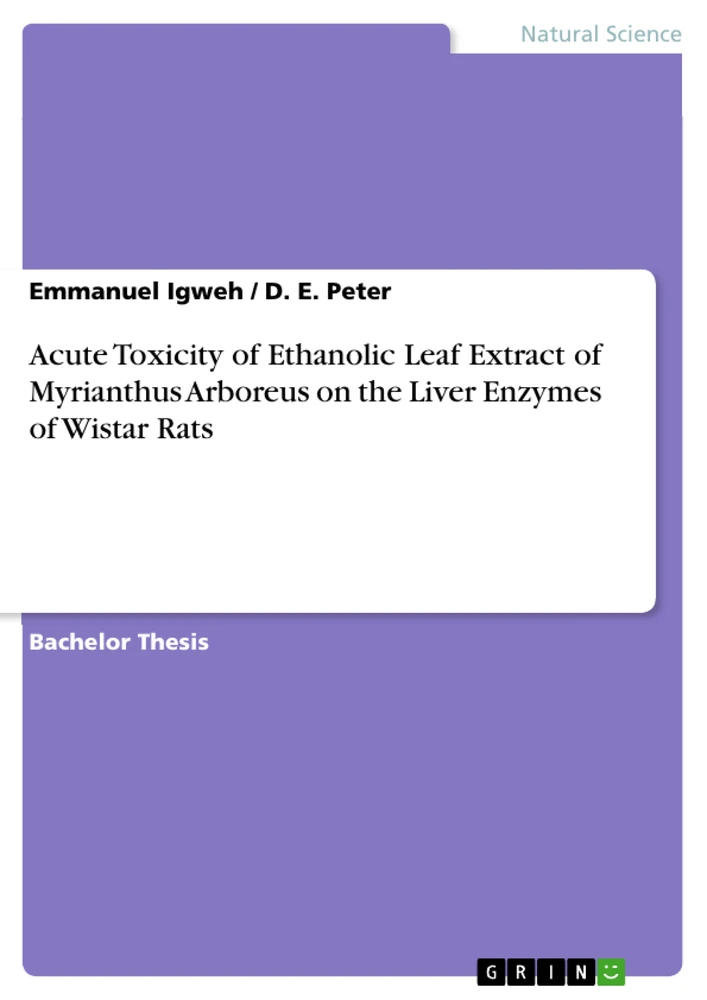
Table of Contents
1.0 INTRODUCTION AND LITERATURE REVIEW
1.1 PLANT PRODUCTS AS DRUGS
1.2 TOXICITY TESTS
1.3 THE USE OF EXPERIMENTAL ANIMAL
1.4 THE LIVER
1.4.1 STRUCTURE AND FUNCTIONS
1.4.2 HEPATOTOXICITY
1.4.3 DETOXIFICATION FUNCTION OF THE LIVER
1.4.4 MARKER MOLECULES AND LIVER TOXICITY
1.5 MYRIANTHUS ARBOREUS, ORIGIN, CLASSIFICATION AND MEDICAL USES
1.6 TAXONOMICAL CLASSIFICATION OF MYRIANTHUS ARBOREUS
1.7 COMPOSITIONS AND PHYTOCHEMISTRY OF MYRIANTHUS ARBOREUS
1.8 AIM AND OBJECTIVES OF THE STUDY
2.0 MATERIALS AND METHODS
2.1 MATERIALS
2.1.1 LABORATORY APPARATUS
2.1.2 LABORATORY EQUIPMENT
2.1.3 CHEMICAL AND REAGENTS
2.1.4 SOURCE OF ANIMAL
2.2 METHODS
2.2.1 COLLECTION AND IDENTIFICATION OF PLANT MATERIALS
2.2.2 PREPARATION OF EXTRACT
2.2.3 PHYTOCHEMICAL SCREENING
2.2.4 SELECTION AND SORTING (INTO SIZE AND SEX) OF ANIMALS
2.2.5 RECONSTITUTION OF EXTRACT
2.2.6 LETHAL DOSE (LD50) STUDY OF THE ETHANOLIC LEAF EXTRACTS OF MYRIANTHUS ARBOREUS
2.2.7 EXPERIMENTAL DESIGN
2.2.8. SACRIFICE OF THE ANIMALS
2.2.9 BIOCHEMICAL PARAMETERS STUDIES
2.2.10 HISTOPATHOLOGICAL STUDIES
2.2.11 STATISTICAL ANALYSIS
3.1 RESULTS
3.2 RESULTS OF HISTOLOGICAL ANALYSIS
3.3 RESULTS OF PHYTOCHEMICAL SCREENING OF THE CRUDE LEAF POWDER OF MYRIANTHUS ARBOREUS (P.BEAUV)
4.0 DISCUSSIONS AND CONCLUSIONS
4.1 DISCUSSIONS
4.2 CONCLUSIONS
4.3 LIMITATIONS TO THE STUDY
4.4 SUGGESTIONS FOR FURTHER RESEARCH
Objectives & Scope
This research aims to evaluate the acute (14-day) toxicological effects of ethanolic leaf extracts of Myrianthus arboreus on the liver function and enzyme profiles of Wistar rats. The study assesses the potential safety or hepatotoxicity of the plant material through biochemical assays and histological examinations.
- Determination of the lethal dose (LD50) of Myrianthus arboreus in Wistar rats.
- Qualitative phytochemical screening of the plant's secondary metabolites.
- Quantitative analysis of liver marker enzymes: Alkaline phosphatase (ALP), Alanine transaminase (ALT), and Aspartate aminotransferase (AST).
- Histopathological analysis of liver tissue to identify potential cellular damage, such as steatosis or necrosis.
Excerpt from the Book
1.1 PLANT PRODUCTS AS DRUGS
Historically, natural products have remained the major and potent source of new drugs. The use of natural products with therapeutic properties is as ancient as human civilisation and, for a long time, mineral, plant and animal products were the main sources of drugs (De Pasquale, 1984). Natural products which included herbs, animals and minerals serve as the lead compounds for the development of new medicines and also for the treatment and prevention of various human ailments.(Prasanth et al., 2014).
Plant products are classified into; Primary metabolites and secondary metabolite.
i. Primary metabolites are chemical compounds (metabolites) that are essential for the basic metabolism (anabolism and catabolism) of the plants, which results to assimilation, respiration, transport, and differentiation. They incudes starch, amino acids, lipids, minerals and vitamins.
ii. Secondary metabolites are chemical compounds (metabolites) that are non-essential for the basic metabolism of the plants. These products accounts for the colour, flavours and smells and are source of fine chemicals such as drugs, insecticides, dyes, fragrances and the phyto-medicines found in medicinal plants. They include alkaloids, glycosides, terpenes/isoprenoids, amines and phenolics.
Summary of Chapters
1.0 INTRODUCTION AND LITERATURE REVIEW: Provides an overview of natural products as drug sources, the role of toxicity testing, and the anatomy and function of the liver.
2.0 MATERIALS AND METHODS: Details the experimental setup, collection of Myrianthus arboreus, biochemical assay procedures, and statistical methods used.
3.1 RESULTS: Presents the biochemical data showing the effects of the extract on liver enzyme levels in rats after 7 and 14 days.
3.2 RESULTS OF HISTOLOGICAL ANALYSIS: Examines liver tissue slides to determine the presence of pathological changes such as necrosis or steatosis.
3.3 RESULTS OF PHYTOCHEMICAL SCREENING OF THE CRUDE LEAF POWDER OF MYRIANTHUS ARBOREUS (P.BEAUV): Outlines the qualitative presence of secondary metabolites like alkaloids and flavonoids.
4.0 DISCUSSIONS AND CONCLUSIONS: Evaluates the findings, concluding that the extract demonstrates potential hepatotoxicity at certain dosages and durations, while offering suggestions for future research.
Keywords
Myrianthus arboreus, Acute Toxicity, Wistar Rats, Liver Enzymes, Hepatotoxicity, Alkaline Phosphatase, Alanine Transaminase, Aspartate Aminotransferase, Phytochemical Screening, Histopathology, Xenobiotic, Biochemical Analysis, Medicinal Plants, LD50, Steatosis
Frequently Asked Questions
What is the core subject of this research?
The research investigates the acute 14-day toxicity of the ethanolic leaf extract of the medicinal plant Myrianthus arboreus on liver enzymes in Wistar rats.
What are the primary thematic areas?
The themes include plant-based pharmacology, liver hepatotoxicity, biochemical marker assessment, and histopathological tissue analysis.
What is the main research objective?
The main objective is to determine the LD50, perform qualitative phytochemical screening, and measure the impact of the extract on ALP, ALT, and AST levels in rat livers.
Which scientific methods are applied?
The study utilizes cold maceration for extraction, ELISA methods for enzyme assay, and H&E staining for histopathological tissue processing.
What does the main body cover?
It covers the literature review on liver function, detailed experimental procedures, empirical results from biochemical tests, and visual interpretations of histological tissue changes.
Which keywords characterize this work?
Key terms include Myrianthus arboreus, acute toxicity, hepatotoxicity, liver enzymes, and histopathology.
What did the histological analysis reveal regarding the extract?
The analysis revealed microvesicular steatosis at lower dosages and ballooning hepatic necrosis at higher dosages and longer administration durations.
Is the ethanolic leaf extract considered safe?
The study concludes that the extract is unsafe at all doses tested over a 14-day period, though doses below 500mg/kg over 7 days might be considered safe.
Why were Wistar rats selected for this study?
Wistar rats are popular model organisms in laboratory research due to their physiological similarities to humans, allowing for extrapolative results.
What did the phytochemical screening detect?
The screening identified several bioactive compounds, including alkaloids, flavonoids, tannins, anthraquinones, triterpenoids, carbohydrates, cardenolide, and saponins.
Ende der Leseprobe aus 34 Seiten
- nach oben
- Arbeit zitieren
- Emmanuel Igweh (Autor:in), D. E. Peter (Autor:in), 2015, Acute Toxicity of Ethanolic Leaf Extract of Myrianthus Arboreus on the Liver Enzymes of Wistar Rats, München, Page::Imprint:: GRINVerlagOHG, https://www.diplomarbeiten24.de/document/420613

neugierig - aktuell - relevant
Entdecken Sie hilfreiche Tipps und Tricks rund ums Studium!

Entdecken Sie hilfreiche Tipps und Tricks rund ums Studium!
Ihre Hausarbeit / Abschlussarbeit:

- - Publikation als E-Book und Buch
- - Hohes Honorar auf die Verkäufe
- - Für Sie komplett kostenlos - mit ISBN
- - Es dauert nur 5 Minuten
- - Jede Arbeit findet Leser

- © GRIN Publishing GmbH.
- Alle Inhalte urheberrechtlich geschützt. Kopieren und verbreiten untersagt.
- info@grin.com
- AGB
- Open Publishing
Der GRIN Verlag hat sich seit 1998 auf die Veröffentlichung akademischer eBooks und Bücher spezialisiert. Der GRIN Verlag steht damit als erstes Unternehmen für User Generated Quality Content. Die Verlagsseiten GRIN.com, Hausarbeiten.de und Diplomarbeiten24 bieten für Hochschullehrer, Absolventen und Studenten die ideale Plattform, wissenschaftliche Texte wie Hausarbeiten, Referate, Bachelorarbeiten, Masterarbeiten, Diplomarbeiten, Dissertationen und wissenschaftliche Aufsätze einem breiten Publikum zu präsentieren.
Kostenfreie Veröffentlichung: Hausarbeit, Bachelorarbeit, Diplomarbeit, Dissertation, Masterarbeit, Interpretation oder Referat jetzt veröffentlichen!
Folgen Sie GRIN auf


- GRIN Verlag GmbH
-
- Nymphenburger Str. 86
- 80636
- Munich, Deutschland
- +49 89-550559-0
- +49 89-550559-10
- info@grin.com
-
