
präsentiert von

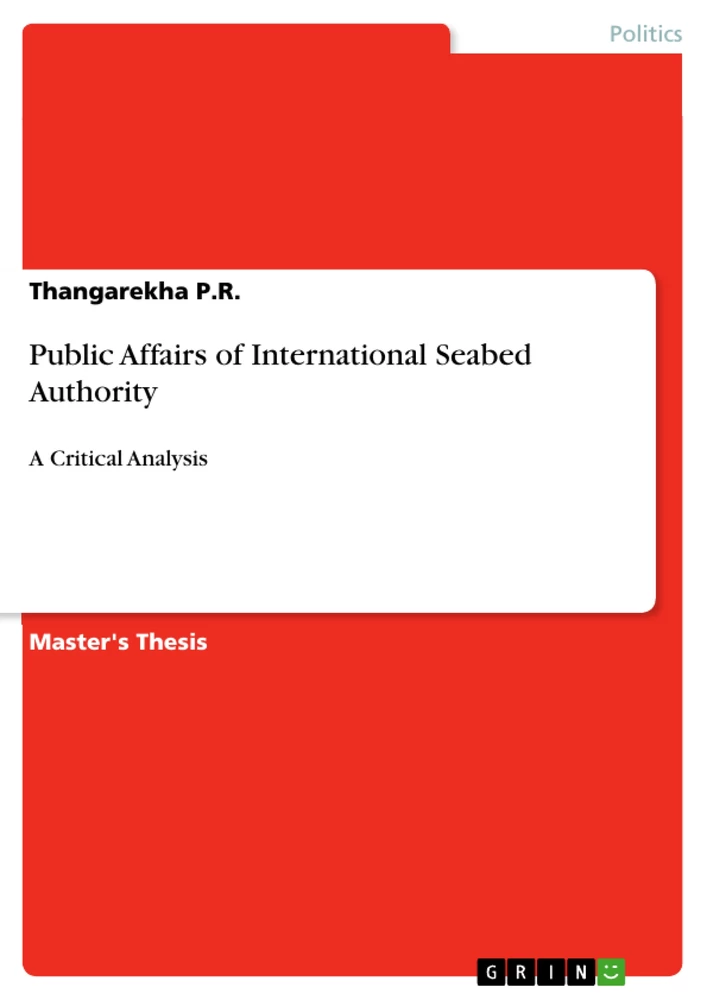
Table of Contents
1. Introduction
1.1. Brief Description
1.2. Object and Scope
1.3. Research Questions
1.4. Hypotheses
1.5. Research Methodology
1.6. Chapterization
2. Origin and Development of the International Seabed Authority
2.1. Preliminary Consideration of UNCLOS 1982
2.2. The Convention and Its Public Affairs
2.3. History of International Seabed Authority
2.4. Nature and Fundamental Principles of the Authority
2.5. Organs of the Authority
2.6. International Fund
2.7. Legal Status, Privileges and Immunities
2.8. International Public Affairs of the Authority
3. Powers and Functions of International Seabed Authority
3.1. Legal Regime of Exclusive Economic Zone
3.2. Legal Regime of Continental Shelf
3.3. Functions of ISA in the Exploitation of Continental Shelf
4. Public Affairs of International Seabed Authority
4.1. Economic Argument
4.2. Shelf Entitlement for Landlocked States and Geographically Disadvantaged States
4.3. Rights of the Landlocked States
4.4. Rights of the Geographically Disadvantaged States
4.5. Revenue Sharing in the Convention among the States
4.6. LLGDS and Revenue Sharing
4.7. ITLOS and Least Developed States and Landlocked States
4.8. International Law of the Sea and Indian Maritime Legislation
4.9. Maritime Boundaries of India
4. Conclusion
Research Objectives & Topics
The research aims to analyze the public affairs of the International Seabed Authority (ISA) regarding the exploration and exploitation of deep-sea resources. It investigates the Authority's role in securing the economic interests of developing, landlocked, and geographically disadvantaged states, ensuring an equitable distribution of benefits within the framework of UNCLOS 1982.
- The origin and organizational structure of the International Seabed Authority.
- Legal frameworks governing the Exclusive Economic Zone and Continental Shelf.
- Economic implications for developing and landlocked nations under UNCLOS.
- The function of ITLOS in settling maritime disputes and protecting resource rights.
- The impact of international maritime law on Indian legislation and territorial boundaries.
Excerpt from the Book
1.1. Brief Description
The percentage of wealth contained beneath the high seas has become more and more apparent in recent years. Hence the technologically developed nations are interested to invest and exploit the resources in the high seas. Consequently it brings inequality in economic status among the international community. As a result, it poses sever problems to the developing countries and also to the landlocked or geographically disadvantaged states.
To carry out the activities in the Area beyond national jurisdiction, for the benefit of mankind, the International Seabed Authority has established. The Authority performs number of public affairs activities for the benefit of developing states: (i) regulates the activities in the seabed, ocean floor and subsoil thereof beyond the limits of national jurisdiction (the Area); and (ii) administers the resources of the Area.
Summary of Chapters
1. Introduction: Provides the study's background, research objectives, research questions, hypothesis, and the methodology used to analyze the ISA.
2. Origin and Development of the International Seabed Authority: Examines the historical context, the establishment of the ISA under UNCLOS 1982, and its internal organizational structure.
3. Powers and Functions of International Seabed Authority: Discusses the legal regimes of the Exclusive Economic Zone and the Continental Shelf, outlining the powers and regulatory functions of the ISA.
4. Public Affairs of International Seabed Authority: Analyzes the economic arguments and the specific rights granted to landlocked and geographically disadvantaged states, including revenue sharing mechanisms and ITLOS involvement.
4. Conclusion: Summarizes the findings and suggests that the UN should further strengthen the ISA to better serve the interests of developing, least developed, and landlocked nations.
Key Terms
International Seabed Authority, ISA, UNCLOS, Law of the Sea, High Seas, Deep Seabed, Common Heritage of Mankind, Exclusive Economic Zone, EEZ, Continental Shelf, Landlocked States, Geographically Disadvantaged States, Revenue Sharing, ITLOS, Maritime Legislation
Frequently Asked Questions
What is the primary focus of this research?
The research focuses on the "Public Affairs" of the International Seabed Authority, specifically how it functions as a regulatory body to secure the economic welfare of developing nations within the framework of UNCLOS 1982.
What are the core research themes?
Key themes include the institutional development of the ISA, the governance of seabed resources, equitable resource benefit sharing, and the legal rights afforded to landlocked and geographically disadvantaged states.
What is the ultimate research objective?
The objective is to evaluate whether the ISA effectively balances the interests of technologically advanced nations with the economic development needs of weaker states, and to provide recommendations for strengthening its role.
Which methodology is employed in the work?
The study utilizes a combination of primary sources, such as international conventions (UN Charter, UNCLOS), legislative guides, and legal principles, alongside secondary sources like academic books and journals.
What does the main body of the work cover?
The main chapters cover the origin of the Authority, its powers regarding the Continental Shelf and EEZ, the specific economic rights of developing states, and the role of the International Tribunal for the Law of the Sea (ITLOS).
Which keywords characterize this study?
Major keywords include International Seabed Authority, UNCLOS, Common Heritage of Mankind, EEZ, Continental Shelf, and Revenue Sharing.
How does the Authority protect the interests of landlocked states?
The Authority is mandated to distribute financial benefits derived from seabed mining equitably, ensuring that landlocked and least developed states receive support to counterbalance their lack of coastal resources.
What role does the 'Common Heritage of Mankind' play in the study?
This principle is the foundation for the ISA's operations, dictating that deep-sea resources should not be subject to appropriation by individual states but should be managed for the benefit of all, particularly the economically weaker nations.
How does India feature in the research?
The work provides a specific case study on Indian maritime legislation, India's role as a 'Pioneer Investor' in seabed mining, and its efforts to define its maritime boundaries and safeguard its national interests post-UNCLOS.
What is the importance of the Review Conference mentioned?
The Review Conference is a mechanism to assess whether the provisions governing exploration and exploitation are meeting their aims, specifically whether they have effectively shared benefits with developing states.
Ende der Leseprobe aus 87 Seiten
- nach oben
- Arbeit zitieren
- Thangarekha P.R. (Autor:in), 2015, Public Affairs of International Seabed Authority, München, Page::Imprint:: GRINVerlagOHG, https://www.diplomarbeiten24.de/document/426847

neugierig - aktuell - relevant
Entdecken Sie hilfreiche Tipps und Tricks rund ums Studium!

Entdecken Sie hilfreiche Tipps und Tricks rund ums Studium!
Ihre Hausarbeit / Abschlussarbeit:

- - Publikation als E-Book und Buch
- - Hohes Honorar auf die Verkäufe
- - Für Sie komplett kostenlos - mit ISBN
- - Es dauert nur 5 Minuten
- - Jede Arbeit findet Leser

- © GRIN Publishing GmbH.
- Alle Inhalte urheberrechtlich geschützt. Kopieren und verbreiten untersagt.
- info@grin.com
- AGB
- Open Publishing
Der GRIN Verlag hat sich seit 1998 auf die Veröffentlichung akademischer eBooks und Bücher spezialisiert. Der GRIN Verlag steht damit als erstes Unternehmen für User Generated Quality Content. Die Verlagsseiten GRIN.com, Hausarbeiten.de und Diplomarbeiten24 bieten für Hochschullehrer, Absolventen und Studenten die ideale Plattform, wissenschaftliche Texte wie Hausarbeiten, Referate, Bachelorarbeiten, Masterarbeiten, Diplomarbeiten, Dissertationen und wissenschaftliche Aufsätze einem breiten Publikum zu präsentieren.
Kostenfreie Veröffentlichung: Hausarbeit, Bachelorarbeit, Diplomarbeit, Dissertation, Masterarbeit, Interpretation oder Referat jetzt veröffentlichen!
Folgen Sie GRIN auf


- GRIN Verlag GmbH
-
- Nymphenburger Str. 86
- 80636
- Munich, Deutschland
- +49 89-550559-0
- +49 89-550559-10
- info@grin.com
-
