
präsentiert von

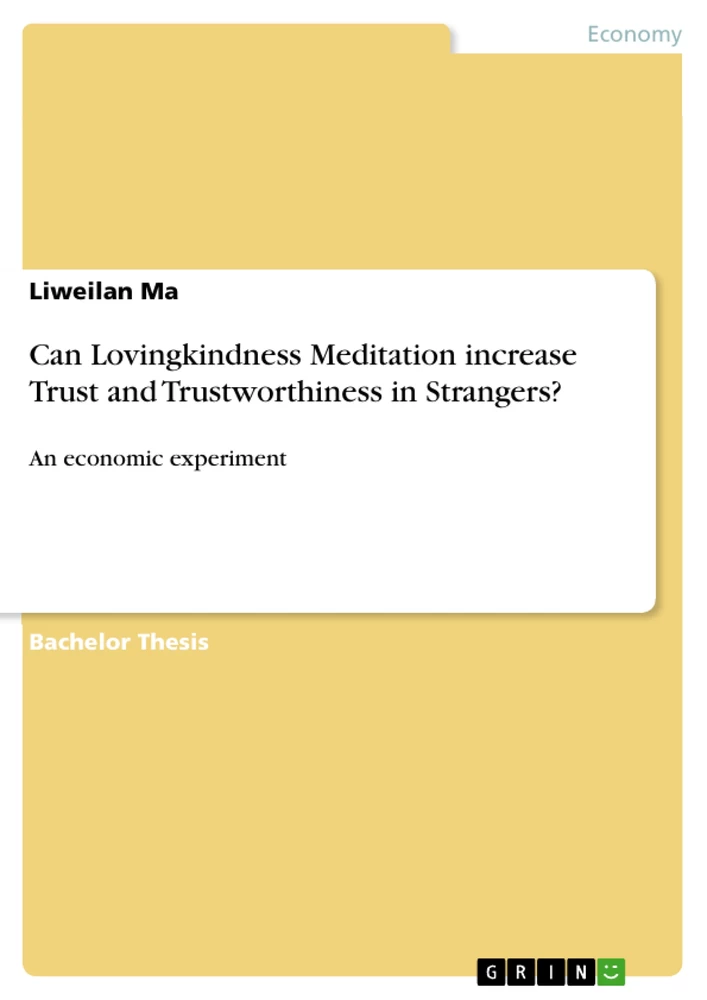
Table of Contents
1. Introduction
2. Lovingkindness Meditation and Trust – a Literature Review
2.1. Meditation and Lovingkindness
2.2. Trust and Trustworthiness
3. Experiment – Design, Measures & Hypotheses
3.1. Research Question
3.2. Participants
3.3. Procedure
3.4. Measures of Trust, Trustworthiness and Kindness
3.5. Hypotheses about Trust, Trustworthiness, Kindness and Game Outcome
3.6. Questionnaire
3.7. Further Steps to Conduct the Experiment
4. Discussion about Limitations and Future Directions
5. Conclusion
Research Objectives and Themes
This study aims to investigate whether the traditional Buddhist practice of "lovingkindness meditation" (LKM) can be used as an effective intervention to increase trust, trustworthiness, and kindness in individuals, particularly in interactions with strangers.
- The impact of LKM on social-economic behaviors.
- Distinction between laboratory-based short-term and intervention-based long-term LKM practices.
- Measurement of trust and trustworthiness using modified game-theoretic experimental designs.
- Evaluation of kindness through incentivized donation behaviors.
- Analysis of the correlation between meditation duration and prosocial behavioral outcomes.
Excerpt from the Book
1. Woche: Bedingungslose Liebe
Ich war etwa dreizehn Jahre alt, als mein Vater mich zur Seite nahm und mir etwas sagte, das mein Leben von Grund auf verändern sollte. Wir saßen damals in seiner alten Rostlaube in einer Seitenstraße eines der ärmsten Vororte Londons.
Er wandte sich mir zu und sagte: „Ganz gleich, was du in deinem Leben tun wirst, mein Sohn, meine Tür steht dir immer offen.“
Als Teenager begriff damals nicht wirklich, was er damit meinte. Aber ich hatte schon verstanden, dass es ziemlich wichtig war, weshalb ich mir diese Worte wohl gemerkt habe. Drei Jahre später war mein Vater tot.
Als ich im Nordosten Thailands Mönch wurde, dachte ich über diesen Satz meines Vaters nach. In meiner Kindheit hatten wir in einer winzigen Sozialwohnung in einem heruntergekommenen Londoner Viertel gewohnt; wahrlich kein besonderes Haus, dessen Tür da offen stehen sollte. Aber ich verstand, dass mein Vater etwas ganz anderes gemeint hatte.
Er hatte die schönste Liebeserklärung, die ich kenne, wie ein Schmuckstück in ein Samttuch verpackt: „Ganz gleich, was du in deinem Leben tun wirst, mein Sohn, eines solltest du wissen: Die Tür meiner Herzen wird dir immer offen stehen.“
Summary of Chapters
1. Introduction: The author discusses the vital role of kindness and trust in the socio-economic world and introduces the hypothesis that LKM can foster these qualities.
2. Lovingkindness Meditation and Trust – a Literature Review: This chapter reviews core concepts of Buddhist meditative practices, specifically LKM, alongside established psychological and economic definitions and measurements of trust and trustworthiness.
3. Experiment – Design, Measures & Hypotheses: This chapter details the experimental design, including participant recruitment, treatment procedures for lab and field groups, the structure of the trust game, and the specific hypotheses to be tested.
4. Discussion about Limitations and Future Directions: The author addresses the inherent limitations of the study design, such as the challenges of field experiments, and provides suggestions for further research combining LKM with other mindfulness practices.
5. Conclusion: The study concludes by summarizing the potential of LKM to mitigate societal isolation and offering policy recommendations for the integration of meditation techniques in academic and professional settings.
Keywords
Lovingkindness, Meditation, Metta, Trust in Strangers, Trust Games, Prosocial Behavior, Trustworthiness, Kindness, Economics, Buddhism, Social Capital, Experimental Design, Interventions, Behavioral Economics, Positive Psychology.
Frequently Asked Questions
What is the primary objective of this thesis?
The study aims to determine if the Buddhist practice of lovingkindness meditation (LKM) can measurably increase trust, trustworthiness, and kindness in strangers through experimental economic methods.
What are the core thematic fields of this work?
The work bridges social psychology and behavioral economics, focusing on the effects of meditative interventions on human cooperation and prosocial preferences.
What is the central research question?
The central question driving the analysis is: "Can LKM increase trust and trustworthiness in strangers?"
Which scientific methodology is employed?
The author proposes an incentivized economic experiment utilizing a modified version of the Berg et al. (1995) trust game and a donation game to assess behavioral changes.
What topics are covered in the main body?
The main body covers the literature review on meditation and trust, the detailed setup of experimental treatments (lab vs. 8-week intervention), the formulation of testable hypotheses, and a discussion on potential experimental limitations.
Which keywords characterize this work?
Key terms include Lovingkindness, Metta, Trust Games, Prosocial Behavior, and Behavioral Economics.
Why did the author choose a 2,500-year-old practice for an economic study?
The author identifies that contemporary societal challenges, such as isolation and distrust, require the implementation of proven traditional techniques that foster emotional balance and cooperation.
How is the "trustworthiness" of the participants measured?
Trustworthiness is operationalized in the trust game as the willingness of the receiver to return a specific amount of money (10€) to the sender, evaluated via a polar "yes/no" choice to reduce complexity.
Ende der Leseprobe aus 53 Seiten
- nach oben
- Arbeit zitieren
- Liweilan Ma (Autor:in), 2016, Can Lovingkindness Meditation increase Trust and Trustworthiness in Strangers?, München, Page::Imprint:: GRINVerlagOHG, https://www.diplomarbeiten24.de/document/426992

neugierig - aktuell - relevant
Entdecken Sie hilfreiche Tipps und Tricks rund ums Studium!

Entdecken Sie hilfreiche Tipps und Tricks rund ums Studium!
Ihre Hausarbeit / Abschlussarbeit:

- - Publikation als E-Book und Buch
- - Hohes Honorar auf die Verkäufe
- - Für Sie komplett kostenlos - mit ISBN
- - Es dauert nur 5 Minuten
- - Jede Arbeit findet Leser

- © GRIN Publishing GmbH.
- Alle Inhalte urheberrechtlich geschützt. Kopieren und verbreiten untersagt.
- info@grin.com
- AGB
- Open Publishing
Der GRIN Verlag hat sich seit 1998 auf die Veröffentlichung akademischer eBooks und Bücher spezialisiert. Der GRIN Verlag steht damit als erstes Unternehmen für User Generated Quality Content. Die Verlagsseiten GRIN.com, Hausarbeiten.de und Diplomarbeiten24 bieten für Hochschullehrer, Absolventen und Studenten die ideale Plattform, wissenschaftliche Texte wie Hausarbeiten, Referate, Bachelorarbeiten, Masterarbeiten, Diplomarbeiten, Dissertationen und wissenschaftliche Aufsätze einem breiten Publikum zu präsentieren.
Kostenfreie Veröffentlichung: Hausarbeit, Bachelorarbeit, Diplomarbeit, Dissertation, Masterarbeit, Interpretation oder Referat jetzt veröffentlichen!
Folgen Sie GRIN auf


- GRIN Verlag GmbH
-
- Nymphenburger Str. 86
- 80636
- Munich, Deutschland
- +49 89-550559-0
- +49 89-550559-10
- info@grin.com
-
