
präsentiert von

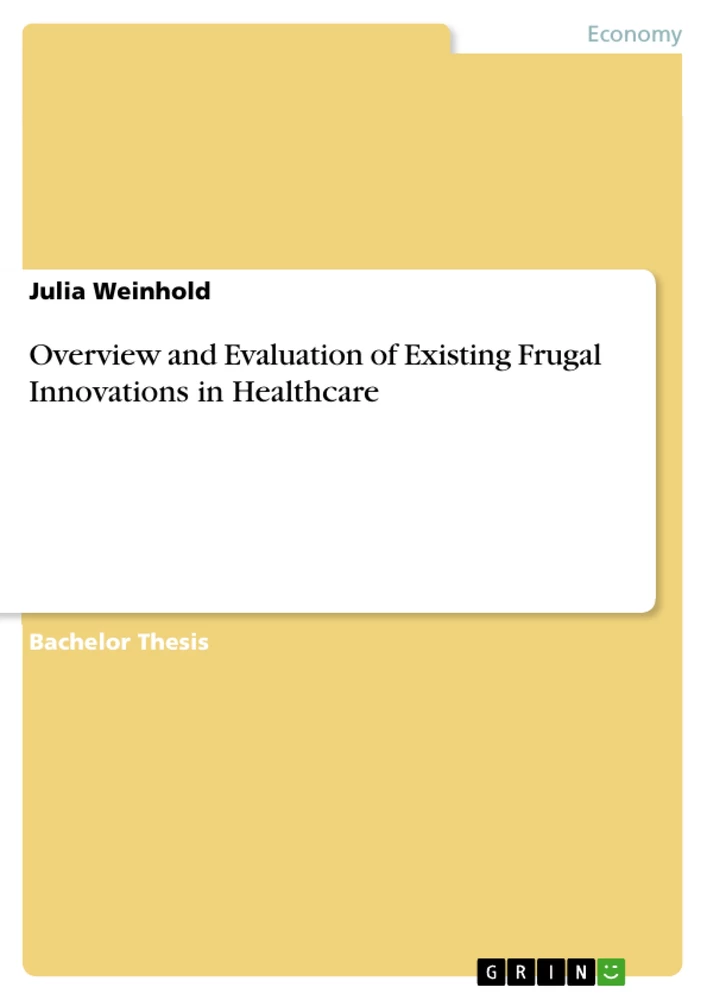
Table of Contents
1 Conceptual background
1.1 Definition of innovation
1.2 Characteristics of frugal innovations
1.2.1 Interrelation with other innovation concepts
1.3 Relevance of frugal innovations in healthcare with focus on India
2 Scientific state of the art
3 Empirical investigation
3.1 Methodology
3.1.1 Research process
3.1.2 Data analysis
3.2 Profiles of ten frugal innovations in healthcare
3.2.1 Aravind Eye Care System
3.2.2 MAC Series
3.2.3 Embrace Infant Warmer
3.2.4 Stanford-Jaipur Knee
3.2.5 Leveraged Freedom Chair (LFC)
3.2.6 Kit Yamoyo
3.2.7 Pratt Pouch
3.2.8 EMRI 108 services
3.2.9 Operation ASHA
3.2.10 Tata Swach
3.3 Evaluation of the data
4 Discussion
5 Conclusion and implications
Objectives & Core Topics
This thesis examines the concept of frugal innovation within the healthcare sector, specifically focusing on how established organizations of various types successfully commercialize low-cost, high-value medical solutions to address under-supply in developing countries. The research investigates business model patterns, financing, and network strategies to provide a foundation for better understanding the implementation of these innovations.
- Theoretical definitions of frugal innovation and its relation to other concepts
- Empirical analysis of ten specific case studies in global healthcare
- Evaluation of business model elements like value proposition and flow of funds
- Comparison of developer types: grassroot, university spin-offs, and MNC subsidiaries
- Strategic importance of networks and local adaptation in resource-constrained markets
Excerpt from the Book
3.2.1 Aravind Eye Care System
Type of innovation: product, process, organisational, ophthalmology Company: Aravind Eye Care System; non-profit organisation Year of foundation: 1976 Type of innovator: grassroot Target market: India
Value proposition:
• prevent people from cataract related blindness without reference to their social and financial background
• treatment includes checking for diabetes and refraction to prevent posterior complications; guarantee low infection rates [GM10][Ara]
Flow of funds:
• by 2006, the cost of cataract surgery at Aravind was about $18 per person, including the intra-ocular lens (IOL) [RT07]
• hybrid business model: 40 % of Aravind’s patients finance the treatment and service for the remaining 60 % of non-paying, or not fully paying patients [RT07]
• the generated surplus stays in the system for constant improvements, like the establishment of Aurolab, scientific research and expansion [RT07]
Internal competences and processes:
• in fiscal year 2016 Aravind Clinics treated 4.7 million outpatients and performed over 408.220 surgeries [Ara]
• in-house manufacturing capacity Aurolab produces high quality intra-ocular lenses at an affordable cost and sells the excess to other hospitals and NGOs in India [RT07]
• a surgeon can perform up to 50 surgeries a day because of their standardised process flow of patients [Ara15]
Network:
• 11 Aravind hospitals across India [GN90]
• in Madurai, India the Lions Aravind Institute Of Community Ophthalmology (LAICO) offers training for doctors and nurses on low rates and knowledge transfer with other eye hospitals in India and 70 more countries [GM10][Lio]
• Vision centres, mobile eye camps in remote areas, offer full examination services and only send patients in need of surgery to city hospitals, to enable an effective resource allocation within the system [Ara][GM10]
Summary of Chapters
1 Conceptual background: Defines innovation and the core characteristics of frugal innovation, while contextualizing the significance of this concept within the Indian healthcare sector.
2 Scientific state of the art: Reviews current academic literature on frugal innovations, highlighting the shift toward low-cost, high-value models in resource-constrained environments.
3 Empirical investigation: Outlines the research methodology and presents detailed profiles of ten selected frugal healthcare innovations, followed by an analytical evaluation of the collected data.
4 Discussion: Analyzes the findings regarding scalability, the role of cross-sectoral partnerships, and the specific challenges faced by different types of innovators.
5 Conclusion and implications: Summarizes the key insights, emphasizes the potential of reverse innovation, and suggests future research directions for affordable healthcare solutions.
Keywords
Frugal Innovation, Healthcare, Developing Countries, Business Models, Sustainability, Value Proposition, Medical Devices, Grassroot Innovators, Reverse Innovation, Scalability, India, Resource-constrained, Social Value, Cost Reduction, Network Strategy
Frequently Asked Questions
What is the core focus of this thesis?
The work focuses on the overview and evaluation of existing frugal innovations in the healthcare sector, analyzing how these solutions are successfully implemented in resource-constrained markets.
Which thematic fields are central to the research?
Central themes include the definition of frugal innovation, the analysis of specific business models, the role of various innovator types, and the strategic importance of networks and financial sustainability.
What is the primary objective of this work?
The aim is to provide a precise understanding of frugal innovations in healthcare and to draw greater scientific and entrepreneurial attention to strategies that improve medical supply in developing nations.
Which scientific method is utilized?
The study employs a qualitative, empirical approach, conducting a comprehensive literature review and utilizing case study research to analyze ten distinct examples of frugal healthcare innovations.
What topics are discussed in the main part of the thesis?
The main part provides theoretical foundations, a review of the state of the art, detailed empirical profiles of ten selected cases, and a final evaluation of these cases based on business model and organizational criteria.
What are the most significant keywords for this work?
Key terms include Frugal Innovation, Healthcare, Business Models, Developing Countries, Scalability, Reverse Innovation, and Social Embeddedness.
How does the Aravind Eye Care System manage to provide affordable treatment?
Aravind utilizes a hybrid business model where 40% of paying patients subsidize the care for the 60% of patients who cannot afford full costs, combined with high-efficiency surgical processes.
What role do university spin-offs play in this research?
University spin-offs, such as those that developed the Embrace Infant Warmer or the Pratt Pouch, are highlighted as key contributors that often develop solutions in industrialised countries for later use in developing markets.
Why is the role of networks considered critical in the study?
Networks are crucial for market success; they facilitate distribution, help reduce costs, and allow innovators to leverage existing infrastructure in the target countries to reach remote populations.
Ende der Leseprobe aus 61 Seiten
- nach oben
- Arbeit zitieren
- Julia Weinhold (Autor:in), 2017, Overview and Evaluation of Existing Frugal Innovations in Healthcare, München, Page::Imprint:: GRINVerlagOHG, https://www.diplomarbeiten24.de/document/431621

neugierig - aktuell - relevant
Entdecken Sie hilfreiche Tipps und Tricks rund ums Studium!

Entdecken Sie hilfreiche Tipps und Tricks rund ums Studium!
Ihre Hausarbeit / Abschlussarbeit:

- - Publikation als E-Book und Buch
- - Hohes Honorar auf die Verkäufe
- - Für Sie komplett kostenlos - mit ISBN
- - Es dauert nur 5 Minuten
- - Jede Arbeit findet Leser

- © GRIN Publishing GmbH.
- Alle Inhalte urheberrechtlich geschützt. Kopieren und verbreiten untersagt.
- info@grin.com
- AGB
- Open Publishing
Der GRIN Verlag hat sich seit 1998 auf die Veröffentlichung akademischer eBooks und Bücher spezialisiert. Der GRIN Verlag steht damit als erstes Unternehmen für User Generated Quality Content. Die Verlagsseiten GRIN.com, Hausarbeiten.de und Diplomarbeiten24 bieten für Hochschullehrer, Absolventen und Studenten die ideale Plattform, wissenschaftliche Texte wie Hausarbeiten, Referate, Bachelorarbeiten, Masterarbeiten, Diplomarbeiten, Dissertationen und wissenschaftliche Aufsätze einem breiten Publikum zu präsentieren.
Kostenfreie Veröffentlichung: Hausarbeit, Bachelorarbeit, Diplomarbeit, Dissertation, Masterarbeit, Interpretation oder Referat jetzt veröffentlichen!
Folgen Sie GRIN auf


- GRIN Verlag GmbH
-
- Nymphenburger Str. 86
- 80636
- Munich, Deutschland
- +49 89-550559-0
- +49 89-550559-10
- info@grin.com
-
