
präsentiert von

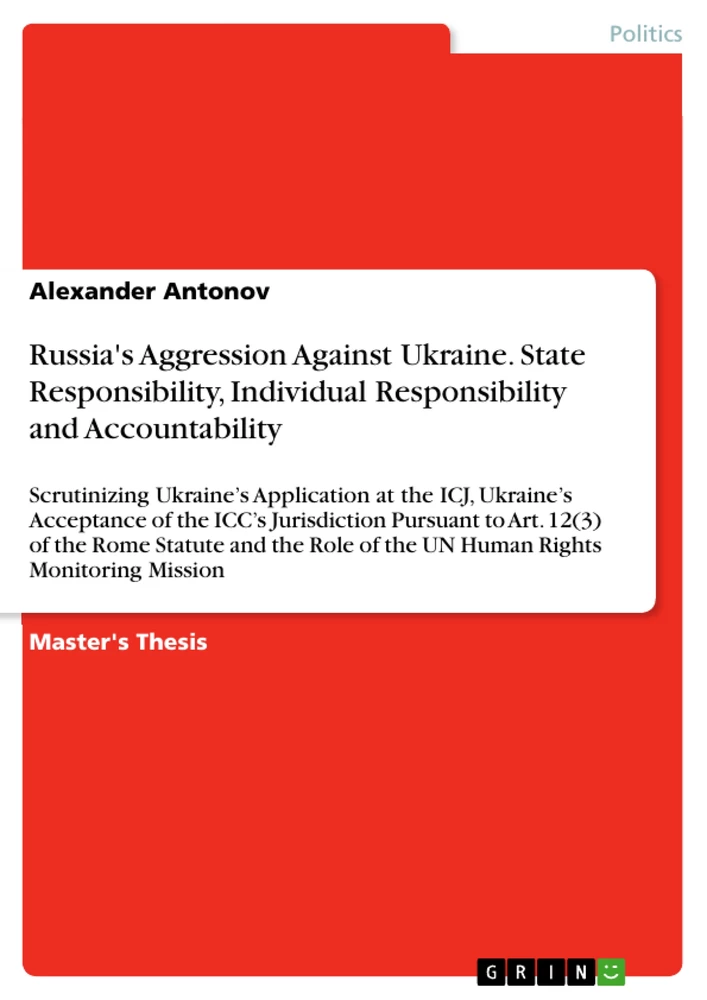
Table of Contents
Chapter I – The Background
1.1) Introduction to the Thesis
Chapter II – Fundamental Norms at Stake
2.1) Core Principles of IL
2.1.1) The Annexation of Crimea
2.1.2) The Conflict in the Donbas
2.2) Summary - The Use of Force in Perspective
Chapter III – Legal Framework and Methodology
3.1) The Three Different Perspectives
3.2) Legal Personality and Responsibility in IL
3.3) The General Procedure
3.4) Sources of IL and Treaty Interpretation
3.4.1) Treaty Interpretation and the ICSFT
3.4.2) Treaty Interpretation and the CERD
3.4.3) Treaty Interpretation and the Rome Statute
3.4.4) The Memorandum of Understanding Between the OHCHR and Ukraine
Chapter IV – Analysis – The Three Mechanisms and Their Tools
4.1) The ICJ and the Statute of the Court
4.1.1) The Principal Judicial Organ of the UN
4.1.2) Basis of the ICJ’s Jurisdiction - Part 1
4.1.3) The Different Procedural Steps During Preliminary Examinations
4.1.4) The Plausibility Test
4.1.5) The Requirement of Urgency
4.1.6) Basis of the ICJ’s Jurisdiction - Part 2
4.1.7) The Advisory Jurisdiction of the ICJ
4.2) The ICC and the Rome Statute System
4.2.1) The Court of Last Resort
4.2.2) The Difference Between a Situation and a Case
4.2.3) The Initiation of a Preliminary Examination
4.2.4) The Remits of the OTP in the Preliminary Examination and Investigation Phase
4.2.5) Ukraine’s Acceptance of the ICC’s Jurisdiction
4.2.6) Preface to Chapter V - Overall Control Test/Effective Control Test
4.3) The OHCHR’s Engagement in Ukraine
4.3.1) The Rationale and Methodology of the HRMMU
4.3.2) HRMMU and Ius in Bello: A Mechanism to Monitor Violations of IHRL and IHL
4.3.3) HRMMU in Perspective to Other Mechanisms of the OHCHR
4.4) Brief Note on Preliminary Results of Chapter IV
Chapter V – Assessment of Ukraine’s Recourse to the Three IL Mechanisms
5.1) The ICJ: Ukraine v. Russian Federation
5.1.1) CERD and ICSFT: The Court’s Order
5.1.2) ICSFT: The Mens Rea of a ‘’Terrorist Act’’
5.1.3) ICSFT: Plausibility Test as a Barrier
5.1.4) ICSFT: Additional Barrier After the Plausibility Requirement - Effective Control Test
5.1.5) ICSFT: Overcoming the Problem of Attribution
5.1.6) ICSFT: Vulnerability Against Plausibility
5.1.7) CERD and ICSFT: Summary and Future Outlook
5.2) The ICC: The Situation in Ukraine
5.2.1) Preliminary Examination: Subject – Matter Jurisdiction
5.2.2) Alleged Crimes in Crimea and Eastern Ukraine
5.2.3) The Overall Control Test as a Barrier?
5.2.4) After the Control Test - Summary and Future Outlook
5.3) The OHCHR: The UN Human Rights Apparatus
Chapter VI – Reflections on The Tools and Barriers of IL
6.1) Results of the First Perspective: ICJ
6.2) Results of the Second Perspective: ICC
6.3) Results of the Third Perspective: HRMMU
Chapter VII – Concluding Remarks
Objectives and Topics
The primary research objective is to identify the tools and barriers within International Law that can hold Russia and its proxies responsible for actions in Crimea and Eastern Ukraine, while investigating available legal recourse for serious crimes committed by individuals in those regions.
- Analysis of legal remedies and institutional constraints of the International Court of Justice (ICJ) regarding state responsibility.
- Evaluation of the International Criminal Court (ICC) mechanisms for establishing individual responsibility for grave crimes.
- Assessment of the role of the UN Human Rights Monitoring Mission in Ukraine (HRMMU) as a mechanism for accountability.
- Investigation into the legal threshold of the "plausibility test" and the "overall/effective control tests" for attributing conduct to states.
- Exploration of how International Human Rights Law and International Humanitarian Law are applied to the ongoing Ukraine crisis.
Auszug aus dem Buch
1.1) Introduction to the Thesis
Who would have envisaged a permanent member of the UNSC bearing ‘’primary responsibility for the maintenance of international peace and security’’ to annex the neighbouring state’s territory in breach of core UNC obligations in the 21st century? With the Ukraine crisis now in its fourth year, one wonders when to see an end to the daily abuse of people’s human rights in the occupied territory of Crimea, the flagrant crimes civilians are constantly exposed to in the rebel controlled regions of the LPR and DPR and the general lawlessness prevalent in these breakaway territories.
Although the Minsk Peace Agreements could halt the most intense shelling that had occurred in the period between Summer 2014 and February 2015, they have not brought back peace to Ukraine with the OSCE Special Monitoring Mission still continuing recording gross cease-fire violations on a daily base. As stated in one of the last reports by the OHCHR, more than 35.000 conflict-related casualties, there under 10.300 killed and 24.700 injured, have been registered since fighting erupted in Eastern Ukraine in April 2014. 2 million people have been displaced. Among the worst tragedies was the downing of a civilian passenger jet with 298 civilians aboard on 17 July 2014.
Summary of Chapters
Chapter I – The Background: Provides the historical context of the Ukraine crisis, distinguishing between responsibility and accountability in international law.
Chapter II – Fundamental Norms at Stake: Clarifies the core international legal principles violated by Russia, including the prohibition of the use of force and non-intervention.
Chapter III – Legal Framework and Methodology: Outlines the three selected institutional perspectives and the methodology for treaty interpretation used throughout the thesis.
Chapter IV – Analysis – The Three Mechanisms and Their Tools: Analyzes the procedural mechanisms and jurisdictional tools of the ICJ, the ICC, and the HRMMU.
Chapter V – Assessment of Ukraine’s Recourse to the Three IL Mechanisms: Evaluates the actual application of these mechanisms by Ukraine, specifically focusing on the outcomes and legal barriers encountered.
Chapter VI – Reflections on The Tools and Barriers of IL: Summarizes the effectiveness and limits of international legal tools in holding perpetrators accountable in the current crisis.
Chapter VII – Concluding Remarks: Offers final reflections on the evolution of international law and the prospects for accountability in the context of the Ukraine crisis.
Keywords
International Court of Justice, State Responsibility, Plausibility Test, International Criminal Court, Individual Responsibility, Overall Control Test, UN Human Rights Monitoring Mission in Ukraine, Accountability, Annexation of Crimea, Donbas, War Crimes, International Humanitarian Law, Human Rights, Reparations, International Armed Conflict
Frequently Asked Questions
What is the central focus of this research paper?
The paper focuses on the legal challenges and possibilities of holding Russia and individual perpetrators responsible and accountable for violations of international law committed in Crimea and Eastern Ukraine.
What are the three main legal perspectives examined?
The work examines three institutional frameworks: the International Court of Justice (ICJ) for state responsibility, the International Criminal Court (ICC) for individual responsibility, and the UN Human Rights Monitoring Mission in Ukraine (HRMMU) for general accountability.
What is the primary research question being addressed?
The research asks which tools are provided by International Law to hold Russia responsible for its actions in Crimea and Eastern Ukraine, and what recourse exists for establishing accountability for serious crimes committed by individuals in those areas.
What is the significance of the "plausibility test" in this study?
The "plausibility test" is analyzed as a critical, high legal threshold and barrier for Ukraine at the ICJ, which significantly impacts the ability to secure preliminary measures.
What role does the HRMMU play in this legal context?
While the HRMMU cannot enforce law, it serves as a crucial evidence-gathering and documentation mechanism that provides factual foundations used by international courts.
How does the author define the key terms of responsibility vs. accountability?
The author distinguishes state responsibility as arising from internationally wrongful acts or serious crimes under ICC jurisdiction, whereas accountability is defined as a broader, often political aspect of answerability.
How does the "overall control test" apply to the ICC's potential involvement?
The paper discusses whether Russia exercised "overall control" over the separatist rebels (DPR/LPR), which is a prerequisite for the ICC to classify the conflict as international for the purpose of investigating specific war crimes.
Does the author believe the ICJ will likely find Russia responsible in the current case?
The author concludes that prospects for holding Russia responsible on the merits regarding the ICSFT are "grim," primarily due to the stringent legal requirements and procedural barriers identified at the preliminary stage.
Ende der Leseprobe aus 120 Seiten
- nach oben
- Arbeit zitieren
- Alexander Antonov (Autor:in), 2018, Russia's Aggression Against Ukraine. State Responsibility, Individual Responsibility and Accountability, München, Page::Imprint:: GRINVerlagOHG, https://www.diplomarbeiten24.de/document/441604

neugierig - aktuell - relevant
Entdecken Sie hilfreiche Tipps und Tricks rund ums Studium!

Entdecken Sie hilfreiche Tipps und Tricks rund ums Studium!
Ihre Hausarbeit / Abschlussarbeit:

- - Publikation als E-Book und Buch
- - Hohes Honorar auf die Verkäufe
- - Für Sie komplett kostenlos - mit ISBN
- - Es dauert nur 5 Minuten
- - Jede Arbeit findet Leser

- © GRIN Publishing GmbH.
- Alle Inhalte urheberrechtlich geschützt. Kopieren und verbreiten untersagt.
- info@grin.com
- AGB
- Open Publishing
Der GRIN Verlag hat sich seit 1998 auf die Veröffentlichung akademischer eBooks und Bücher spezialisiert. Der GRIN Verlag steht damit als erstes Unternehmen für User Generated Quality Content. Die Verlagsseiten GRIN.com, Hausarbeiten.de und Diplomarbeiten24 bieten für Hochschullehrer, Absolventen und Studenten die ideale Plattform, wissenschaftliche Texte wie Hausarbeiten, Referate, Bachelorarbeiten, Masterarbeiten, Diplomarbeiten, Dissertationen und wissenschaftliche Aufsätze einem breiten Publikum zu präsentieren.
Kostenfreie Veröffentlichung: Hausarbeit, Bachelorarbeit, Diplomarbeit, Dissertation, Masterarbeit, Interpretation oder Referat jetzt veröffentlichen!
Folgen Sie GRIN auf


- GRIN Verlag GmbH
-
- Nymphenburger Str. 86
- 80636
- Munich, Deutschland
- +49 89-550559-0
- +49 89-550559-10
- info@grin.com
-
