
präsentiert von

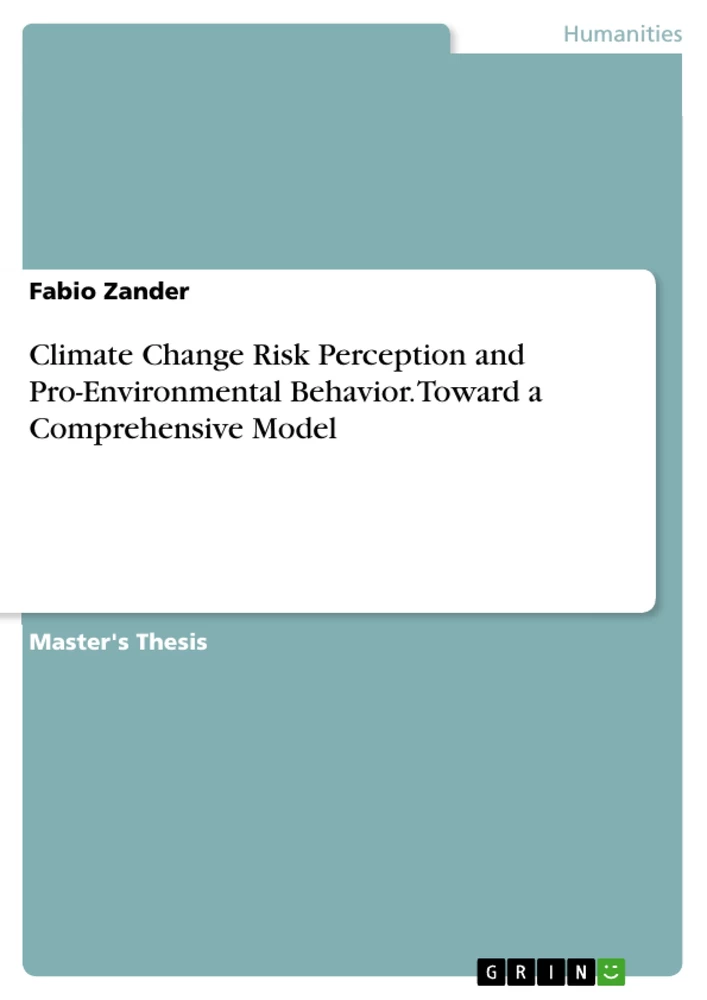
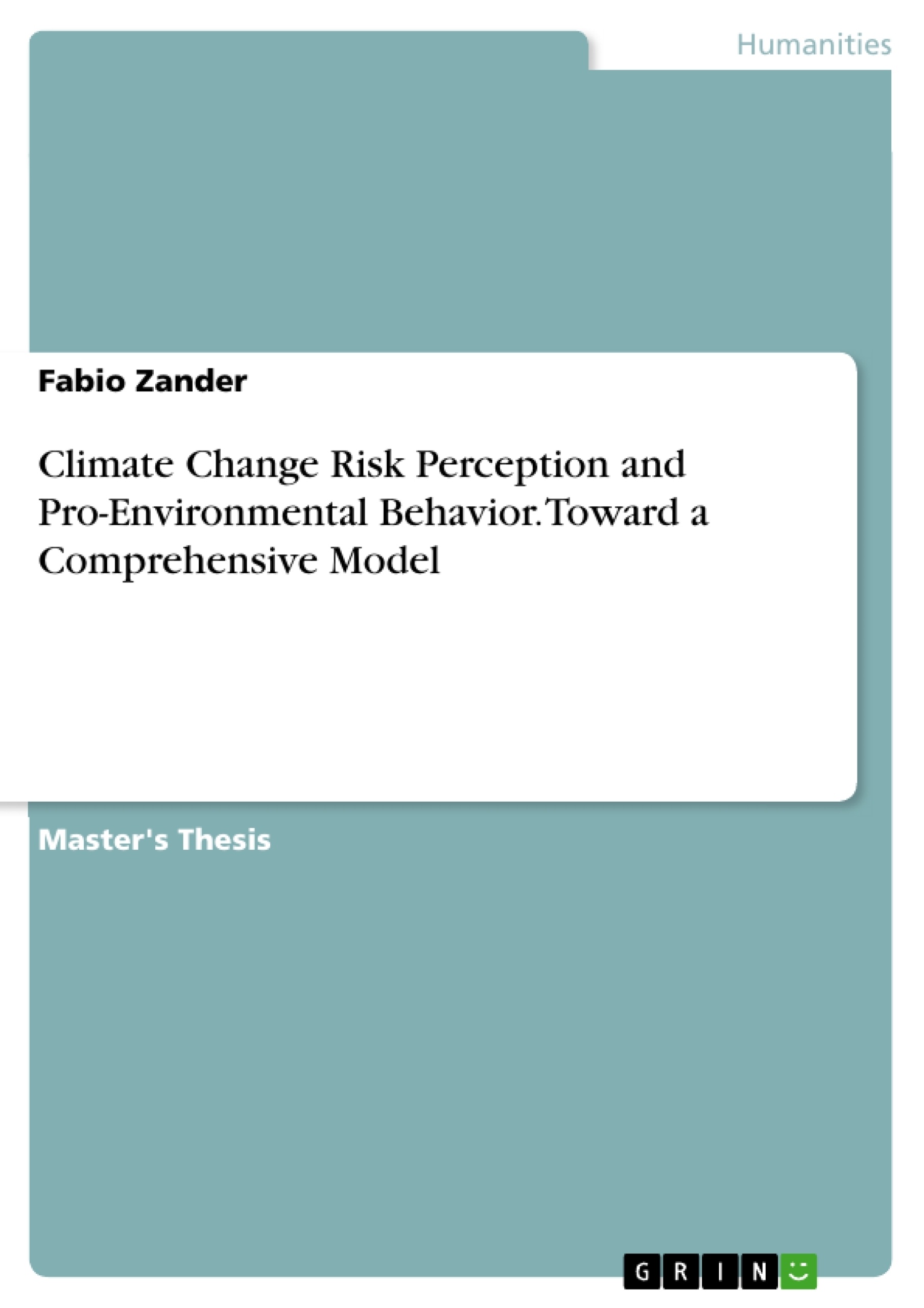
Table of Contents
1. Climate Change Risk Perception and Pro-Environmental Behavior – Toward a Comprehensive Model
2. Pro-Environmental Behavior
3. Theory of Planned Behavior (TPB)
4. Norm-Activation Model (NAM)
5. Integrated TPB / NAM Framework
6. Climate Change Risk Perception
6.1 Climate Change Risk Perception Model
6.1.1 Cognitive Factors
6.1.2 Experiential processing
6.1.3 Socio-cultural factors
6.1.4 Socio-demographic characteristics
7. Objective and Aims
8. Research Questions and Hypotheses
9. Method
9.1 Participants
9.2 Materials
9.3 Procedure
9.4 Data Analysis
9.5 Ethical Considerations
10. Results
11. Discussion
11.1 Limitations and Future Research
12. Conclusion
Research Objectives and Topics
This study aims to examine the relationship between climate change risk perception and specific pro-environmental behavior among young educated adults. It seeks to resolve measurement inconsistencies in existing literature by aligning predictors and criteria with the same level of specificity, and by assessing whether personal worry acts as an effective indicator of risk perception in relation to individual pro-environmental actions.
- Measurement correspondence between risk perception and pro-environmental behavior
- Distinction between personal worry and general concern as indicators of risk perception
- Mediating role of behavioral intentions in pro-environmental engagement
- Predictive power of risk perception within the Theory of Planned Behavior and Norm-Activation Model
- Drivers of pro-environmental behavior in young, educated demographic groups
Excerpt from the Book
Experiential processing
An individual is not only able to have cognitive knowledge about climate change but can also experience it in emotional terms (van der Linden, 2015). One of today’s widely acknowledged theories, the dual-process theory by Kahneman (2011), suggests that information processing occurs in two fundamentally different ways. The theory suggests that thought can arise as a result of two different processes. These can be divided into cognition, indicated by slow, conscious, controlled, analytical and rule-based processes, and affect, indicated by fast, unconscious, automatic and associative processes. According to Loewenstein, Weber, Hsee, and Welch (2001), affective climate change risk judgments are often more dominant than cognitive judgments. For example, studies examining individual’s first thought response when thinking about climate change often find negative affects related to the impacts of climate change to be the first thing that comes to mind (Leiserowitz, 2006; Smith & Leiserowitz, 2012). Since climate change is an intangible phenomenon that cannot be experienced directly (Whitmarsh, 2008), the individual’s emotional judgment of it is mostly influenced either by media coverage or their social environment (Swim et al., 2009). Although it is hard to actually grasp climate change on a sensory level (Pawlik, 1991), research shows that people do detect changes in local weather patterns.
Summary of Chapters
Pro-Environmental Behavior: Discusses various definitions and domains of pro-environmental behavior, ranging from impacts on the environment to motivations rooted in self-interest or altruism.
Theory of Planned Behavior (TPB): Explains the rational choice model where attitudes, subjective norms, and perceived behavioral control determine intentions and subsequent behavior.
Norm-Activation Model (NAM): Describes a model focused on altruistic behavior where personal norms, triggered by awareness of consequences and responsibility, drive pro-social actions.
Integrated TPB / NAM Framework: Examines how combining self-interest and pro-social motives provides a more robust explanation of pro-environmental behavior than either model alone.
Climate Change Risk Perception: Defines the core construct and outlines the Climate Change Risk Perception Model (CCRPM) including cognitive, experiential, and socio-cultural determinants.
Objective and Aims: Details the study's focus on bridging knowledge gaps by ensuring measurement correspondence and examining the link between specific behaviors and risk perceptions.
Research Questions and Hypotheses: Outlines the four specific research questions and corresponding hypotheses regarding the predictive power of personal worry.
Method: Provides details on the survey of 141 young educated adults and the instruments used to measure risk perception, TPB constructs, and pro-environmental actions.
Results: Presents statistical findings from correlation and hierarchical regression analyses, demonstrating the mediation effect of intentions and the predictive value of personal worry.
Discussion: Interprets the findings in the context of existing literature, acknowledging the methodological strengths while addressing limitations like social desirability bias and sampling methods.
Conclusion: Synthesizes the main findings, noting that personal worry is a significant predictor of pro-environmental behavior, though suggesting further research is needed to refine these links.
Keywords
climate change, risk perception, pro-environmental behavior, personal worry, general concern, theory of planned behavior, norm-activation model, measurement correspondence, behavioral intentions, psychological research, environmental impact, sustainability, self-interest, altruism, cognitive factors
Frequently Asked Questions
What is the fundamental focus of this research?
The research investigates the relationship between an individual's perception of climate change as a personal risk and their actual engagement in pro-environmental behaviors.
What are the primary thematic fields covered?
The paper bridges environmental psychology and behavioral science, specifically focusing on the Theory of Planned Behavior, the Norm-Activation Model, and how different levels of risk perception influence human action.
What is the central research question?
The central question is how climate change risk perception relates to specific pro-environmental behaviors and whether this relationship is direct or mediated by behavioral intentions.
Which scientific methodology is employed?
The study uses a cross-sectional design with an online questionnaire and applies statistical methods including correlation analysis, mediation analysis, and multiple hierarchical regression.
What is addressed in the main section of the paper?
The main section establishes the theoretical frameworks, details the empirical study methodology and data analysis, and discusses the results regarding personal worry as a predictor of behavior.
Which keywords define this work?
Key terms include climate change, risk perception, pro-environmental behavior, personal worry, theory of planned behavior, and measurement correspondence.
How does personal worry differ from general concern in this study?
Personal worry is identified as an active emotional state directly linked to behavioral responses, whereas general concern is seen as a more passive state that does not always trigger specific motivational or emotional outcomes.
Why is the concept of "measurement correspondence" so important for this study?
Measurement correspondence ensures that the predictor (risk perception) and the criterion (specific pro-environmental behavior) are defined at the same level of specificity, which significantly enhances the predictive validity of the research model.
What role do behavioral intentions play in the proposed model?
Behavioral intentions act as a partial mediator, meaning that personal worry increases the individual's intention to behave pro-environmentally, which then leads to actual behavior.
Ende der Leseprobe aus 65 Seiten
- nach oben
- Arbeit zitieren
- Fabio Zander (Autor:in), 2018, Climate Change Risk Perception and Pro-Environmental Behavior. Toward a Comprehensive Model, München, Page::Imprint:: GRINVerlagOHG, https://www.diplomarbeiten24.de/document/445024

neugierig - aktuell - relevant
Entdecken Sie hilfreiche Tipps und Tricks rund ums Studium!

Entdecken Sie hilfreiche Tipps und Tricks rund ums Studium!
Ihre Hausarbeit / Abschlussarbeit:

- - Publikation als E-Book und Buch
- - Hohes Honorar auf die Verkäufe
- - Für Sie komplett kostenlos - mit ISBN
- - Es dauert nur 5 Minuten
- - Jede Arbeit findet Leser

- © GRIN Publishing GmbH.
- Alle Inhalte urheberrechtlich geschützt. Kopieren und verbreiten untersagt.
- info@grin.com
- AGB
- Open Publishing
Der GRIN Verlag hat sich seit 1998 auf die Veröffentlichung akademischer eBooks und Bücher spezialisiert. Der GRIN Verlag steht damit als erstes Unternehmen für User Generated Quality Content. Die Verlagsseiten GRIN.com, Hausarbeiten.de und Diplomarbeiten24 bieten für Hochschullehrer, Absolventen und Studenten die ideale Plattform, wissenschaftliche Texte wie Hausarbeiten, Referate, Bachelorarbeiten, Masterarbeiten, Diplomarbeiten, Dissertationen und wissenschaftliche Aufsätze einem breiten Publikum zu präsentieren.
Kostenfreie Veröffentlichung: Hausarbeit, Bachelorarbeit, Diplomarbeit, Dissertation, Masterarbeit, Interpretation oder Referat jetzt veröffentlichen!
Folgen Sie GRIN auf


- GRIN Verlag GmbH
-
- Nymphenburger Str. 86
- 80636
- Munich, Deutschland
- +49 89-550559-0
- +49 89-550559-10
- info@grin.com
-
