
präsentiert von

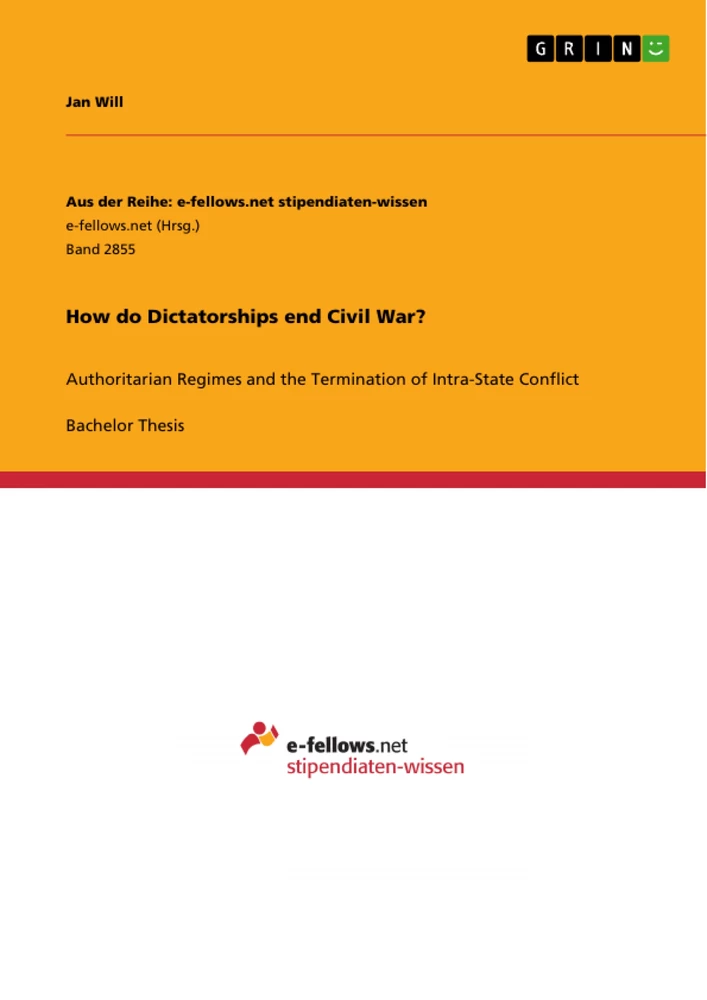
Table of Contents
1. Introduction
2. Previous Literature
3. How Regimes impact Conflict Termination
3.1 Nonpersonalist Civilian Regime
3.2 Personalist Civilian Regime
3.3 Personalist Military Regime
3.4 Nonpersonalist Military Regime
4. Data and Research Design
4.1 Dependent Variable
4.2 Independent Variable
4.3 Control Variables
4.4 Model
5. Results
6. Discussion and Conclusion
Research Objectives and Themes
This thesis investigates whether different types of authoritarian regimes—categorized by their personalist or nonpersonalist nature and their military or civilian backgrounds—have a significant impact on the outcome and termination of civil wars. The research seeks to determine if specific regime characteristics influence the likelihood of a conflict resulting in a government victory, a rebel victory, or a negotiated settlement.
- The influence of authoritarian regime types on civil war termination patterns.
- Theoretical distinctions between personalist and nonpersonalist, as well as civilian and military, autocracies.
- The role of co-optation capabilities and the domestic audience in regime stability and conflict resolution.
- Statistical analysis using multinomial logit models for the period 1946–2010.
- Empirical evaluation of hypotheses regarding how different dictatorships handle internal violent conflict.
Excerpt from the Book
3.2 Personalist Civilian Regime
Although personalist civilian leaders lack the military education and the allegiance to the army, they nevertheless might have used arms to overthrow the previous regime. Many personalist civilians take power by making use of violent means like revolution or civil war (Weeks, 2012). An example of such a leader is Yoweri Museveni, president of Uganda since 1986. He overthrew the previous regime with his National Resistance Army and took over control (Tripp, 2010). Being a former rebel, the costs of use of force subsequently are perceived as low (Colgan, 2010) and the repeated use of violence becomes more likely (Horowitz & Stam, 2014). Additionally, the regime lacks a domestic audience that due to their civilian roots would mitigate the military drive of the leader. As stated above, personalist leaders have a high inclination for the regime which is expressed by a cult of personality. Museveni in Uganda created such a cult as well (Omach, 2017). All these points together should make personalist civilian autocrats more likely to end civil conflict with a victory of the government. Due to their civilian nature, these regimes are not as exclusionary to broad parts of the society as both personalist and nonpersonalist military regimes are (Fjelde, 2010). This indicates that cooptation as a tool to appease rebels is available. Nevertheless, they cannot rely on parties as a “forum where the dictator can make offers to distribute spoils in exchange for cooperation” (Fjelde, 2010, p. 203). Furthermore, the lack of such an institution does not guarantee a continuation of spoils obtainment in the long run. Rebel group leaders are therefore expected to accept bribery offered by personalist civilian leaders less likely than from party-based regimes. In accordance with the arguments outlined above, dictatorships led by personalistic civilians are expected to experience a negotiated settlement to end an intra state conflict less likely than party-based regimes but still more likely than military ones.
Summary of Chapters
1. Introduction: Outlines the research gap regarding how different authoritarian regime types influence civil war outcomes and presents the core objectives of the study.
2. Previous Literature: Reviews existing political science research on civil war dynamics, focusing on conflict termination, third-party interventions, and the role of duration and regime characteristics.
3. How Regimes impact Conflict Termination: Develops theoretical arguments categorizing regimes into four types (nonpersonalist/personalist civilian and military) to predict their behavior in managing civil conflicts.
4. Data and Research Design: Describes the methodology, detailing the UCDP and Geddes et al. datasets, the definition of variables, and the application of multinomial logit models.
5. Results: Presents the statistical findings and predicted probabilities of the regression models, comparing the hypothesized outcomes against empirical data.
6. Discussion and Conclusion: Interprets the findings, acknowledges the limitations of the data, and suggests implications for future research on authoritarian regimes and conflict termination.
Keywords
Authoritarian Regimes, Civil War, Conflict Termination, Personalist Dictatorships, Nonpersonalist Regimes, Civilian Autocracy, Military Regime, Negotiated Settlement, Government Victory, Political Survival, Multinomial Logit, Co-optation, Regime Types, Political Science, Internal Conflict
Frequently Asked Questions
What is the primary focus of this thesis?
The research focuses on the impact of different authoritarian regime types—distinguished by their personalist/nonpersonalist and civilian/military character—on the ways civil wars terminate.
What are the main categories of authoritarian regimes examined?
The study differentiates between four main types: nonpersonalist civilian, personalist civilian, personalist military, and nonpersonalist military regimes.
What is the central research question?
The study asks whether specific characteristics of dictatorships make them more or less likely to reach a negotiated settlement or achieve a military victory in civil wars.
Which methodology is used for the analysis?
The author employs large-N statistical analysis using multinomial logit models on UCDP and Geddes et al. datasets covering the years 1946 to 2010.
What does the main body of the work cover?
The main body covers a literature review, the development of theoretical arguments based on regime leadership and audience constraints, the research design, and an extensive statistical results section.
Which keywords best describe this study?
Key terms include Authoritarian Regimes, Civil War, Conflict Termination, Personalist Dictatorships, and Negotiated Settlement.
How do civilian and military regimes theoretically differ in conflict?
The thesis argues that civilian regimes have an advantage in co-opting opponents to reach settlements, whereas military regimes are expected to be more prone to using force and achieving decisive victories.
Why are personalist regimes expected to fight harder?
Personalist dictators often view the state as their own property and utilize cults of personality, which increases their inclination to forcefully defend their position against rebel threats.
What was the result of the statistical testing?
The analysis showed that while some conjectures were met, the data did not reveal many statistically significant relationships at the 5% level, suggesting that regime type has a more complex effect on conflict outcomes than initially hypothesized.
How does the end of the Cold War influence the findings?
The study controls for the post-Cold War period, finding that after 1989, there was a notable increase in negotiated settlements compared to previous decades.
Ende der Leseprobe aus 38 Seiten
- nach oben
- Arbeit zitieren
- Jan Will (Autor:in), 2018, How do Dictatorships end Civil War?, München, Page::Imprint:: GRINVerlagOHG, https://www.diplomarbeiten24.de/document/445066

neugierig - aktuell - relevant
Entdecken Sie hilfreiche Tipps und Tricks rund ums Studium!

Entdecken Sie hilfreiche Tipps und Tricks rund ums Studium!
Ihre Hausarbeit / Abschlussarbeit:

- - Publikation als E-Book und Buch
- - Hohes Honorar auf die Verkäufe
- - Für Sie komplett kostenlos - mit ISBN
- - Es dauert nur 5 Minuten
- - Jede Arbeit findet Leser

- © GRIN Publishing GmbH.
- Alle Inhalte urheberrechtlich geschützt. Kopieren und verbreiten untersagt.
- info@grin.com
- AGB
- Open Publishing
Der GRIN Verlag hat sich seit 1998 auf die Veröffentlichung akademischer eBooks und Bücher spezialisiert. Der GRIN Verlag steht damit als erstes Unternehmen für User Generated Quality Content. Die Verlagsseiten GRIN.com, Hausarbeiten.de und Diplomarbeiten24 bieten für Hochschullehrer, Absolventen und Studenten die ideale Plattform, wissenschaftliche Texte wie Hausarbeiten, Referate, Bachelorarbeiten, Masterarbeiten, Diplomarbeiten, Dissertationen und wissenschaftliche Aufsätze einem breiten Publikum zu präsentieren.
Kostenfreie Veröffentlichung: Hausarbeit, Bachelorarbeit, Diplomarbeit, Dissertation, Masterarbeit, Interpretation oder Referat jetzt veröffentlichen!
Folgen Sie GRIN auf


- GRIN Verlag GmbH
-
- Nymphenburger Str. 86
- 80636
- Munich, Deutschland
- +49 89-550559-0
- +49 89-550559-10
- info@grin.com
-
