
präsentiert von

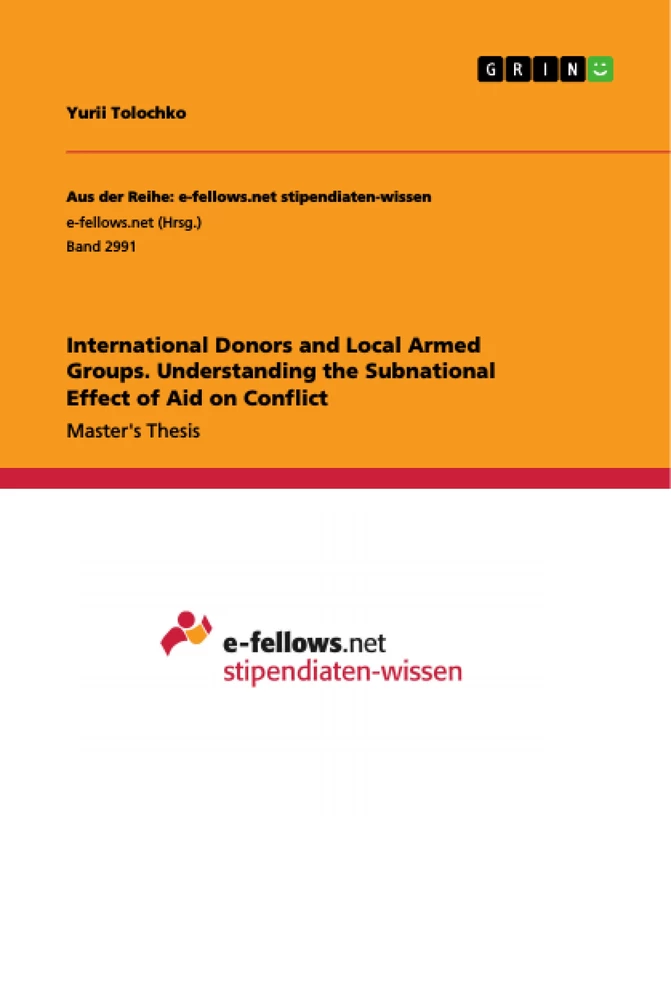
Table of Contents
Introduction
Theoretical Background
Current state of research
Economic development and conflict
Foreign aid and conflcit
Justification for ADM1 level of precision
Measures of adaptability and receptivity
Hypotheses
Research design and estimation framework
Data
Data sources
Chosen countries
Descriptive statistics of the data
Results
Discussion
Conclusion
Research Objectives and Themes
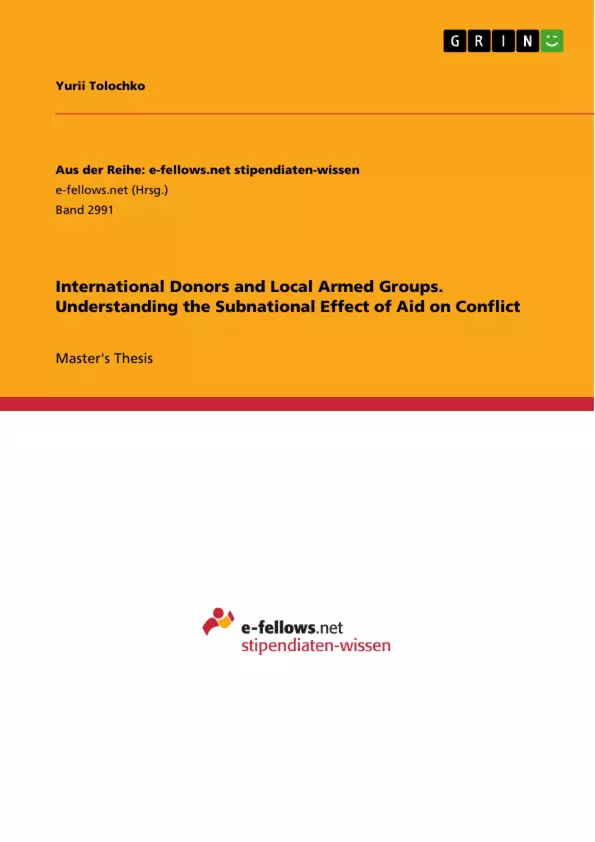
This thesis examines the relationship between international foreign aid and the intensity of subnational conflict in five African countries, moving beyond traditional country-level analyses to investigate how specific donor characteristics and local environmental receptivity influence conflict outcomes.
- The subnational administrative (ADM1) analysis of foreign aid and conflict intensity.
- Development and application of "donor adaptability" indices to measure resource allocation flexibility.
- Operationalization of "local receptivity" using data on attacks against aid workers.
- The impact of aid fungibility on the probability and magnitude of regional conflict.
- Comparative testing of Bayesian and Frequentist statistical frameworks in conflict research.
Excerpt from the Book
Justification for ADM1 level of precision
The most prevalent level of aggregation used in the studies that examine and attempt to quantify the extent and causes of conflict, in particular the relationship between international aid flows and the magnitude of civil war, is the annual country-level data. This approach is somewhat problematic from a number of perspectives. First of all, considering conflict and aid on the level of countries as a whole disregards all of the geographical variation of the events and simply assumes that conflict as well as aid in a given year is evenly distributed across a given country. This, of course, is not the case, as aid projects usually have a specific purpose (thematic focus) and the funds are committed to a specific geographically bounded entity. Assuming that conflict events are evenly distributed across a country is also quite erroneous. For instance, most intrastate conflicts take place on the peripheries of a country. Usually there is a direct relationship between the distance to the capital and the magnitude of intrastate conflict, i.e. the closer a region is to the capital, the less likely it is to experience conflict. Moreover, it is important to point out that the usual predictors of an intrastate conflict are also not uniformly distributed across a geographical entity. There is convincing evidence that links the probability of conflict onset and intensity of a conflict with the degree of local population clustering, exacerbated by the distance to the capital. Of course, a country’s population is never uniformly distributed across a country and neither are other sociodemographic characteristics of a country.
Summary of Chapters
Introduction: Provides a global context on the decline of war casualties versus the persistence of conflict in Sub-Saharan Africa and identifies the research gap regarding aid-conflict dynamics at the subnational level.
Theoretical Background: Reviews existing literature on the relationship between economic development and conflict, while introducing the concepts of donor adaptability and local receptivity as moderating variables.
Research design and estimation framework: Describes the methodology, specifically the use of a first-difference estimator and Bayesian regression on ADM1-level annual panel data to avoid endogeneity and omitted variable bias.
Data: Details the primary data sources including AidData, UCDP Georeferenced Event Dataset, and the Aid Worker Security Database, while justifying the selection of Burundi, Democratic Republic of Congo, Ethiopia, Sudan, and Uganda.
Descriptive statistics of the data: Presents an overview of the spatial distribution of aid and conflict events, noting the lack of a clear visual pattern and the importance of median nearest neighbor distances over averages.
Results: Reports the primary finding that there is no statistically significant association between foreign aid and conflict intensity, while confirming the predictive power of lagged dependent variables.
Discussion: Interprets the findings as evidence that aid-conflict dynamics are highly heterogeneous and dependent on local contexts, questioning the efficacy of country-level modeling.
Conclusion: Summarizes the research, rejects the primary hypotheses, and provides policy recommendations for donors to prioritize region-specific information over broad-scale reports.
Key Terms
Foreign aid, subnational conflict, administrative units (ADM1), conflict intensity, donor adaptability, local receptivity, aid fungibility, Bayesian regression, first-difference estimator, UCDP, AidData, casualties, economic development, poverty reduction, conflict traps.
Frequently Asked Questions
What is the core subject of this research?
The research investigates whether foreign aid commitments are associated with changes in the level of conflict at the subnational level in five African countries.
What are the primary thematic fields addressed?
The study centers on international relations, development economics, and conflict studies, specifically focusing on the micro-geography of aid delivery and political violence.
What is the central research question?
The study asks whether foreign aid can measurably influence conflict intensity and if that relationship is conditional upon the adaptability of donors and the receptivity of the local environment.
Which scientific methods are utilized in this work?
The author employs a first-difference estimator with Bayesian regression and frequently validated OLS models, focusing on subnational (ADM1) panel data.
What topics are covered in the main body?
The main body covers the theoretical link between aid and conflict, the operationalization of adaptability and receptivity, detailed data sources, statistical model specifications, and the analysis of aid fungibility.
Which keywords best characterize this work?
Subnational conflict, foreign aid, ADM1, donor adaptability, local receptivity, aid fungibility, and causal inference.
How does the author define 'local receptivity'?
Local receptivity is operationalized using the Aid Worker Security Database, where an ADM1 unit in a specific year is considered to have low receptivity if violent incidents against aid workers occurred.
What conclusion does the author reach regarding the impact of aid on conflict?
The author finds no statistically significant association between foreign aid and conflict intensity, suggesting that previous findings of a link may be artifacts of broader, country-level data aggregation.
Why were the five specific countries selected for this study?
Burundi, DRC, Ethiopia, Sudan, and Uganda were selected due to the availability of complete, uninterrupted data coverage from 1999 to 2009 and their shared characteristics as a geographically linked group in Central-Eastern Africa.
Ende der Leseprobe aus 64 Seiten
- nach oben
- Arbeit zitieren
- Yurii Tolochko (Autor:in), 2018, International Donors and Local Armed Groups. Understanding the Subnational Effect of Aid on Conflict, München, Page::Imprint:: GRINVerlagOHG, https://www.diplomarbeiten24.de/document/448515

neugierig - aktuell - relevant
Entdecken Sie hilfreiche Tipps und Tricks rund ums Studium!

Entdecken Sie hilfreiche Tipps und Tricks rund ums Studium!
Ihre Hausarbeit / Abschlussarbeit:

- - Publikation als E-Book und Buch
- - Hohes Honorar auf die Verkäufe
- - Für Sie komplett kostenlos - mit ISBN
- - Es dauert nur 5 Minuten
- - Jede Arbeit findet Leser

- © GRIN Publishing GmbH.
- Alle Inhalte urheberrechtlich geschützt. Kopieren und verbreiten untersagt.
- info@grin.com
- AGB
- Open Publishing
Der GRIN Verlag hat sich seit 1998 auf die Veröffentlichung akademischer eBooks und Bücher spezialisiert. Der GRIN Verlag steht damit als erstes Unternehmen für User Generated Quality Content. Die Verlagsseiten GRIN.com, Hausarbeiten.de und Diplomarbeiten24 bieten für Hochschullehrer, Absolventen und Studenten die ideale Plattform, wissenschaftliche Texte wie Hausarbeiten, Referate, Bachelorarbeiten, Masterarbeiten, Diplomarbeiten, Dissertationen und wissenschaftliche Aufsätze einem breiten Publikum zu präsentieren.
Kostenfreie Veröffentlichung: Hausarbeit, Bachelorarbeit, Diplomarbeit, Dissertation, Masterarbeit, Interpretation oder Referat jetzt veröffentlichen!
Folgen Sie GRIN auf


- GRIN Verlag GmbH
-
- Nymphenburger Str. 86
- 80636
- Munich, Deutschland
- +49 89-550559-0
- +49 89-550559-10
- info@grin.com
-
