
präsentiert von

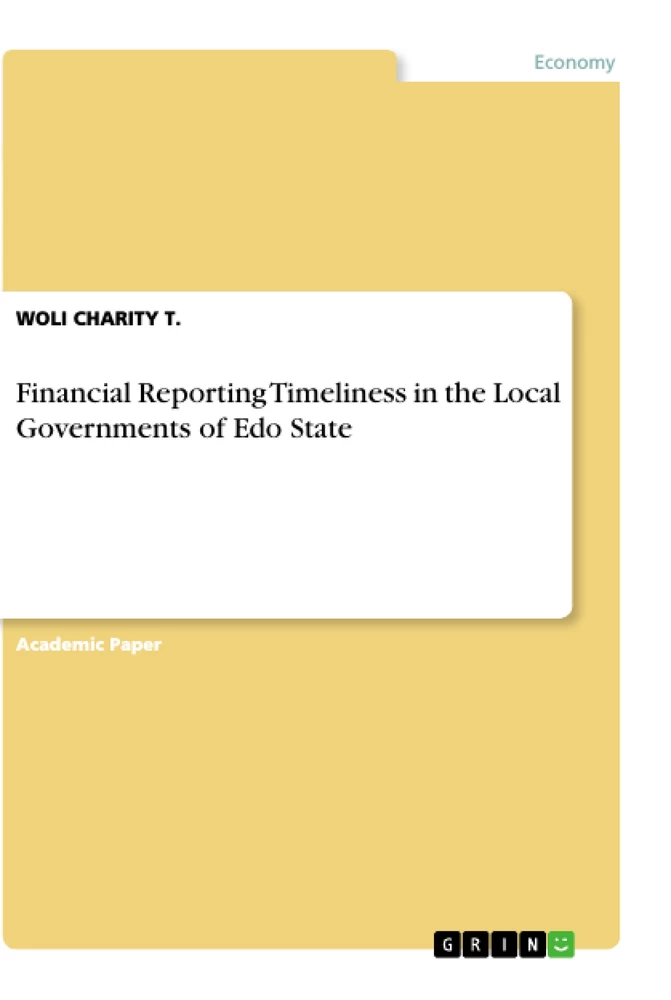
Table of Contents
1. Introduction
1.1 BACKGROUND TO THE STUDY
1.2 STATEMENT OF THE PROBLEM
1.3 OBJECTIVE OF THE STUDY
1.4 RESEARCH HYPOTHESIS
1.5 SCOPE OF THE STUDY
1.6 SIGNIFICANCE OF THE STUDY
2. Literature Review
2.1 INTRODUCTION
2.2 CONCEPTUAL FRAMEWORK
2.3 SIZE OF LOCAL GOVERNMENT AND TIMELINESS OF FINANCIAL REPORTING
2.4 LOCAL GOVERNMENT COMPLEXITY AND TIMELINESS OF FINANCIAL REPORTING
2.5 IMPACT OF TECHNOLOGY AND TIMELINESS OF FINANCIAL REPORTING
2.6 AUDITOR COMPETENCE AND TIMELINESS OF FINANCIAL REPORTING
2.7 EMPIRICAL EVIDENCE
3. Methodology
3.1 INTRODUCTION
3.2 RESEARCH DESIGN
3.3 POPULATION AND SAMPLE SIZE
3.4 SAMPLE TECHNIQUE
3.5 SOURCE OF DATA
3.6 METHOD OF DATA ANALYSIS
3.7 DECISION RULE
4. Data Presentation, Analysis and Interpretation
4.1 INTRODUCTION
4.2 PRESENTATION OF DATA
4.2.1 Personal Data
4.3 TEST OF HYPOTHESIS
4.3.1 TEST OF HYPOTHESIS ONE
4.3.2 TEST OF HYPOTHESIS TWO
4.3.3 TEST OF HYPOTHESIS THREE
4.3.4 TEST OF HYPOTHESIS FOUR
5. Summary of Findings, Conclusion and Recommendations
5.1 SUMMARY
5.2 FINDINGS
5.3 CONCLUSION
5.4 RECOMMENDATIONS
Research Objectives and Core Themes
This study investigates the timeliness of financial reporting within the local governments of Edo State, focusing on the critical need for accounting information to be available to stakeholders for effective decision-making. The primary objective is to evaluate how specific organizational and operational factors influence the promptness of these financial disclosures.
- The impact of local government size on reporting timeliness.
- The relationship between operational complexity and audit delays.
- The role of information technology and accounting system sophistication.
- The influence of auditor competence and independence on financial reporting speed.
Extract from the Book
1.1 BACKGROUND TO THE STUDY
In recent times, government stakeholders and accountants who have operational interest in the administration of local government have cause for concern about the timeliness of local government financial reporting (Government Accounting Standards Board GASB 2011). According to GASB (2011), financial report will retain its usefulness to local government stakeholders, municipal bond analysts, legislative fiscal staff and researchers at tax payer association and citizen groups if the report is timely say for about six months of its fiscal year end. Therefore, timeliness requires that information should be made available to financial statement users as rapid as possible and it is a necessary condition to be satisfied if financial statements are to be useful (Asli 2010).
According to Iyoha (2012), timeliness of financial reporting is the availability of information needed by decision makers for useful decision making before it loses it capacity to influence decision. Hence, timely information in reporting financial statement assumes greater importance since other non-financial statement sources such as media release news conferences and financial analysts forecast are not well developed and the regulatory bodies are not as effective.
The Auditor’s General Report of the New South Wales Government (2011), notes that timely and accurate financial reporting is essential for effective and quick decision making, more effective and timely management of public fund in enhancing public accountability in local government. The report also suggest that financial reporting in local government needed to be of higher standard to better inform budget decisions in local government, enable more effective and timely management of public funds by government agencies and to improve accountability for public expenditure.
Chapter Summaries
1. Introduction: Outlines the core research problem regarding the delayed release of local government financial reports and presents the study's specific objectives and hypotheses.
2. Literature Review: Examines theoretical and empirical frameworks regarding factors such as government size, operational complexity, IT usage, and auditor competence in relation to financial reporting.
3. Methodology: Describes the research design, specifically a longitudinal survey of selected local government areas, and defines the statistical techniques, including chi-square testing, used for data analysis.
4. Data Presentation, Analysis and Interpretation: Presents the gathered questionnaire data and provides the empirical test results for the four formulated research hypotheses.
5. Summary of Findings, Conclusion and Recommendations: Synthesizes the research results and offers policy recommendations for improving financial reporting timeliness in Edo State local governments.
Keywords
Financial Reporting, Timeliness, Local Government, Edo State, Accountability, Auditor Competence, Audit Delay, Operational Complexity, Information Technology, Financial Statements, Public Sector Accounting, Internal Control, Stakeholders, Data Analysis, Disclosure.
Frequently Asked Questions
What is the core focus of this research?
The research investigates the factors affecting the timeliness of financial reporting in the local government councils of Edo State, Nigeria.
What are the primary themes addressed?
The study centers on how government size, operational complexity, technological advancement, and auditor competence affect the prompt disclosure of financial information.
What is the main goal of this study?
The primary goal is to examine the influences on reporting speed and provide recommendations to ensure that financial statements are published in a timely manner for effective stakeholder use.
What research methodology was employed?
The study utilized a longitudinal survey approach, gathering primary data via structured questionnaires from four local government areas in Edo State, analyzed using chi-square statistical testing.
What is discussed in the main chapters?
The chapters cover the background and problem statement, a review of relevant literature, the methodology for data collection, the presentation and analysis of findings, and finally, conclusions and policy recommendations.
Which keywords best characterize this work?
Key terms include Financial Reporting, Timeliness, Local Government, Accountability, Auditor Competence, and Public Sector Accounting.
What was the outcome regarding local government size?
The research found that the size of local government has a significant influence on the timeliness of financial reporting, largely due to the resources available for better internal controls.
Did auditor competence significantly affect reporting speed?
The findings indicated that, contrary to some expectations, auditor competence did not show a statistically significant influence on the timeliness of financial reporting in this specific context.
Ende der Leseprobe aus 70 Seiten
- nach oben
- Arbeit zitieren
- WOLI CHARITY T. (Autor:in), 2016, Financial Reporting Timeliness in the Local Governments of Edo State, München, Page::Imprint:: GRINVerlagOHG, https://www.diplomarbeiten24.de/document/448998

neugierig - aktuell - relevant
Entdecken Sie hilfreiche Tipps und Tricks rund ums Studium!

Entdecken Sie hilfreiche Tipps und Tricks rund ums Studium!
Ihre Hausarbeit / Abschlussarbeit:

- - Publikation als E-Book und Buch
- - Hohes Honorar auf die Verkäufe
- - Für Sie komplett kostenlos - mit ISBN
- - Es dauert nur 5 Minuten
- - Jede Arbeit findet Leser

- © GRIN Publishing GmbH.
- Alle Inhalte urheberrechtlich geschützt. Kopieren und verbreiten untersagt.
- info@grin.com
- AGB
- Open Publishing
Der GRIN Verlag hat sich seit 1998 auf die Veröffentlichung akademischer eBooks und Bücher spezialisiert. Der GRIN Verlag steht damit als erstes Unternehmen für User Generated Quality Content. Die Verlagsseiten GRIN.com, Hausarbeiten.de und Diplomarbeiten24 bieten für Hochschullehrer, Absolventen und Studenten die ideale Plattform, wissenschaftliche Texte wie Hausarbeiten, Referate, Bachelorarbeiten, Masterarbeiten, Diplomarbeiten, Dissertationen und wissenschaftliche Aufsätze einem breiten Publikum zu präsentieren.
Kostenfreie Veröffentlichung: Hausarbeit, Bachelorarbeit, Diplomarbeit, Dissertation, Masterarbeit, Interpretation oder Referat jetzt veröffentlichen!
Folgen Sie GRIN auf


- GRIN Verlag GmbH
-
- Nymphenburger Str. 86
- 80636
- Munich, Deutschland
- +49 89-550559-0
- +49 89-550559-10
- info@grin.com
-
