
präsentiert von

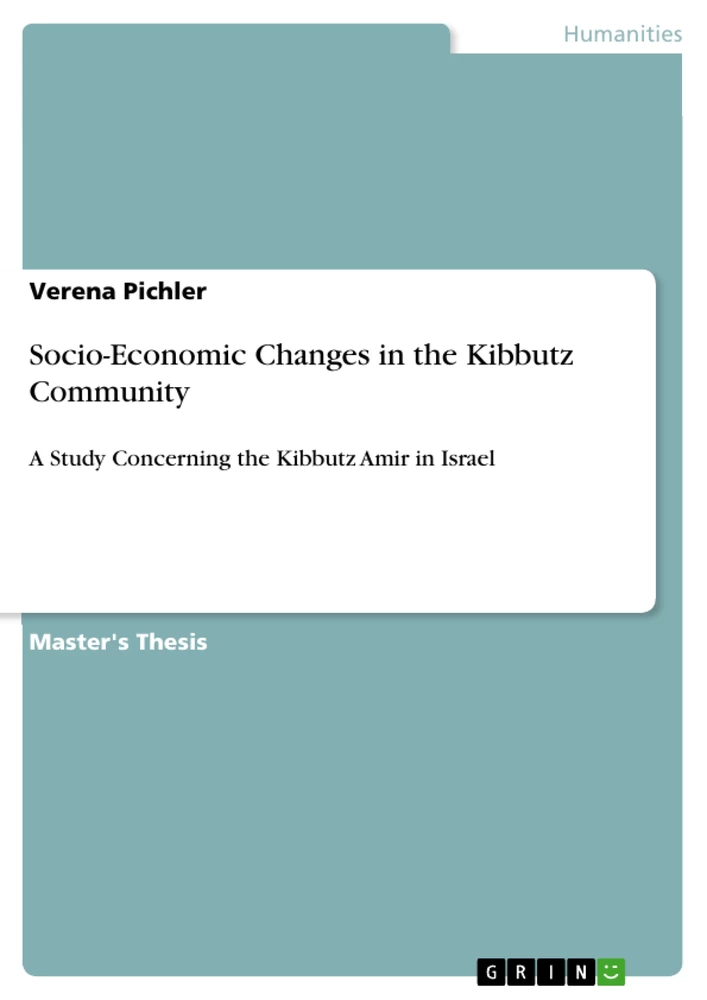
Table of Contents
CHAPTER ONE: INTRODUCTION
1.1. Research Question
1.2 Research Aim
1.3 Research Objectives
CHAPTER TWO: LITERATURE REVIEW
2.1 Review of Literature
2.1.1 Kibbutz community as a Utopian community model
2.1.2 Characteristics of Kibbutz Community
2.2 Theoretical Perspective
2.2.1 Theory of Change
2.2.2 Model of Equality: A Kibbutz-level Case
2.2.3 Crisis and Reform model
CHAPTER 3: RESEARCH DESIGN AND METHODS
3.1 Method
3.2 Population and Sampling
3.3 Data Collection and Interview Process
3.4 Data Analysis
3.5 Ethical Issues
3.6 Limitations
3.7 Chapter Summary
CHAPTER 4: FINDINGS
4.1 Overview
4.2 The Kibbutzim Ideology
4.2.1 Understanding the Kibbutzim
4.2.2 Challenges
4.2.3 Changes Presented in the New Kibbutzim
4.2.4 Significant Changes
4.3 Cultural Diversity
4.3.1 Family Life
4.3.2 Equality and the Role of Men and Women
4.3.3 Privacy and Independence
4.3.4 Issue of multi-culturalism
4.4 The Economic Perspective
4.5 The Educational Perspective
4.6 Chapter Summary
CHAPTER 5: DISCUSSION AND CONCLUSION
5.1 Summary of this Study
5.2 Discussion of the Findings
5.2.1 The Kibbutz Ideology
5.2.2 The Cultural and Educational Diversity
5.2.3 The Economic Perspective
5.3 Implications and Future Research
5.4 Future Research
5.5 Conclusion
Research Objectives and Focus
The primary aim of this research is to investigate the socio-economic transformations experienced within Kibbutz Amir, specifically analyzing how the transition from a traditional socialist, collectivist model to a more privatized, capitalist-oriented system has affected community members' perceptions and social lives.
- Factors driving the socio-economic evolution within Kibbutz Amir.
- The impact of the 1987 economic crisis on the community’s collective structure.
- Member experiences and perceptions regarding the old versus new social models.
- Cultural shifts in family structure, gender roles, and individual independence.
Excerpt from the Book
4.2.1 Understanding the Kibbutzim
The analysis of this theme is discussed under numerous pertinent sub-themes that were derived from the thematic analysis. Findings associated with this theme, linked to the other main themes derived in the analysis, attribute the livelihood that was pursued by the community member and its disintegration that is manifested in the current times. Thus, some of the sub-themes that are addressed under this theme comprehensively include: ideological-based community and the identity created through the two phases because of the social and economic transformation that was experienced from the late 1970s to the 2000s and the present times. According to the participants’ responses, the Kibbutz is a complex concept that many people fail to understand.
The philosophy of the old Kibbutz revolved around communalism, where community members were all equal. Most of the respondents acknowledged that the old Kibbutz could be defined using the word ‘collective’ because everyone was equal regardless of the work they were undertaking. The aspect of collectiveness was woven into the community with differentiation of duties determined by a centralized group of individuals, identified as the committee. Nevertheless, people in the community worked different hours and undertook different tasks. Overall, most of the respondents stipulated that they were happy with this social arrangement where everyone was equal. When interviewed, one of the participants attributed the complexity of understanding what a Kibbutz was based on these diverse interpretations of the community. For example, findings from the analysis of the interviews revealed that the Kibbutz community used to subscribe to the utopian model in the old Kibbutz system, but the changes brought by the current times are manifested with the transformation as continuous ongoing practice.
Chapter Summaries
CHAPTER ONE: INTRODUCTION: This chapter introduces the Kibbutz Amir community and defines the research scope regarding the shift from an egalitarian socialist model to a modern capitalist-influenced system.
CHAPTER TWO: LITERATURE REVIEW: This chapter provides an overview of existing research on utopian communities, theoretical models of change, and the specific historical context of the Kibbutz economic crisis.
CHAPTER 3: RESEARCH DESIGN AND METHODS: This chapter outlines the qualitative methodological approach, detailing the interview process with 19 community members and the application of thematic analysis to evaluate their experiences.
CHAPTER 4: FINDINGS: This chapter presents the data gathered from interviews, structured around the key thematic areas of ideology, cultural diversity, economic shifts, and changes in educational perspectives.
CHAPTER 5: DISCUSSION AND CONCLUSION: This chapter synthesizes the study's findings with the literature review, offering a comprehensive discussion on the societal implications of the Kibbutz transformation and recommendations for future research.
Keywords
Kibbutz, Socio-economic changes, Israel, Community, Socialism, Utopian model, Privatization, Collective, Equality, Capitalism, Cultural diversity, Education, Interview, Thematic analysis, Kibbutz Amir.
Frequently Asked Questions
What is the core subject of this thesis?
The thesis examines the socio-economic changes that occurred in the Kibbutz Amir community, specifically focusing on the transition from a traditional socialist/collectivist system to a more individualized and privatized environment.
What are the primary themes discussed in the research?
The research is categorized into four main thematic areas: Kibbutz ideology, cultural diversity, economic perspectives, and educational perspectives.
What is the central research question?
The research explores the perceptions and reactions of Kibbutz community members regarding their personal experiences and observations of the changes from the old Kibbutz system to the new one.
What scientific methodology was employed?
The researcher utilized a qualitative research design, conducting semi-structured, face-to-face interviews with 19 purposively selected community members and applying thematic analysis to the data.
What does the main body of the work cover?
The main body covers a literature review of utopian models, a detailed research design, the presentation of findings derived from participant interviews, and a concluding discussion on the implications of these findings.
Which key terms best describe this work?
The work is characterized by terms such as Kibbutz, socio-economic changes, community, socialist model, privatization, egalitarianism, and qualitative thematic analysis.
How did the economic crisis of 1987 impact the Kibbutz?
The crisis served as a catalyst for the collapse of the traditional collective/collaboration model, leading to the disbandment of socialist practices and the subsequent adoption of privatized economic structures to ensure survival.
What was the function of the "children's house" in the old Kibbutz system?
It functioned as a communal space for child-rearing, serving the dual purposes of safety and ensuring that parents were free to contribute their labor to the Kibbutz.
Why did the author use purposive sampling for this study?
Purposive sampling was used to specifically select individuals who had experienced both the old and new Kibbutz systems, ensuring that participants possessed the necessary depth of experience to provide meaningful insights into the transformation process.
Ende der Leseprobe aus 56 Seiten
- nach oben
- Arbeit zitieren
- Verena Pichler (Autor:in), 2018, Socio-Economic Changes in the Kibbutz Community, München, Page::Imprint:: GRINVerlagOHG, https://www.diplomarbeiten24.de/document/449008

neugierig - aktuell - relevant
Entdecken Sie hilfreiche Tipps und Tricks rund ums Studium!

Entdecken Sie hilfreiche Tipps und Tricks rund ums Studium!
Ihre Hausarbeit / Abschlussarbeit:

- - Publikation als E-Book und Buch
- - Hohes Honorar auf die Verkäufe
- - Für Sie komplett kostenlos - mit ISBN
- - Es dauert nur 5 Minuten
- - Jede Arbeit findet Leser

- © GRIN Publishing GmbH.
- Alle Inhalte urheberrechtlich geschützt. Kopieren und verbreiten untersagt.
- info@grin.com
- AGB
- Open Publishing
Der GRIN Verlag hat sich seit 1998 auf die Veröffentlichung akademischer eBooks und Bücher spezialisiert. Der GRIN Verlag steht damit als erstes Unternehmen für User Generated Quality Content. Die Verlagsseiten GRIN.com, Hausarbeiten.de und Diplomarbeiten24 bieten für Hochschullehrer, Absolventen und Studenten die ideale Plattform, wissenschaftliche Texte wie Hausarbeiten, Referate, Bachelorarbeiten, Masterarbeiten, Diplomarbeiten, Dissertationen und wissenschaftliche Aufsätze einem breiten Publikum zu präsentieren.
Kostenfreie Veröffentlichung: Hausarbeit, Bachelorarbeit, Diplomarbeit, Dissertation, Masterarbeit, Interpretation oder Referat jetzt veröffentlichen!
Folgen Sie GRIN auf


- GRIN Verlag GmbH
-
- Nymphenburger Str. 86
- 80636
- Munich, Deutschland
- +49 89-550559-0
- +49 89-550559-10
- info@grin.com
-
