
präsentiert von

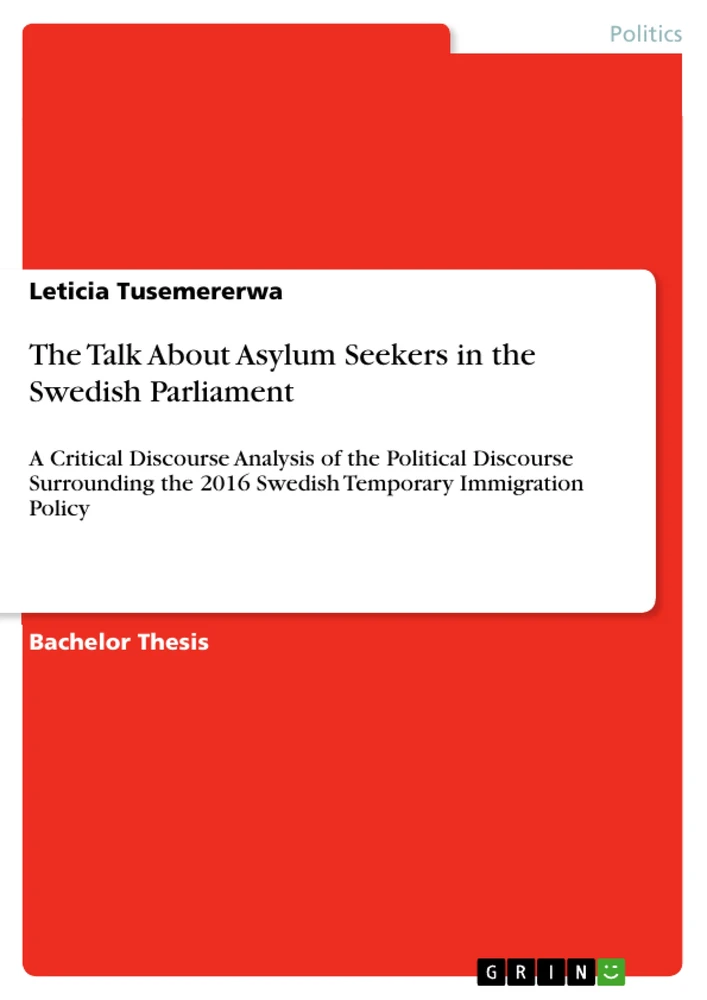
Table of contents
1. Introduction
1.1 Rationale for the study
1.2 Relevance to IMER-International Migration and Ethnic Relations
1.3 Research problem
1.4 Aim and Research Question
1.5 Materials and data collection:
1.6 Definitions
1.7 Previous Research
1.7.1 Immigration policy history in Sweden
1.7.2 Political discourse and construction of asylum seekers
1.8 Delimitation
1.9 Disposition
2. Conceptual and theoretical framework
2.1 The “Othering”
2.2 The “Stranger” and moral panic
2.3 Elements of ‘othering’
3. Methodology
3.1 Critical Discourse Analysis method
3.2 Ethics, Validity, and Reliability
4. Findings and Analysis
4.1 Construction of asylum seekers in the temporary policy propositional paper and parliamentary debate
4.1.1 An Overload and Strain on the asylum and social system
4.1.2 Threat to Integration system
4.1.3 Threat to National Security
4.1.4 Economic burden
4.1.5 Queue-jumpers
4.1.6 Liars
4.1.7 Criminals
4.1.8 Morally deviant
4.1.9 Humans in need of humanitarian aid
4.1.10 Tool for integration
4.2 Contribution of the construction of asylum seekers in the 2016 Swedish temporary immigration propositional paper and parliamentary debate on the theory and concept of ‘othering'
5. Discussions and Conclusion
5.1 Further Research
Research Objectives and Themes
The primary aim of this research is to critically examine the political-parliamentary discourse in Sweden during 2016, specifically focusing on how asylum seekers were constructed during the debate and the proposal of the temporary immigration policy. The study explores how these discursive constructions contribute to the sociological theory of "Othering" and analyzes the subjective and objective impacts on asylum seekers.
- The discursive construction of asylum seekers within the Swedish parliament.
- Application of the "Othering" theory to analyze political rhetoric.
- Evaluation of the restrictive 2016 immigration policy measures.
- Analysis of the intersection between political language and the stigmatization of migrants.
Excerpt from the book
4.1.1 An Overload and Strain on the asylum and social system
The discourse regarding asylum seekers placing a strain on the country’s asylum and social system in restrictive immigration policies is not uncommon. While analysing the Canadian Immigration pact Huot et al (2015) found forced migrants are deemed as a threat to the asylum system’s integrity due to human smuggling. Also, Grove et al. (2006) citing Tazreiter state that public perceptions of refugees and asylum seekers as an overload straining the asylum and nation-states public system in many developed countries are one of the difficulties facing refugees and asylum seekers. Both these statements justifying the case of how asylum seekers are discursively constructed as the threat to the asylum and social systems is relevant in the case of Sweden due to the record numbers of asylum seekers in 2015 that challenged the country’s asylum and other central societal systems like hospitals (Prop, 2015/16:174). In this case, the increased number asylum seekers are believed to collapse the asylum and social system if their number is not minimised. The quotes below support the statement of asylum seekers being constructed as a threat overloading and straining the asylum and social system in the 2016 temporary Immigration policy.
Summary of Chapters
1. Introduction: This chapter provides the background on the 2015/2016 refugee crisis in Sweden, establishes the research problem regarding political discourse, and outlines the research aims and definitions.
2. Conceptual and theoretical framework: This section details the theoretical foundation of the study, focusing on the concepts of "Othering," the "Stranger," and moral panic as tools for analysis.
3. Methodology: This chapter introduces the Critical Discourse Analysis (CDA) method, its relevance to the study, and discusses ethics, validity, and reliability.
4. Findings and Analysis: This chapter presents the empirical data, illustrating how asylum seekers were categorized through various lenses such as economic burden, security threats, and moral deviance, as well as counter-narratives of humanitarian need.
5. Discussions and Conclusion: This chapter synthesizes the findings, discusses the implications of political "Othering" on asylum seekers' rights and societal integration, and suggests areas for future research.
Keywords
Swedish 2016 Temporary Immigration Policy, political discourse, parliamentary discourse, othering, stranger, asylum seekers, refugee crisis, restrictive legislation, migration, social construction, critical discourse analysis, national security, marginalization, moral panic.
Frequently Asked Questions
What is the core subject of this thesis?
The research examines the political-parliamentary discourse in Sweden during the adoption of the 2016 temporary immigration policy and how asylum seekers were linguistically and politically constructed during this period.
What are the central themes of the work?
Key themes include the political "Othering" of migrants, the framing of asylum seekers as economic or security threats, the tension between humanitarian obligations and restrictive policies, and the role of parliamentary language in shaping public perception.
What is the primary objective of the study?
The goal is to understand how asylum seekers were represented in Swedish parliamentary debates and how these representations contribute to the concept of "Othering," thereby affecting the treatment and social standing of asylum seekers.
Which methodology is employed for this research?
The researcher uses Critical Discourse Analysis (CDA), specifically drawing on Fairclough’s three-dimensional framework, to analyze the propositional parliamentary paper and the associated parliamentary debates.
What topics are covered in the main body?
The analysis covers how parliamentarians used specific narratives—such as the threat to the welfare system, national security risks, criminality, and "queue-jumping"—to justify the shift toward more restrictive immigration laws.
Which keywords best characterize the work?
Important keywords include "Othering," "Political discourse," "Asylum seekers," "Swedish 2016 Temporary Immigration Policy," and "Critical Discourse Analysis."
How does the author define "Othering" in the context of this study?
The author uses the concept to describe the process of differentiation and stigmatization, where a dominant group (the "us") defines an out-group (asylum seekers) as deviant, fragile, or threatening to maintain national identity.
What conclusion does the author draw regarding the impact of these discourses?
The author concludes that such political rhetoric legitimizes restrictive policies, triggers prejudice, and leads to the social exclusion of asylum seekers, suggesting a need to shift from a focus on "state interest" toward a "moral duty" in political language.
Ende der Leseprobe aus 54 Seiten
- nach oben
- Arbeit zitieren
- Leticia Tusemererwa (Autor:in), 2017, The Talk About Asylum Seekers in the Swedish Parliament, München, Page::Imprint:: GRINVerlagOHG, https://www.diplomarbeiten24.de/document/450113

neugierig - aktuell - relevant
Entdecken Sie hilfreiche Tipps und Tricks rund ums Studium!

Entdecken Sie hilfreiche Tipps und Tricks rund ums Studium!
Ihre Hausarbeit / Abschlussarbeit:

- - Publikation als E-Book und Buch
- - Hohes Honorar auf die Verkäufe
- - Für Sie komplett kostenlos - mit ISBN
- - Es dauert nur 5 Minuten
- - Jede Arbeit findet Leser

- © GRIN Publishing GmbH.
- Alle Inhalte urheberrechtlich geschützt. Kopieren und verbreiten untersagt.
- info@grin.com
- AGB
- Open Publishing
Der GRIN Verlag hat sich seit 1998 auf die Veröffentlichung akademischer eBooks und Bücher spezialisiert. Der GRIN Verlag steht damit als erstes Unternehmen für User Generated Quality Content. Die Verlagsseiten GRIN.com, Hausarbeiten.de und Diplomarbeiten24 bieten für Hochschullehrer, Absolventen und Studenten die ideale Plattform, wissenschaftliche Texte wie Hausarbeiten, Referate, Bachelorarbeiten, Masterarbeiten, Diplomarbeiten, Dissertationen und wissenschaftliche Aufsätze einem breiten Publikum zu präsentieren.
Kostenfreie Veröffentlichung: Hausarbeit, Bachelorarbeit, Diplomarbeit, Dissertation, Masterarbeit, Interpretation oder Referat jetzt veröffentlichen!
Folgen Sie GRIN auf


- GRIN Verlag GmbH
-
- Nymphenburger Str. 86
- 80636
- Munich, Deutschland
- +49 89-550559-0
- +49 89-550559-10
- info@grin.com
-
