
präsentiert von

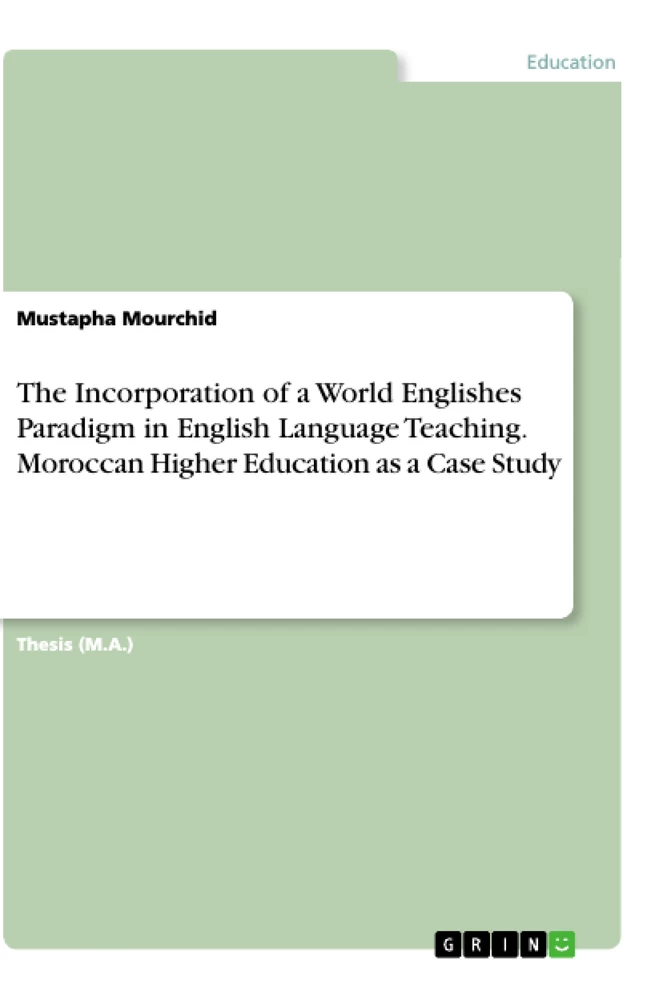
Table of Contents
Chapter one: Introduction
1. Summary and key terms
2. Introduction and contextualization
3. Aim and research questions
4. Contextual background
5. Methodology
Chapter two: Introducing World Englishes
1. The spread of English
1.1 ENL, ESL, EFL
1.2 Inner Circle, Outer Circle, Expanding Circle
2. Native speakers vs. non-native speakers of English: a controversy in World Englishes
3. Who owns English today?
4. Standard English vs. non-standard Englishes
5. Interlanguage and fossilization
6. English today debate
6.1 Phillipson’s Linguistic Imperialism
6.2 The Kachru-Quirk Debate
7. World Englishes
8. English as an international language and English as a lingua franca
Chapter three: World Englishes, applied linguistics and ELT
1. Integrating language variation in TESOL programs
2. World Englishes and composition
3. World Englishes and English literatures
4. World Englishes and test evaluation
5. Using functional approaches in teaching World Englishes
6. Native speaker English teachers
Chapter four: Research methodology
1. Restating research questions
2. Instruments of data collection
2.1 Survey
2.1.1 Subjects
2.1.2 Method
2.2 Interview
2.2.1 Subjects
2.2.2 Method
3. Participants in figures
Chapter five: Data analysis and discussion
1. Introduction
2. The purpose of learning/ teaching English in Morocco
2.1 University professors’ reported answers
2.2 Master students’ reported answers
2.3 BA holders’ reported answers
3. The different varieties of English
3.1 University professors’ reported answers
3.2 Master students’ reported answers
3.3 BA holders’ reported answers
4. The use of ICT tools in teaching varieties of English
4.1 University professors’ reported answers
4.2 Master students’ reported answers
5. The issue of NETs vs. NNETs
5.1 University professors’ reported answers
5.2 Master students reported answers
6. The issue of a standard English
6.1 University professors’ reported answers
6.2 Master students’ reported answers
6.3 BA holders’ reported answers
7. The integration of a World Englishes paradigm in ELT in Moroccan Higher Education
7.1 University professors’ reported perceptions
7.2 Master students’ reported perceptions
7.3 BA holders’ reported perceptions
Chapter six: Conclusion and recommendations
1. Findings
1.1 The purpose of learning/ teaching English in Morocco
1.2 The different varieties of English
1.3 The use of ICT tools in teaching varieties of English
1.4 The issue of NETs vs. NNETs
1.5 The issue of a standard variety
1.6 The integration of a World Englishes paradigm in ELT in Moroccan Higher Education
2. Limitations of the study
3. Suggestions for further research
4. Conclusion
Objectives & Research Questions
This study aims to investigate the incorporation of a World Englishes (WEs) paradigm into English Language Teaching (ELT) within the Moroccan higher education system. The research seeks to explore the perceptions and attitudes of key stakeholders—university professors, Master students, and BA holders—regarding this paradigm, while evaluating how such an approach could potentially enhance the sociolinguistic awareness of Moroccan learners and better prepare them for their future professional careers in a globalized context.
- Investigating the current perceptions of Moroccan academics and students toward the World Englishes paradigm.
- Analyzing the gap between theoretical knowledge of English variation and pedagogical practices in Moroccan universities.
- Exploring the role of Information and Communication Technology (ICT) in teaching diverse varieties of English.
- Evaluating the attitudes toward native speaker (NETs) versus non-native speaker (NNETs) English teachers.
- Assessing the relevance of standard language ideology versus the reality of pluricentric English usage.
Book Excerpt
1. The Spread of English
Because of the global spread of English and because of the increasing interest in learning it either as a second language or a foreign language, English has recently enjoyed a dominant position among the languages of the world. Kachru (1991, p. 180), for example, pointed out that “English has acquired unprecedented sociological and ideological dimensions.”
The spread of English has been discussed by different scholars in different ways; however, the spread of English, according to Jenkins (2009, p. 15), “is often discussed in terms of three distinct groups of users, those who speak English respectively as”:
a native language (ENL)
a second language (ESL)
a foreign language (EFL)
English as Native Language is defined by Jenkins as “the language of those born and raised in one of the countries where English is historically the first language to be spoken.” She argued that speakers of English as a native language are said to number around 350 million. (Jenkins, 2009)
English as a Second Language is defined by Jenkins as “the language spoken in a large number of territories such as India, Bangladesh, Nigeria and Singapore, which were once colonized by the English”. Again, she argued that speakers of English as a second language are said to number around 350 million. (Jenkins, 2009)
English as a Foreign Language, as is defined by Jenkins, is “the language of those for whom the language serves no purposes within their countries”. These people have historically “learned the language in order to use it with its native speakers in the US and UK- though this is no longer the case”. The number of speakers of EFL, according to Jenkins, is more difficult to assess, and much depends of the level of competence which is used to identify such a speaker. She, however, stated that if “we use the criterion of ‘reasonable competence’, then the number is likely to be around 1 billion (although it should be said that this figure is not uncontroversial)”.
Summary of Chapters
Chapter one: Introduction: This chapter outlines the study's aim to investigate the incorporation of the World Englishes paradigm in Morocco and details the mixed-method research approach used.
Chapter two: Introducing World Englishes: This chapter provides the theoretical foundation, discussing the global spread of English, Kachru’s concentric circles model, and debates surrounding native speaker ownership and linguistic standards.
Chapter three: World Englishes, applied linguistics and ELT: This chapter examines the relationship between World Englishes research and current ELT practices, focusing on curriculum design, writing instruction, and the role of literature and testing.
Chapter four: Research methodology: This chapter describes the research design, including the instruments used for data collection (surveys and interviews) and profiles the study participants.
Chapter five: Data analysis and discussion: This chapter presents the empirical data gathered from university professors, Master students, and BA holders, analyzing their perceptions of English varieties, ICT usage, and teacher identity.
Chapter six: Conclusion and recommendations: This chapter summarizes the research findings, highlights study limitations, and offers suggestions for future research regarding the sociolinguistic reality of English in Morocco.
Keywords
World Englishes, English Language Teaching, ELT, Morocco, sociolinguistics, applied linguistics, English as a Lingua Franca, Kachru, linguistic variation, standard English, higher education, mixed methodology, Inner Circle, Outer Circle, Expanding Circle.
Frequently Asked Questions
What is the primary focus of this thesis?
The thesis focuses on the potential incorporation of a World Englishes paradigm into the English Language Teaching curriculum within Moroccan higher education, moving beyond the traditional focus on native-speaker varieties.
What are the central thematic areas discussed?
The study covers the spread of English, the controversy surrounding native vs. non-native speakers, the role of ICT in teaching English variation, and the debate between monocentric and pluricentric approaches to English.
What is the main research objective?
The objective is to determine the attitudes of Moroccan university stakeholders toward a World Englishes approach and to explore how such an approach might help learners develop critical sociolinguistic awareness.
Which research methodology does the author employ?
The author uses a mixed-method approach, gathering both qualitative and quantitative data through surveys distributed to university professors and BA holders, and semi-structured interviews conducted with Master students.
What does the main body of the work cover?
The main body examines the theoretical background of World Englishes, the intersection of applied linguistics with ELT, and an extensive analysis of the survey and interview data collected from Moroccan participants.
Which keywords best characterize this research?
The work is best characterized by terms such as World Englishes, Moroccan Higher Education, sociolinguistic awareness, ELT, linguistic variation, and pluricentricity.
How is "Moroccan English" defined in this study?
The study highlights that participants refer to "Moroccan English" as the English taught and spoken in Morocco, which is naturally influenced by the local linguistic landscape, including French, Arabic, and Amazigh.
What is the author's conclusion regarding current teacher preferences?
The author concludes that while professors are theoretically aware of World Englishes, there remains a significant gap between this awareness and their actual pedagogical practices, which continue to prioritize Inner Circle (British/American) varieties.
What limitations does the author acknowledge regarding the study?
The author notes that the research was constrained by a small sample size (22 participants across 8 universities) and that the data collection occurred during the summer break, which may have impacted the results.
Does the author suggest that World Englishes should be a separate module?
The majority of participants, as noted by the author, believe that World Englishes should not necessarily be a standalone module, but rather integrated into existing courses like grammar, sociolinguistics, and applied linguistics.
Ende der Leseprobe aus 78 Seiten
- nach oben
- Arbeit zitieren
- Mustapha Mourchid (Autor:in), 2018, The Incorporation of a World Englishes Paradigm in English Language Teaching. Moroccan Higher Education as a Case Study, München, Page::Imprint:: GRINVerlagOHG, https://www.diplomarbeiten24.de/document/451980

neugierig - aktuell - relevant
Entdecken Sie hilfreiche Tipps und Tricks rund ums Studium!

Entdecken Sie hilfreiche Tipps und Tricks rund ums Studium!
Ihre Hausarbeit / Abschlussarbeit:

- - Publikation als E-Book und Buch
- - Hohes Honorar auf die Verkäufe
- - Für Sie komplett kostenlos - mit ISBN
- - Es dauert nur 5 Minuten
- - Jede Arbeit findet Leser

- © GRIN Publishing GmbH.
- Alle Inhalte urheberrechtlich geschützt. Kopieren und verbreiten untersagt.
- info@grin.com
- AGB
- Open Publishing
Der GRIN Verlag hat sich seit 1998 auf die Veröffentlichung akademischer eBooks und Bücher spezialisiert. Der GRIN Verlag steht damit als erstes Unternehmen für User Generated Quality Content. Die Verlagsseiten GRIN.com, Hausarbeiten.de und Diplomarbeiten24 bieten für Hochschullehrer, Absolventen und Studenten die ideale Plattform, wissenschaftliche Texte wie Hausarbeiten, Referate, Bachelorarbeiten, Masterarbeiten, Diplomarbeiten, Dissertationen und wissenschaftliche Aufsätze einem breiten Publikum zu präsentieren.
Kostenfreie Veröffentlichung: Hausarbeit, Bachelorarbeit, Diplomarbeit, Dissertation, Masterarbeit, Interpretation oder Referat jetzt veröffentlichen!
Folgen Sie GRIN auf


- GRIN Verlag GmbH
-
- Nymphenburger Str. 86
- 80636
- Munich, Deutschland
- +49 89-550559-0
- +49 89-550559-10
- info@grin.com
-
