
präsentiert von

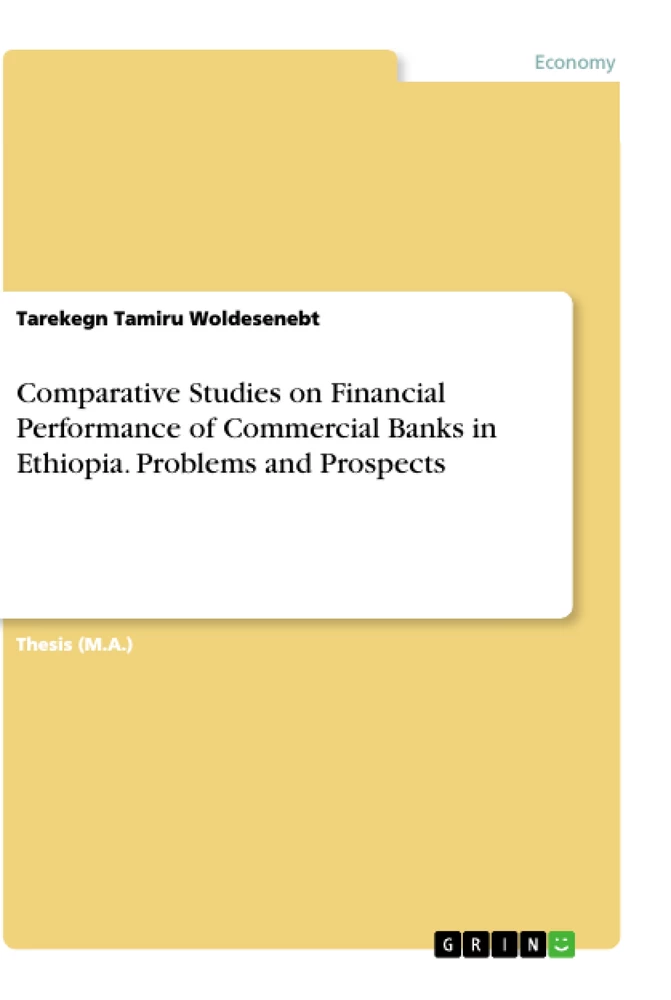
Table of Contents
CHAPTER ONE
INTRODUCTION
1.1 BACK GROUD OF THE STUDY
1.2 STATEMENT OF THE PROBLEM
1.3 RESEARCH QUESTION
1.4 OBJECTIVES OF THE STUDY
1.4.1 GENERAL OBJECTIVE
1.4.2 SPECIFIC OBJECTIVES
1.5 SCOPE AND LIMITATION OF THE STUDY
1.6 SIGNIFICANCE OF THE STUDY
1.7 ORGANIZATION OF THE STUDY
CHAPTER TWO
REVIEW OF LITERATURE
2.1 DEFINITION OF IMPORTANT TERMS
2.2 MEASURES OF FINANCIAL PERFORMANCE
2.2.1 RATIO ANALYSIS
2.2.2 TREND ANALYSIS
2.2.3 HORIZONTAL ANALYSIS
2.2.4 VERTICAL ANALYSIS
2.2.5 THE ROLE OF A FINANCIAL STATEMENT
2.2.6 USERS OF FINANCIAL STATEMENTS
2.3 EMPIRICAL EVIDENCE
2.3.1 EVIDENCE FROM INTERNATIONAL
2.3.2 EVIDENCE FROM AFRICA
2.3.3 EVIDENCE FROM ETHIOPIA
CHAPTER THREE
RESEARCH METHODOLOGY
3.1 DESIGN
3.2 THE SAMPLE SIZE AND SAMPLING TECHNIQUES
3.3 SAMPLING TECHNIQUE
3.4 DATA COLLECTION METHODS
3.5 DATA MEASUREMENTS
3.6 METHOD OF DATA ANALYSIS
3.7 BACKGROUND OF THE BANKING INDUSTRY IN ETHIOPIA
CHAPTER FOUR
RESULTS AND DISCUSSIONS
4.1 ANALYIS FROM SECONDARY DATA SOURCES
4.1.1 COMPARATIVE ANALYSIS OF COMMERCIAL BANKS
4.1.2 TREND ANALYSIS OF COMMERCIAL BANKS
4.2 DATA FROM PRIMARY DATA SOURCES
4.2.1 PROBLEMS OF COMMERCIAL BANKS
4.2.2 FUTURE PROSPECTS OF THE COMMERCIAL BANKS
CHAPTER FIVE
CONCLUSIONS AND RECOMMENDATIONS
5.1 CONCLUSIONS
5.2 RECOMMENDATIONS
Objectives and Topics
The primary objective of this research is to perform a comparative study on the financial performance of major commercial banks in Ethiopia by analyzing specific financial ratios (profitability, liquidity, efficiency, and solvency) over the period 2005-2009. The study evaluates the operational effectiveness of these institutions and identifies internal and external challenges, while offering recommendations for improved financial management.
- Comparative financial performance analysis of six Ethiopian commercial banks.
- Trend analysis using profitability, liquidity, efficiency, and solvency indicators.
- Evaluation of managerial effectiveness in cost reduction and revenue generation.
- Assessment of current banking sector challenges, including infrastructure and policy influences.
- Future prospects and strategic opportunities for the Ethiopian banking industry.
Excerpt from the book
1.1 BACK GROUD OF THE STUDY
Commercial bank is financial institution that offers a wide variety of services including checking accounts and business loans (Ritter et al. 1997). Moreover, commercial bank can be defined as a deposit intermediary that accepts deposits and makes loans (Smith 1999). Thus, commercial bank is an institution that accept deposits, pay interest, clear checks, make loans, act as an intermediary in financial transactions, and provide other financial services to its customers.
There is a close relationship between the well being of the banking industry and the general growth of the economy as a whole, (Rajan et.al 1998). This demonstrates that a country banking sector development have a potential to the growth of the whole economy. Hence, knowledge of the core variables that influence the performance of the commercial bank are essential for the bank management, national banks, governments, and other interested parties.
Hossain and Bhuiyan (1990) stated that there is no universally accepted operational definition of performance measures. In broad sense performance level of an enterprise can be measured by the extent of its organizational effectiveness. In the context of services rendered towards public the performance of an organization can be viewed as the extent to which its work is carried out within established specifications for goods and services produced, to the general satisfaction of the clientele served, within given cost and time constraints, and in such a manner as to support or contribute to the achievement of the organization objectives.
Bhattacharya (2007) pointed out that six major recent policy measures that influence the performance of the commercial bank which includes reduction of bank rate and lending rate, linking classified loans to large loan sanctioning, rationalization and merger of bank branches, measures for loan recovery, and demarcation of responsibilities between the management and the board and decision on cash reserve ratio.
Summary of Chapters
CHAPTER ONE: INTRODUCTION: Provides an overview of the role of commercial banks in the economy, states the research problem, and defines the scope, objectives, and research questions of the study.
CHAPTER TWO: REVIEW OF LITERATURE: Establishes the theoretical framework by defining key banking terms and explaining various financial performance measures such as ratio, trend, horizontal, and vertical analyses.
CHAPTER THREE: RESEARCH METHODOLOGY: Details the research design, sampling techniques used to select the six banks, data collection methods (secondary and primary), and the specific financial variables used for analysis.
CHAPTER FOUR: RESULTS AND DISCUSSIONS: Presents the findings of the comparative and trend analyses based on financial statements and primary data collected through interviews regarding problems and prospects.
CHAPTER FIVE: CONCLUSIONS AND RECOMMENDATIONS: Summarizes the key findings regarding the performance of the sampled banks and provides strategic recommendations for management and policy improvement.
Keywords
Profitability, Liquidity, Solvency, Efficiency, Commercial Banks, Financial Performance, Ratio Analysis, Trend Analysis, Ethiopia, Asset Management, Capital Reserve, Banking Reform, Interest Margin, Credit Risk, Debt-Equity Ratio
Frequently Asked Questions
What is the core focus of this research?
The research focuses on the financial performance of commercial banks in Ethiopia, comparing performance metrics among six major institutions between 2005 and 2009.
What are the central themes covered in the study?
The study covers profitability, liquidity, solvency, and efficiency ratios, alongside an examination of the historical and policy context of the Ethiopian banking industry.
What is the primary objective of this work?
The primary objective is to use average financial ratios to compare and assess the performance of Ethiopian commercial banks and provide actionable recommendations for enhancing their profitability and efficiency.
Which scientific methodology is applied?
The study employs a quantitative and descriptive research design, utilizing both trend and comparative analysis approaches, and incorporates qualitative data gathered through unstructured interviews.
What is addressed in the main chapters?
The chapters transition from theoretical literature and research methodology to a detailed quantitative analysis of secondary financial data and an exploration of operational challenges and future prospects.
Which keywords best characterize this work?
Key terms include Profitability, Liquidity, Solvency, Efficiency, Banking Reform, and Financial Statement Analysis.
How does this study evaluate the efficiency of commercial banks?
It utilizes specific efficiency indicators such as the Asset Utilization Ratio (AUR) and the Income to Expense Ratio (IER) to measure how effectively banks generate revenue relative to their assets and operating expenses.
What specific challenges do Ethiopian commercial banks face according to the interviews?
Challenges identified include internal issues like misaligned employee mindsets and weak lending practices, as well as external factors such as foreign currency shortages, infrastructure limitations, and state bank market dominance.
What are the reported future prospects for the banks?
Prospects include deregulation, consolidation, geographic expansion, the technological revolution (e.g., ATM and mobile banking), and the potential for globalization through financial sector liberalization.
Ende der Leseprobe aus 82 Seiten
- nach oben
- Arbeit zitieren
- Tarekegn Tamiru Woldesenebt (Autor:in), 2011, Comparative Studies on Financial Performance of Commercial Banks in Ethiopia. Problems and Prospects, München, Page::Imprint:: GRINVerlagOHG, https://www.diplomarbeiten24.de/document/452215

neugierig - aktuell - relevant
Entdecken Sie hilfreiche Tipps und Tricks rund ums Studium!

Entdecken Sie hilfreiche Tipps und Tricks rund ums Studium!
Ihre Hausarbeit / Abschlussarbeit:

- - Publikation als E-Book und Buch
- - Hohes Honorar auf die Verkäufe
- - Für Sie komplett kostenlos - mit ISBN
- - Es dauert nur 5 Minuten
- - Jede Arbeit findet Leser

- © GRIN Publishing GmbH.
- Alle Inhalte urheberrechtlich geschützt. Kopieren und verbreiten untersagt.
- info@grin.com
- AGB
- Open Publishing
Der GRIN Verlag hat sich seit 1998 auf die Veröffentlichung akademischer eBooks und Bücher spezialisiert. Der GRIN Verlag steht damit als erstes Unternehmen für User Generated Quality Content. Die Verlagsseiten GRIN.com, Hausarbeiten.de und Diplomarbeiten24 bieten für Hochschullehrer, Absolventen und Studenten die ideale Plattform, wissenschaftliche Texte wie Hausarbeiten, Referate, Bachelorarbeiten, Masterarbeiten, Diplomarbeiten, Dissertationen und wissenschaftliche Aufsätze einem breiten Publikum zu präsentieren.
Kostenfreie Veröffentlichung: Hausarbeit, Bachelorarbeit, Diplomarbeit, Dissertation, Masterarbeit, Interpretation oder Referat jetzt veröffentlichen!
Folgen Sie GRIN auf


- GRIN Verlag GmbH
-
- Nymphenburger Str. 86
- 80636
- Munich, Deutschland
- +49 89-550559-0
- +49 89-550559-10
- info@grin.com
-
