
präsentiert von

List of contents
1. Introduction
1.1 Background of the subject
1.2 Outline of the research aims and objectives
1.3 Rationale for the research questions
1.4 Outline of the structure of the dissertation
2. Literature review
2.1 Outline of the literature review
2.2 Studies on characteristics of offender-accountants
2.3 Studies on characteristics of white-collar criminals
3. Methodology
3.1 Research design
3.2 Methods of data collection
3.3 Methods of data analysis
3.4 Advantages and disadvantages of the methods used
3.5 Ethical considerations
4. Results
4.1 Personal characteristics
4.1.1 Age
4.1.2 Gender
4.1.3 Marital status
4.1.4 Educational level
4.1.5 Addiction
4.2 Professional standing
4.2.1 Occupational rank
4.2.2 Length of service
4.2.3 History of previous offenses
4.3 Victimology
4.4 International scope of offenses
4.5 Study of offenses
4.5.1 Financial offenses (FINANCE)
4.5.1.1 Audit related offenses (AUDIT)
4.5.1.2 Offenses related to preparation and filing of financial statements (P&FFS)
4.5.1.3 Tax related offenses (TAX)
4.5.1.4 Other financial offenses (OFIN)
4.5.2 Non-financial offenses (NON-FIN)
4.5.3 Disciplinary offenses (DISCIP)
4.5.4 Social offenses (SOCIAL)
4.5.5 Concluding remarks on the study of offenses
4.6 Collusion
4.7 Damages caused
4.8 Duration of offenses
4.9 Method of detection
4.10 Penalties
4.10.1 Monetary penalties
4.10.2 Non-monetary penalties
4.10.2.1 Disciplinary penalties
4.10.2.2 Public administrative penalties
4.10.2.3 Criminal penalties
5. Conclusion
5.1 Answering the research questions
5.2 Challenges of research
5.3 Recommendations for future research
Research Objectives and Key Themes
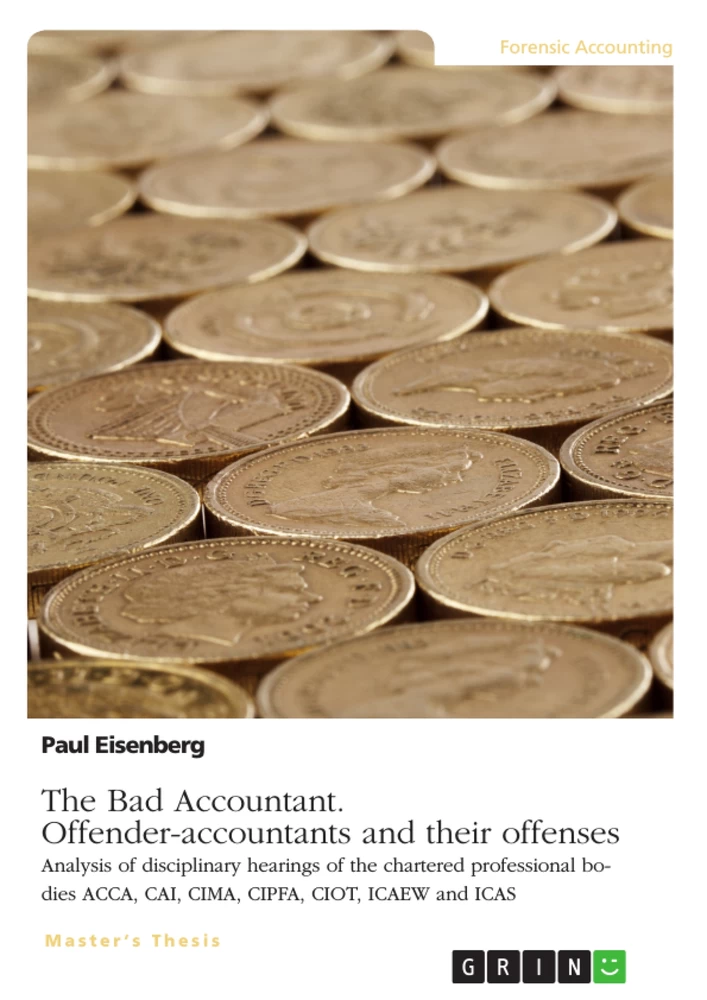
This dissertation aims to analyze the demographic characteristics of the homogeneous group of white-collar crime offenders who are qualified accountants and members of UK chartered professional bodies. Beyond demographics, the research elaborates on the crimes committed, methods of detection, and the disciplinary and penal regimes applied to these professionals.
- Demographic profiling of delinquent accountants (age, gender, marital status).
- Analysis of the types of financial and disciplinary offenses committed.
- Examination of victimology and the international scope of offenses.
- Evaluation of detection methods and disciplinary penalty structures.
- Comparison of findings with existing white-collar crime theories and statistics.
Auszug aus dem Buch
1.1 Background of the subject
Disciplinary and judicial action against accountants has attracted academic attention in the recent past. But this has not always been the case. Why?
During the last decades, academic literature and mass media have broadly covered the never-ending stream of deceit, fraud and monetary delinquency (Friedrichs, 2010). However, literature has essentially focussed on CEO / top management crimes. This interest was caused by the fraudulent involvement of the upper corporate echelons in highflying cases like Tesco (Merison, 2014) and the LIBOR scandal (Hou, & Skeie, 2014) in the UK, Enron (Schilit, & Perler, 2010) and WorldCom (Zerkany, Braun, & Warder, 2004) in the USA or Satyam (Niazi, & Ali, 2015) and Toshiba (Rahman, & Marc, 2016) internationally. Although many CFOs / CEOs happened to be qualified accountants (Bhasin, 2013), delinquent accountants as a group have attracted less scholarly attention. This is surprising, as several studies point out that the accounting profession is not exempt from sin. The trilogy of the accounting Professor Abraham Briloff (1981, 1976, 1972) shows on numerous occasions how accountants engage in fraudulent financial reporting. In more recent studies, Professor Prem Sikka demonstrates how accountants develop and commercialise tax avoidance schemes (Sikka, 2016, 2015; Sikka, & Willmott, 2013).
But things are changing now. With the works of Andon, Free and Scard (2015), Krom (2016), Mescall, Phillips and Schmidt (2017) and many others, that will be addressed in this dissertation, offender-accountants are becoming subject to academic scrutiny.
Summary of Chapters
1. Introduction: Introduces the background of accounting-related white-collar crime and outlines the aims, research questions, and structure of the dissertation.
2. Literature review: Reviews existing studies on offender-accountants and general white-collar criminals to establish theoretical and empirical benchmarks.
3. Methodology: Details the research design, data collection via disciplinary hearings, content analysis methods, and the scope of analyzed bodies.
4. Results: Presents the findings regarding personal characteristics, professional standing, victimology, and the nature of offenses and penalties.
5. Conclusion: Synthesizes the results by answering the research questions and provides recommendations for professional bodies and future research.
Keywords
White-collar crime, accountant, disciplinary hearings, financial fraud, tax delinquency, audit failure, demographic profiling, recidivism, professional ethics, sanctions, victimology, embezzlement, corporate governance, content analysis, UK accounting profession.
Frequently Asked Questions
What is the fundamental focus of this dissertation?
The dissertation focuses on analyzing demographic characteristics and offenses committed by a specific, homogeneous group of white-collar offenders: qualified accountants who are members of UK chartered professional bodies.
What are the primary themes investigated in the study?
The study examines demographic profiles, professional standing, specific types of financial and disciplinary offenses, methods of offense detection, and the impact of disciplinary and criminal penalty regimes.
What is the core research objective?
The primary goal is to determine the characteristics of offender-accountants (RQ1) and to analyze the nature and frequency of the offenses they commit (RQ2) within the UK context.
Which scientific method is utilized for this research?
The study employs a content analysis of 2,596 publicly available disciplinary documents published by UK accountancy bodies and regulatory authorities between January 2012 and June 2017.
What topics are covered in the main body of the work?
The main body (Chapter 4) covers personal traits (age, gender, etc.), professional standing, victimology, the study of various financial and non-financial offenses, collusion, damages, and the efficacy of imposed penalties.
Which keywords characterize this research?
Key terms include white-collar crime, accountant, disciplinary hearings, financial fraud, tax delinquency, professional ethics, recidivism, and sanctions.
How does this study contribute to existing research on elderly offenders?
The dissertation reveals a surprisingly high rate of elderly offenders (60-65 years old) among accountants, which is significantly higher than what is typically observed in official crime statistics.
What does the study conclude regarding the recidivism of accountants?
The findings indicate a recidivist rate of 35.7%, which is above the UK adult reoffender rate, contradicting the popular assumption that financial delinquents generally have a clean prior history.
Ende der Leseprobe aus 160 Seiten
- nach oben
- Arbeit zitieren
- Paul Eisenberg (Autor:in), 2018, The Bad Accountant. Offender-accountants and their offenses, München, Page::Imprint:: GRINVerlagOHG, https://www.diplomarbeiten24.de/document/453024

neugierig - aktuell - relevant
Entdecken Sie hilfreiche Tipps und Tricks rund ums Studium!

Entdecken Sie hilfreiche Tipps und Tricks rund ums Studium!
Ihre Hausarbeit / Abschlussarbeit:

- - Publikation als E-Book und Buch
- - Hohes Honorar auf die Verkäufe
- - Für Sie komplett kostenlos - mit ISBN
- - Es dauert nur 5 Minuten
- - Jede Arbeit findet Leser

- © GRIN Publishing GmbH.
- Alle Inhalte urheberrechtlich geschützt. Kopieren und verbreiten untersagt.
- info@grin.com
- AGB
- Open Publishing
Der GRIN Verlag hat sich seit 1998 auf die Veröffentlichung akademischer eBooks und Bücher spezialisiert. Der GRIN Verlag steht damit als erstes Unternehmen für User Generated Quality Content. Die Verlagsseiten GRIN.com, Hausarbeiten.de und Diplomarbeiten24 bieten für Hochschullehrer, Absolventen und Studenten die ideale Plattform, wissenschaftliche Texte wie Hausarbeiten, Referate, Bachelorarbeiten, Masterarbeiten, Diplomarbeiten, Dissertationen und wissenschaftliche Aufsätze einem breiten Publikum zu präsentieren.
Kostenfreie Veröffentlichung: Hausarbeit, Bachelorarbeit, Diplomarbeit, Dissertation, Masterarbeit, Interpretation oder Referat jetzt veröffentlichen!
Folgen Sie GRIN auf


- GRIN Verlag GmbH
-
- Nymphenburger Str. 86
- 80636
- Munich, Deutschland
- +49 89-550559-0
- +49 89-550559-10
- info@grin.com
-
