
präsentiert von


Table of Contents
1. Introduction
2. Violence – Definitions
2.1 Physical Violence
2.2 Physical Violence in the Era of Slavery and Jim Crow
2.3 Structural Violence
2.4 Structural Violence in the Era of Slavery and Jim Crow
2.5 Power and Dominance - Symbolic Violence
3. The Representation of Violence in Douglass` Narrative
3.1 The Impact of (Sub-) Genre on the Representation of Physical Violence in Slave Narratives
3.2 Physical Violence in Douglass` Narrative
3.3 Symbolic Violence in Douglass` Narrative
3.4 Structural Violence in Douglass` Narrative
4. The Representation of Violence in Richard Wright’s Autobiography Black Boy
4.1 Black Boy – An Afro-American Autobiography and Its Intricacy of Depicting Violence
4.2 Structural Violence in Black Boy
4.3 Physical Violence in Black Boy
4.4 Symbolic Violence in Black Boy
5. The Representation of Violence – A Comparison between Douglass` Narrative and Wright`s Black Boy
6. Conclusion
Research Objectives and Themes
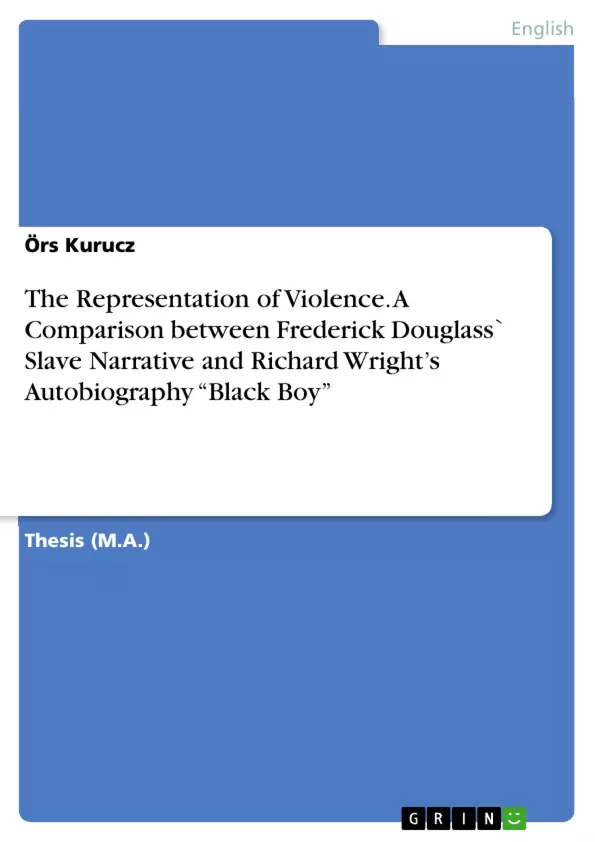
This thesis examines the representation of violence in Frederick Douglass's Narrative of the Life of Frederick Douglass, an American Slave and Richard Wright's Black Boy, exploring how these autobiographical works reflect the experiences of black individuals under slavery and the Jim Crow era, respectively. The central research question investigates the stylistic and thematic ways both authors portray physical, structural, and symbolic violence to critique the oppressive systems of their times.
- The differentiation between physical, structural, and symbolic forms of violence.
- The role of autobiography as a medium for social protest and individual testimony.
- A comparative analysis of how Douglass and Wright utilize literary devices to depict systemic oppression.
- The impact of institutionalized racism on the identity formation and psychological well-being of black individuals.
- The contrast between Douglass’s political abolitionist rhetoric and Wright’s naturalistic, disillusioned prose.
Excerpt from the Book
Physical Violence in Douglass` Narrative
He was a cruel man, hardened by a long life of slaveholding. He would at times seem to take great pleasure in whipping a slave. I have often been awakened at the dawn of day by the most heartrending shrieks of an own aunt of mine, whom he used to tie up to a joist, and whip upon her naked back till she was literally covered with blood. No words, no tears, no prayers, from his gory victim, seemed to move his iron heart from his bloody purpose.
Summary of Chapters
1. Introduction: Outlines the scope of the thesis, defining the focus on the representation of violence in two seminal Afro-American autobiographies and setting the methodological framework.
2. Violence – Definitions: Provides a theoretical basis for the study, categorizing violence into physical, structural, and symbolic forms and explaining their mechanisms of power and control.
3. The Representation of Violence in Douglass` Narrative: Analyzes how Douglass uses narrative techniques to document the brutality of slavery and expose the hypocrisy of slaveholders.
4. The Representation of Violence in Richard Wright’s Autobiography Black Boy: Explores Wright's naturalistic depiction of the pervasive violence and racism experienced in the Jim Crow South.
5. The Representation of Violence – A Comparison between Douglass` Narrative and Wright`s Black Boy: Synthesizes the findings by contrasting the stylistic, ideological, and thematic approaches of both authors.
6. Conclusion: Summarizes the thesis, reinforcing the importance of these autobiographies in documenting the historical and psychological impact of violence on black Americans.
Keywords
Violence, Physical Violence, Structural Violence, Symbolic Violence, Frederick Douglass, Richard Wright, Black Boy, Slave Narrative, Autobiography, Jim Crow, Racism, Oppression, Identity, Literacy, Abolitionism.
Frequently Asked Questions
What is the core focus of this thesis?
The thesis explores the manner in which violence—specifically physical, structural, and symbolic—is represented in the autobiographies of Frederick Douglass and Richard Wright.
What are the primary themes analyzed in these works?
Central themes include the systemic nature of racism, the function of literacy as a path to freedom, and the psychological impact of living in a culture of constant threat.
What is the primary research goal?
The goal is to illuminate how these authors utilize their life stories to critique the socio-political structures of slavery and the Jim Crow era, using their personal experiences as a "mirror" to society.
Which scientific methodology is applied?
The thesis employs a textual and stylistic analysis, examining rhetorical devices, narrative structure, and thematic content to compare the authors' ideological and literary strategies.
What topics are covered in the main body?
The main body details the definitions of violence, provides in-depth textual analyses of both autobiographies, and compares the authors' different approaches to depicting trauma and rebellion.
How are the works characterized by the keywords?
The works are characterized by their focus on systemic oppression, the struggle for agency, and the transition from a victimized state to a voice of resistance, as reflected in the provided keywords.
How does the author characterize Aunt Hester's experience in Douglass' narrative?
Douglass characterizes Aunt Hester's whipping as an explicit and disturbing act of cruelty, using it to establish the power imbalance between the sadistic oppressor and the helpless victim.
How does Wright describe the psychological effect of his childhood?
Wright describes a childhood defined by hunger, fear, and a sense of "lopsided" development, where the constant threat of violence from both white society and his own family forced him into a state of emotional withdrawal.
What is the significance of "the mask" in Wright's work?
It represents the survival strategy of concealing one's true feelings and thoughts in front of white authority to avoid becoming a target of racial violence.
Ende der Leseprobe aus 129 Seiten
- nach oben
- Arbeit zitieren
- Örs Kurucz (Autor:in), 2015, The Representation of Violence. A Comparison between Frederick Douglass` Slave Narrative and Richard Wright’s Autobiography “Black Boy”, München, Page::Imprint:: GRINVerlagOHG, https://www.diplomarbeiten24.de/document/453330

neugierig - aktuell - relevant
Entdecken Sie hilfreiche Tipps und Tricks rund ums Studium!

Entdecken Sie hilfreiche Tipps und Tricks rund ums Studium!
Ihre Hausarbeit / Abschlussarbeit:

- - Publikation als E-Book und Buch
- - Hohes Honorar auf die Verkäufe
- - Für Sie komplett kostenlos - mit ISBN
- - Es dauert nur 5 Minuten
- - Jede Arbeit findet Leser

- © GRIN Publishing GmbH.
- Alle Inhalte urheberrechtlich geschützt. Kopieren und verbreiten untersagt.
- info@grin.com
- AGB
- Open Publishing
Der GRIN Verlag hat sich seit 1998 auf die Veröffentlichung akademischer eBooks und Bücher spezialisiert. Der GRIN Verlag steht damit als erstes Unternehmen für User Generated Quality Content. Die Verlagsseiten GRIN.com, Hausarbeiten.de und Diplomarbeiten24 bieten für Hochschullehrer, Absolventen und Studenten die ideale Plattform, wissenschaftliche Texte wie Hausarbeiten, Referate, Bachelorarbeiten, Masterarbeiten, Diplomarbeiten, Dissertationen und wissenschaftliche Aufsätze einem breiten Publikum zu präsentieren.
Kostenfreie Veröffentlichung: Hausarbeit, Bachelorarbeit, Diplomarbeit, Dissertation, Masterarbeit, Interpretation oder Referat jetzt veröffentlichen!
Folgen Sie GRIN auf


- GRIN Verlag GmbH
-
- Nymphenburger Str. 86
- 80636
- Munich, Deutschland
- +49 89-550559-0
- +49 89-550559-10
- info@grin.com
-
