
präsentiert von

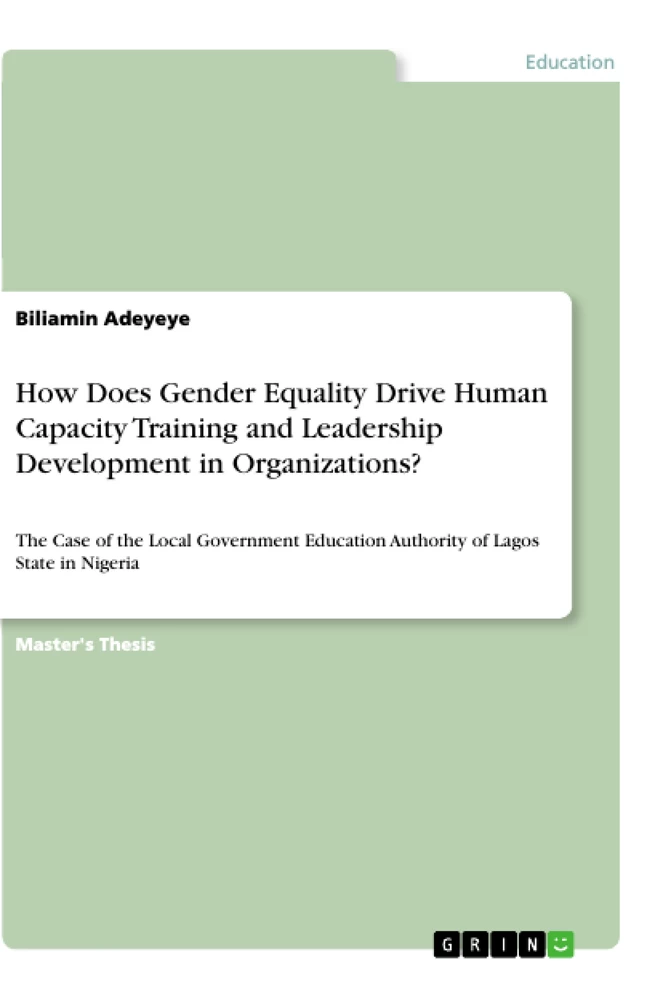
Table of Contents
1 INTRODUCTION
1.1 Background of the study
1.2 Statement of the Problem
1.3 Purpose of the Study
1.4 Hypotheses
1.5 Significance of the Study
1.6 Scope of the Study
1.7 Operational definition of Terms
2 REVIEW OF RELATED LITERATURES
2.1 Conceptual Review
2.2 Concept of Gender
2.2.1 Concept of Gender Equity and Equality
2.2.2 Concept of Capacity-Building and Development
2.2.3 The Concept of Training and Development
2.2.4 Inadequate Capacity
2.2.5 Effectiveness of Capacity Building
2.3 Theoretical framework
2.3.1 The Human Capital Theory
2.4 Empirical Review
2.4.1 Studies of Gender Issues and Equity
2.4.2 Issues on Human Capacity, Training and Development
2.5 Appraisal of Literature
3 RESEARCH METHODS
3.1 Research Design
3.2 Population of the Study
3.3 Sample and Sampling Techniques
3.4 Instrumentation
3.5 Validity of the Instrument
3.6 Reliability of the Instrument
3.7 Procedure for Data Collection
3.8 Methods of Data Analysis
4 PRESENTATION AND ANALYSIS OF DATA
4.1 Analysis of Respondents' Demographic Characteristics/Variables
4.1.1 Respondents' Age Distribution in terms of Gender
4.1.2 Respondents' Religious Affiliation in terms of Gender
4.1.3 Distribution of Respondents' Educational Levels in terms of Gender
4.2 Testing of Hypotheses
4.2.1 Hypothesis 1
4.2.2 Hypothesis 2
4.2.3 Hypothesis 3
4.2.4 Discussion of Findings
5 SUMMARY, CONCLUSIONS, AND RECOMMENDATIONS
5.1 Summary
5.2 Conclusion
5.3 Recommendations
5.4 Suggestions for Further Studies
Research Objectives and Core Themes
This study aims to assess the application of gender equity principles within human capacity training programs for staff at Local Government Education Authorities (LGEAs) in Lagos State, Nigeria, and to determine whether current training and development opportunities are distributed equitably across both genders.
- Assessment of gender equity in professional training opportunities.
- Investigation of educational advancement and leadership access for staff.
- Evaluation of financial support provided for training across genders.
- Identification of structural or social factors contributing to gender imbalance.
- Application of Human Capital Theory to evaluate workplace equity.
Excerpt from the Book
1.1 Background of the study
The issue of human capacity training is critical and the scale of need is enormous. Capacity training and building in its broadest intervention encompasses human resource development (HRD) as an essential part of development. It is based on the concept that education and training lie at the heart of development efforts and that without HRD most development interventions will be ineffective. It focuses on a series of actions directed at helping participants in development process to increase their knowledge, skills, and understandings and to develop the attitude needed to bring about the desired developmental change.
Human capacity development or human capital development will continue to be an issue of discourse in the academia, human resource or personnel management, and also in the labour market. Human capacity building plays a fundamental role and remains the most important factor in economic growth and development in countries of the world. Talking about unemployment, one pivotal cause of it is lack of employability skills, talking about technological development and advancement it is definitely possible only because of human capacity development through rigorous personnel training.
Talking about the importance of human capacity development from the economist perspective of it, Bill Gates (2018) at the National Economic Council stated that investments in infrastructure and competitiveness must go hand in hand with investments in people. People without roads, ports, and factories cannot flourish. And roads, ports, and factories without skilled workers to build and manage them cannot sustain an economy.
Human capacity development can only happen when human resources are enhanced by new knowledge through trainings either in the classroom or on-the-job training. Justification for economic growth and development can only be advanced if adequate skills are added on into our stock of human resource. This can be achieved through the concerted efforts of the organization in the area of giving adequate training opportunities to the workforce through workshop attendance, attendance at relevance seminars and furtherance of higher education of the workers. This will improve their skills and on the job performance.
Summary of Chapters
1 INTRODUCTION: This chapter provides the foundation for the study, establishing the critical importance of human capacity training and defining the research scope and objectives within the Lagos State LGEAs.
2 REVIEW OF RELATED LITERATURES: This section examines existing research on gender equity, capacity building, and human capital theory, providing a theoretical framework to analyze the distribution of professional opportunities.
3 RESEARCH METHODS: This chapter outlines the survey research design, population sampling, and the statistical tools, including non-parametric tests, utilized to collect and evaluate empirical data.
4 PRESENTATION AND ANALYSIS OF DATA: This section presents the empirical findings regarding demographics, hypothesis testing on training and leadership access, and a detailed discussion of the results.
5 SUMMARY, CONCLUSIONS, AND RECOMMENDATIONS: This final chapter synthesizes the research findings, concludes on the state of gender equity in LGEAs, and offers strategic recommendations for future improvement.
Keywords
Gender Equity, Human Capacity Training, Local Government, Human Capital Theory, Professional Development, Workforce Training, Lagos State, Gender Imbalance, Leadership Positions, Education Furtherance, Staff Empowerment, Organizational Growth, Nigeria, Capacity Building, Personnel Management.
Frequently Asked Questions
What is the primary focus of this research?
The research focuses on assessing whether gender equity is effectively implemented in human capacity training programs for staff within the Local Government Education Authorities (LGEAs) in Lagos State, Nigeria.
What are the central themes of the work?
The central themes include gender equity in the workplace, the importance of human capital development for organizational growth, access to professional training, and the impact of social factors on career progression.
What is the core research objective?
The core objective is to investigate if male and female staff are provided with equal opportunities for training, leadership development, and education furtherance to enhance their professional performance.
What scientific methodology is utilized?
The study employs a survey research design, utilizing quantitative data collected through questionnaires. It applies non-parametric statistical tools, such as the Wilcoxon-signed Rank Test, to analyze the findings.
What does the main body cover?
The main body covers the conceptual and empirical literature on gender issues, the theoretical framework based on the Human Capital Theory, detailed research methodology, and the statistical analysis of the field survey.
Which keywords characterize this work?
Key terms include Gender Equity, Human Capacity Training, Local Government, Human Capital Theory, Professional Development, and Workforce Training.
Did the study find significant gender differences in training access?
The study found no significant difference in the availability of general training and workshop opportunities between men and women, although it noted differences in the degree of participation.
Is there a gender gap in education furtherance opportunities?
Yes, the study concluded there is a significant difference in education furtherance opportunities, attributing this primarily to social constraints and domestic responsibilities rather than deliberate organizational bias.
Ende der Leseprobe aus 72 Seiten
- nach oben
- Arbeit zitieren
- Biliamin Adeyeye (Autor:in), 2018, How Does Gender Equality Drive Human Capacity Training and Leadership Development in Organizations?, München, Page::Imprint:: GRINVerlagOHG, https://www.diplomarbeiten24.de/document/453827

neugierig - aktuell - relevant
Entdecken Sie hilfreiche Tipps und Tricks rund ums Studium!

Entdecken Sie hilfreiche Tipps und Tricks rund ums Studium!
Ihre Hausarbeit / Abschlussarbeit:

- - Publikation als E-Book und Buch
- - Hohes Honorar auf die Verkäufe
- - Für Sie komplett kostenlos - mit ISBN
- - Es dauert nur 5 Minuten
- - Jede Arbeit findet Leser

- © GRIN Publishing GmbH.
- Alle Inhalte urheberrechtlich geschützt. Kopieren und verbreiten untersagt.
- info@grin.com
- AGB
- Open Publishing
Der GRIN Verlag hat sich seit 1998 auf die Veröffentlichung akademischer eBooks und Bücher spezialisiert. Der GRIN Verlag steht damit als erstes Unternehmen für User Generated Quality Content. Die Verlagsseiten GRIN.com, Hausarbeiten.de und Diplomarbeiten24 bieten für Hochschullehrer, Absolventen und Studenten die ideale Plattform, wissenschaftliche Texte wie Hausarbeiten, Referate, Bachelorarbeiten, Masterarbeiten, Diplomarbeiten, Dissertationen und wissenschaftliche Aufsätze einem breiten Publikum zu präsentieren.
Kostenfreie Veröffentlichung: Hausarbeit, Bachelorarbeit, Diplomarbeit, Dissertation, Masterarbeit, Interpretation oder Referat jetzt veröffentlichen!
Folgen Sie GRIN auf


- GRIN Verlag GmbH
-
- Nymphenburger Str. 86
- 80636
- Munich, Deutschland
- +49 89-550559-0
- +49 89-550559-10
- info@grin.com
-
