
präsentiert von

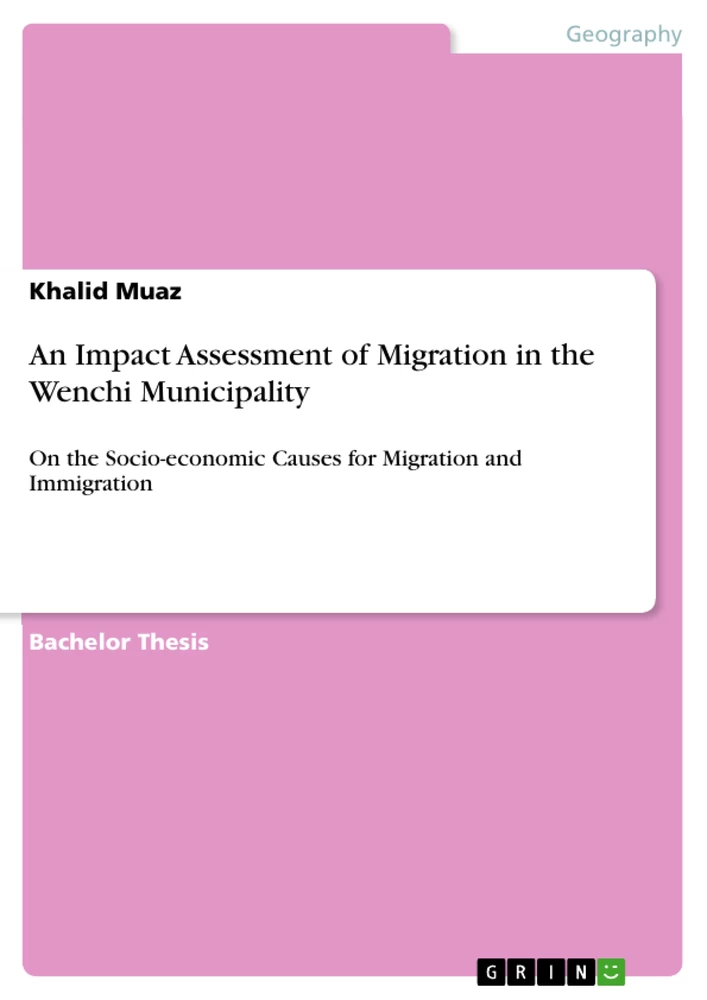
Table of Contents
CHAPTER ONE
INTRODUCTION
1.1 Background to the study
1.2 Problem Statement
1.3 Research Question
1.4 Measurable Objectives
1.5 Propositions
1.6 Rationale For The Study
1.7 Organisation Of The Study
CHAPTER TWO
LITERATURE REVIEW
2.1 Introduction
2.2 Definition of migration
2.3.0 Migrants
2.3.1 In-migration
2.3.2 Out-migration
2.3.3 Gross migration
2.3.4 Net internal migration
2.3.5 Net migration
2.3.6 Return migration
2.4. Definition of Impact
2.5 Definition of Assessment
2.5.1 Migration Assessment
2.6 Overview of migration
2.7 Population movement
2.8 History of migration
CHAPTER THREE
RESEARCH METHODOLOGY
3.1 Introduction
3.2 Research Design
3.3 Population of the study area
3.4 Sample and sampling techniques
3.5 Instruments for data collection
3.5.1. Procedure for administration of instruments
3.6 Data analysis
CHAPTER FOUR
DATA ANALYSIS AND PRESENTATION
4.1 Introduction
4.2.0 Distribution of respondents according to background characteristics
4.2.1. Migration Processes
4.3.0 Migrants duration of stay
4.3.1 Migrants’ source region
4.3.2 Pull Factors
4.3.3 Migrants Current job
4.4.0 Amount earned monthly
4.4.1 Monthly Savings
4.4.2 Access to electricity
4.4.3 Access to water at home
4.4.4 Purpose of sending money at home
CHAPTER FIVE
SUMMARY, CONCLUSION AND RECOMMENDATIONS
5.1 Introduction
5.2 Summary of the findings
5.2.1 Conditions of migrants in Wenchi
5.2.2 Factors Improving Wellbeing
5.3 Conclusions
5.4 Recommendations
Research Objectives and Themes
The primary aim of this dissertation is to assess the impact of migration within the Wenchi Municipality. The research seeks to identify the drivers of in-migration, evaluate the socio-economic conditions of migrants, analyze the associated benefits and challenges, and provide actionable policy recommendations for managing migration flows effectively.
- Causes and patterns of in-migration to Wenchi.
- Socio-economic impact of migration on migrants' livelihoods.
- Evaluation of infrastructure access (water and electricity) for migrant populations.
- Role of education and employment as pull factors for the municipality.
- Strategic recommendations for youth empowerment and sustainable migration management.
Excerpt from the Book
4.3.2 Pull Factors
These are factors that draw migrants to a named destination. Among the factors that pull (draw) people from their homes to Wenchi include the quest for education, work and religious practices. Others are also seen in the town as a result of occupational transfers, and those who have escaped from volatile situations from neighboring countries – countries prone to wars and insecurity such as Nigeria. These people have described the town, Wenchi as a place with peaceful co-existence between and among all religious bodies and thus conducive for their stay. This is seen as quite contrary to the notion that the salient pull factors of national migration in Ghana comprises financial gain, work and other chances for self-endowment and growth (Awumbila et al. 2014).
Summary of Chapters
CHAPTER ONE: This chapter introduces the study, presenting the background, the problem statement regarding migration in Wenchi, research questions, and the organizational structure of the dissertation.
CHAPTER TWO: This chapter provides a literature review, defining key concepts such as migration, impact assessment, and different types of population movements.
CHAPTER THREE: This chapter outlines the research methodology, detailing the design, population of the study area, sampling techniques, and the instruments used for data collection.
CHAPTER FOUR: This chapter presents the data analysis, offering findings on respondent demographics, migration processes, pull factors, economic status, and access to basic amenities.
CHAPTER FIVE: This chapter summarizes the research findings, offers conclusions on the well-being of migrants, and provides recommendations for policy intervention.
Keywords
Migration, Wenchi Municipality, In-migration, Socio-economic Conditions, Population Mobility, Pull Factors, Youth Empowerment, Sustainable Development, Education, Livelihood, Infrastructure, Ghana, Internal Migration, Labour Force, Impact Assessment.
Frequently Asked Questions
What is the primary focus of this dissertation?
The study focuses on assessing the impact of migration within the Wenchi Municipality in Ghana, specifically examining why people move there and how it affects their socio-economic status.
What are the central themes addressed in the research?
The main themes include the drivers of migration (push and pull factors), the socio-economic conditions of migrants, access to social amenities, and the influence of educational institutions.
What is the core research objective?
The research aims to identify the causes of in-migration in Wenchi, evaluate the living conditions of migrants, describe the resulting impacts, and propose policy actions for better migration management.
Which scientific methodology was employed?
The study employed both qualitative and quantitative research methods, using primary data collected through structured and semi-structured questionnaires and interviews alongside secondary sources.
What does the main body of the work cover?
The main body covers a review of migration literature, a detailed methodology section, and an extensive analysis of survey data regarding respondent backgrounds, current employment, and living standards.
Which keywords define this work?
Key terms include migration, Wenchi Municipality, impact assessment, socio-economic conditions, and population movement.
How does migration affect the educational infrastructure in Wenchi?
The findings indicate that education is a major pull factor, as many migrants move to Wenchi specifically to attend the various Senior High Schools and tertiary institutions located there.
What role does Wenchi play for migrants from neighboring countries?
Wenchi serves as a destination for individuals escaping volatile situations in neighboring countries, such as Nigeria, due to its peaceful environment and religious co-existence.
What is the conclusion regarding migrants' well-being?
The study concludes that the well-being of most migrants in Wenchi has improved compared to their conditions in their places of origin, with most having access to electricity and water.
Ende der Leseprobe aus 47 Seiten
- nach oben
- Arbeit zitieren
- Khalid Muaz (Autor:in), 2015, An Impact Assessment of Migration in the Wenchi Municipality, München, Page::Imprint:: GRINVerlagOHG, https://www.diplomarbeiten24.de/document/453968

neugierig - aktuell - relevant
Entdecken Sie hilfreiche Tipps und Tricks rund ums Studium!

Entdecken Sie hilfreiche Tipps und Tricks rund ums Studium!
Ihre Hausarbeit / Abschlussarbeit:

- - Publikation als E-Book und Buch
- - Hohes Honorar auf die Verkäufe
- - Für Sie komplett kostenlos - mit ISBN
- - Es dauert nur 5 Minuten
- - Jede Arbeit findet Leser

- © GRIN Publishing GmbH.
- Alle Inhalte urheberrechtlich geschützt. Kopieren und verbreiten untersagt.
- info@grin.com
- AGB
- Open Publishing
Der GRIN Verlag hat sich seit 1998 auf die Veröffentlichung akademischer eBooks und Bücher spezialisiert. Der GRIN Verlag steht damit als erstes Unternehmen für User Generated Quality Content. Die Verlagsseiten GRIN.com, Hausarbeiten.de und Diplomarbeiten24 bieten für Hochschullehrer, Absolventen und Studenten die ideale Plattform, wissenschaftliche Texte wie Hausarbeiten, Referate, Bachelorarbeiten, Masterarbeiten, Diplomarbeiten, Dissertationen und wissenschaftliche Aufsätze einem breiten Publikum zu präsentieren.
Kostenfreie Veröffentlichung: Hausarbeit, Bachelorarbeit, Diplomarbeit, Dissertation, Masterarbeit, Interpretation oder Referat jetzt veröffentlichen!
Folgen Sie GRIN auf


- GRIN Verlag GmbH
-
- Nymphenburger Str. 86
- 80636
- Munich, Deutschland
- +49 89-550559-0
- +49 89-550559-10
- info@grin.com
-
