
präsentiert von

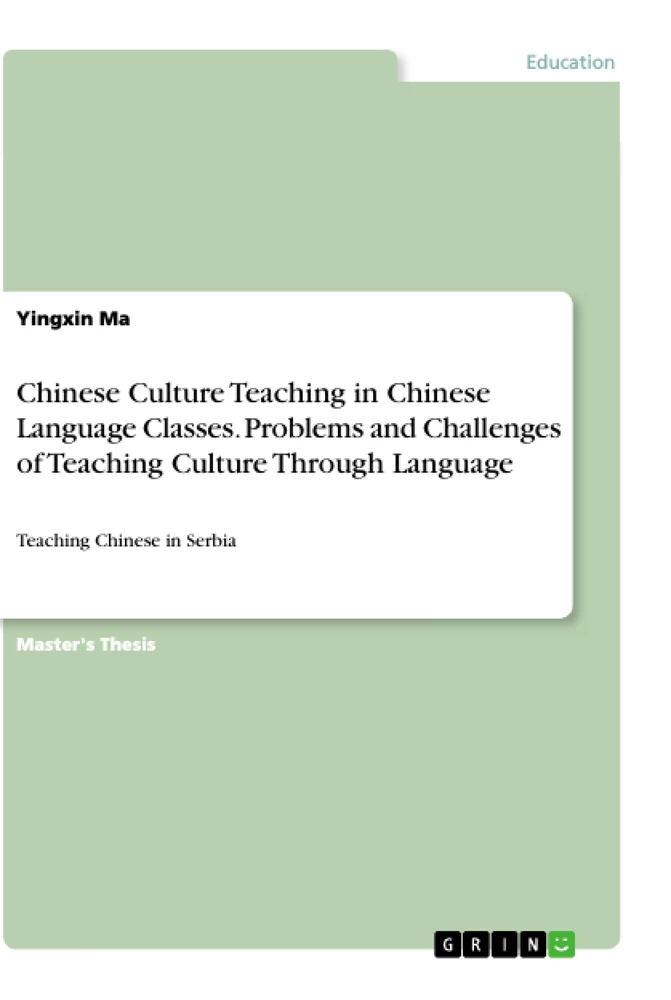
Table of Contents
Chapter 1: Introduction
Chapter 2: Literature review
2.1 What is culture?
2.2 What is Language?
2.3 Relations between Language and Culture
2.4 Integrating Culture into Language Teaching
2.5 Differences between Chinese culture and western culture
2.5.1 Chinese culture and Serbian culture
2.6 Chinese Language and Culture
2.6.1 Chinese Characters
2.6.2 Calligraphy
2.6.3 Relation between Chinese language and culture
Chapter 3:Methodology
3.1 Research questions
3.1.1 How will Chinese culture influence students in Chinese language education?
3.1.2 How should Chinese culture be taught in Chinese language education?
3.1.3 What aspects of Chinese culture should be taught in Chinese language education?
3.1.4 What are the problems in teaching Chinese culture? How can we solve them?
3.2 Sample
3.2.1 Students sample
3.2.2 Teachers sample
3.3 Data collection methods
3.3.1 Documentation review
3.3.2 Questionnaire
3.3.3 Interview
3.4 Data analysis methods
3.4.1 Content analysis of textbook
3.4.2 SPSS analysis for questionnaire
3.4.3 Qualitative analysis
Chapter 4: Textbook analysis
Chapter 5: Questionnaire Analysis
5.1 Students’ motivation to learn Chinese language
5.2 Teaching form
5.3 Culture aspects
5.4 Open-ended questions
5.4.1 What is your suggestion about cultural knowledge in Chinese textbook?
5.4.2 What is your suggestion about cultural knowledge teaching in Chinese class?
5.4.3 What is your suggestion about teachers?
Chapter 6: Interview
6.1 Culture teaching content
6.2 Culture teaching method
6.3 Culture teaching materials
6.4 Culture teaching time
6.5 Culture teaching activities
6.6 Culture teaching barriers
6.7 Culture teaching effect
Chapter 7: Students and teachers’ option about learning and teaching Chinese culture
7.1 Culture teaching content
7.2 Culture teaching method
7.3 Culture teaching materials
7.4 Culture teaching activities
Research Objectives and Themes
This master's thesis aims to investigate the current state of Chinese culture teaching within the context of Chinese language education in Belgrade high schools. By gathering insights from both students and teachers, the research explores effective pedagogical approaches, content selection, and potential barriers to cultural integration to improve language acquisition and cultural awareness.
- The relationship between Chinese language learning and cultural instruction.
- Methods for effectively integrating cultural content into the classroom.
- Analysis of students' interests and motivations regarding specific Chinese cultural aspects.
- Challenges faced by teachers and students in navigating cross-cultural differences.
- The role of teaching materials and interactive activities in enhancing student engagement.
Excerpt from the Book
2.6.3 Relation between Chinese language and culture
There are over 1 billion people living in China: that is one-sixth of the world’s total population. ‘China’ is eagerly leaping into this global world of postmodern culture, while still negotiating the claims of traditional Chinese values and a state socialist system (Hodge & Louie, 1998). The traditional Chinese values are harmony and stability while a new Chinese culture is characterized by conflict and instability. And the Chinese language has a complex relationship to notion of ‘China’.
Language is the carrier of culture and vocabulary is the basic ingredient of language. The cultural difference will inevitably exhibit on the vocabulary, and the explanation of vocabulary will also reflect the national or cultural difference (Choudhury, 2014). Take color as an example. In English, white, denoting a color, often associates with “pure, noble and moral goodness”, and the bride is dressed in white during the wedding in most western countries. In China the bride must wear red in the traditional wedding, definitely not white. Because Red means “happiness, good luck, flourishing and prosperous” in the future and people only wear white in funerals when one’s family member or relative is dead. White in China, is associated with “pale, weak and without vitality”. Also, the number four (sì) sounds like the character for death (sǐ). That is why the number four is avoided particularly on phone numbers, license plates, and addresses. For addresses that do contain fours, the rent is usually less (Choudhury, 2014).
Like other aspects of Chinese life, cuisine is heavily influenced by geography and ethnic diversity. Rice is not only a major food source in China; it is also a major element that helped grow the society (Fuller, 2011). The Chinese word for rice is fan, which also means "meal," and it is a staple of their diet. Eating fish during Chinese New Year (鱼, yú) is a must, though diners have to make sure they do not eat all the fish. Having leftovers can ensure there is a surplus (余, yú) every year (Kim, 2015).
Summary of Chapters
Chapter 1: Introduction: Discusses the vital role of culture in foreign language instruction and outlines the research context in Belgrade.
Chapter 2: Literature review: Provides theoretical definitions of culture, language, and their complex interrelationships, including cross-cultural comparisons between China and Serbia.
Chapter 3: Methodology: Details the research questions, participant samples, and qualitative/quantitative data collection methods used to gather evidence.
Chapter 4: Textbook analysis: Evaluates the content of two primary textbooks used in Belgrade schools regarding their cultural information.
Chapter 5: Questionnaire Analysis: Presents quantitative findings regarding student motivations, preferences for teaching methods, and interest levels in different cultural aspects.
Chapter 6: Interview: Analyzes feedback from teachers regarding their experiences, challenges, and instructional strategies for teaching Chinese culture.
Chapter 7: Students and teachers’ option about learning and teaching Chinese culture: Synthesizes findings and discusses implications for improving the integration of culture in Chinese language education.
Keywords
Chinese culture, Chinese language, cultural integration, language teaching, secondary education, Serbia, student motivation, teaching methods, teaching materials, cross-cultural competence, curriculum, pedagogical strategies, language acquisition, cultural awareness, interactional teaching.
Frequently Asked Questions
What is the core focus of this master's thesis?
The research examines the teaching of Chinese culture within Chinese language classes specifically for Serbian high school students in Belgrade, exploring how culture can enhance language learning.
What are the primary themes discussed in the research?
Central themes include the relationship between language and culture, the selection of effective teaching materials, the role of student motivation, and the challenges teachers encounter in cross-cultural classrooms.
What is the main research objective?
The thesis aims to identify how learning about Chinese culture contributes to language acquisition, determine effective teaching methods, understand what content students find interesting, and address problems faced during instruction.
Which scientific methods were utilized in this study?
The researcher employed a mixed-methods approach, including a documentation review of textbooks, quantitative surveys (questionnaires) with 81 students, and semi-structured interviews with five language teachers.
What is explored in the main body of the work?
The main body covers a literature review on culture and language, an analysis of textbooks, statistical evaluation of student questionnaires, and qualitative thematic analysis of teacher interviews.
Which keywords define this research?
Key terms include Chinese culture, Chinese language, cultural integration, secondary education, student motivation, teaching strategies, and cross-cultural competence.
How does the author evaluate the "face" concept in the context of teaching?
The author highlights "face" (mianzi) as a complex cultural nuance that requires careful navigation for foreigners to avoid embarrassing situations, emphasizing the importance of understanding this concept in cultural instruction.
What conclusions does the author draw regarding the role of native versus local teachers?
The author suggests that while Serbian teachers have advantages in language communication and comparing cultures, Chinese teachers offer unique insights into Chinese reality; thus, cooperation between both is recommended.
Ende der Leseprobe aus 80 Seiten
- nach oben
- Arbeit zitieren
- Yingxin Ma (Autor:in), 2018, Chinese Culture Teaching in Chinese Language Classes. Problems and Challenges of Teaching Culture Through Language, München, Page::Imprint:: GRINVerlagOHG, https://www.diplomarbeiten24.de/document/455007

neugierig - aktuell - relevant
Entdecken Sie hilfreiche Tipps und Tricks rund ums Studium!

Entdecken Sie hilfreiche Tipps und Tricks rund ums Studium!
Ihre Hausarbeit / Abschlussarbeit:

- - Publikation als E-Book und Buch
- - Hohes Honorar auf die Verkäufe
- - Für Sie komplett kostenlos - mit ISBN
- - Es dauert nur 5 Minuten
- - Jede Arbeit findet Leser

- © GRIN Publishing GmbH.
- Alle Inhalte urheberrechtlich geschützt. Kopieren und verbreiten untersagt.
- info@grin.com
- AGB
- Open Publishing
Der GRIN Verlag hat sich seit 1998 auf die Veröffentlichung akademischer eBooks und Bücher spezialisiert. Der GRIN Verlag steht damit als erstes Unternehmen für User Generated Quality Content. Die Verlagsseiten GRIN.com, Hausarbeiten.de und Diplomarbeiten24 bieten für Hochschullehrer, Absolventen und Studenten die ideale Plattform, wissenschaftliche Texte wie Hausarbeiten, Referate, Bachelorarbeiten, Masterarbeiten, Diplomarbeiten, Dissertationen und wissenschaftliche Aufsätze einem breiten Publikum zu präsentieren.
Kostenfreie Veröffentlichung: Hausarbeit, Bachelorarbeit, Diplomarbeit, Dissertation, Masterarbeit, Interpretation oder Referat jetzt veröffentlichen!
Folgen Sie GRIN auf


- GRIN Verlag GmbH
-
- Nymphenburger Str. 86
- 80636
- Munich, Deutschland
- +49 89-550559-0
- +49 89-550559-10
- info@grin.com
-
