
präsentiert von

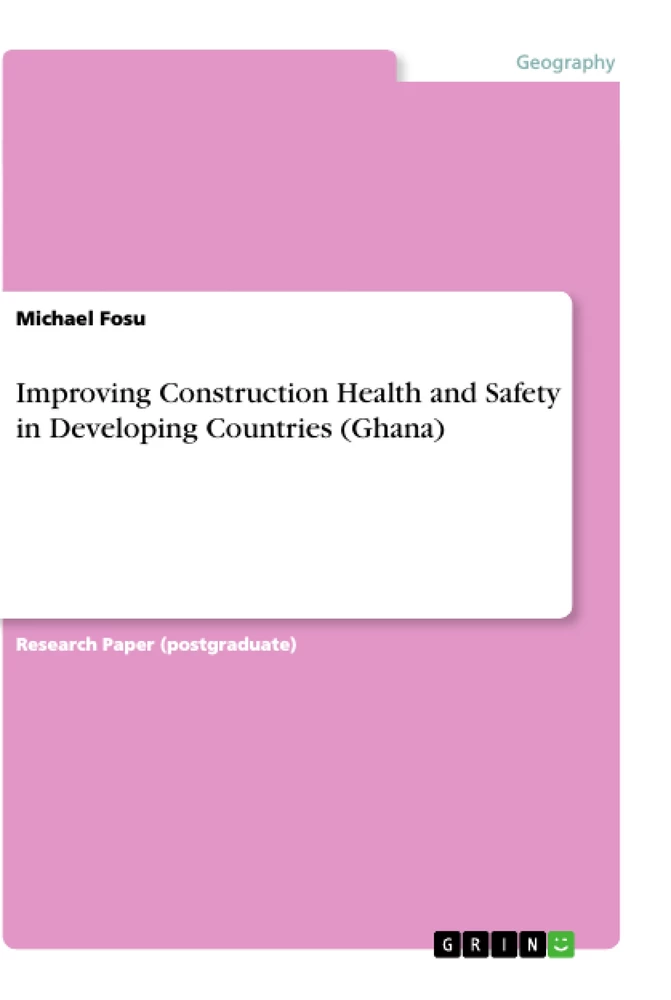
Table of Contents
CHAPTER 1: INTRODUCTION
1.1 Context (Overview of H&S performance in Ghana)
1.2 Problem statement
1.3 Aim of study
1.4 Objectives
1.5 Research questions
1.6 Scope of study
1.7 Methodology
1.8 Significance of study
1.9 Impact of Study
1.10 Limitation of study
1.11 Organization of chapters
1.12 Research timeline
CHAPTER 2: CONSTRUCTION HEALTH & SAFETY
2.1 Defining health & safety
2.2 The need for H&S practices in the construction industry
2.3 Legislative governing H&S in the construction industry
2.3.1 Factors influencing poor construction H&S in developed and developing countries
2.3.2 Disparity of construction H&S challenges between developed and developing countries
2.3.3 Comparing H&S performance between developed and developing countries
2.4 Overview of H&S performance in the UK construction Industry
2.4.1 H&S legislation in the UK construction industry
2.4.2 The Health and Safety Executive as a regulating body
2.4.3 Roles/duties of HSE in the UK construction industry
2.5 The Construction Design Management (CDM 2015)
2.5.1 Health & Safety roles/duties of the client
2.5.2 Commercial client
2.5.3 Duties of the commercial client
2.5.4 Domestic client
2.5.5 A contractor
2.5.6 Duties of the contractor
2.6 Overview of H&S performance in Australian construction industry
2.6.1 H&S legislation in the Australian construction industry
2.7 Occupational Health & Safety Act, Code of Practice and Regulators
2.7.1 Occupational Health & Safety Act 2004
2.7.2 Code of Practice: Victorian compliance code
2.7.3 Regulator: WorkSafe Victoria
2.8 Occupational Health & Safety Regulation 2017
2.8.1 H&S role of client (employer) and contractor
2.8.2 Section 21: Duties of the client (employer)
2.8.3 Section 22: Duties of the contractor
2.9 Summary
CHAPTER 3: THE GHANAIAN CONSTRUCTION INDUSTRY
3.1 Overview of the Ghanaian construction industry
3.2 Existing H&S legislation in the Ghanaian construction industry
3.3 H&S Challenges in the Ghanaian construction industry
3.4 Summary
CHAPTER 4: RESEARCH METHOD
4.1 The Research Approach
4.2 The Research Strategy
4.3 Limitations of Approach
CHAPTER 5: RESULTS & DISCUSSIONS
5.1 Results of the study
5.2 Discussion
5.2.1 Health & Safety Regulation – Part 1
5.2.2 Health & Safety Regulator – Part 2
5.2.3 Role of duty holders -Part 3
5.3 The challenges of implementing Health & Safety
CHAPTER 6: Conclusion & Recommendations
6.1 Conclusion
6.2 Recommendations
6.3 Contribution to the field of knowledge
6.4 Future research
Research Objective and Scope
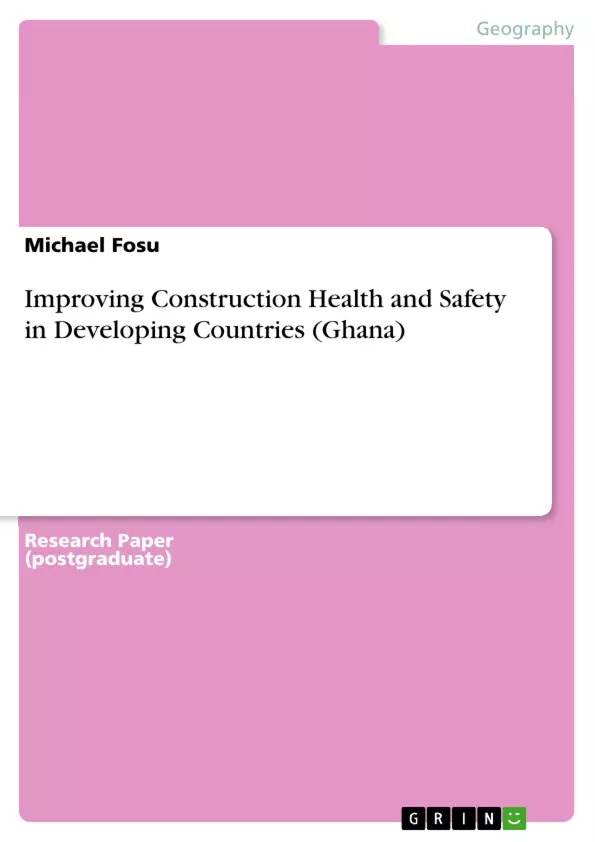
This study critically investigates the constraints and barriers hindering the implementation of effective health and safety practices within the Ghanaian construction industry. By analyzing and comparing the successful legislative frameworks and standards utilized in the UK and Australia, the research aims to provide actionable recommendations for improving H&S management in Ghana.
- Examination of existing construction H&S legislative frameworks in the UK and Australia.
- Identification of barriers and challenges specific to the Ghanaian construction sector.
- Analysis of the roles and responsibilities of key stakeholders (clients, contractors, and regulators).
- Development of a proposed H&S legislative framework adapted for the Ghanaian context.
- Investigation of the impact of casual labor and skill scarcity on site safety.
Excerpt from the Book
1.2 PROBLEM STATEMENT
The genesis of poor construction health and safety practice within the Ghanaian construction industry subsequently stems from the basic factors such as the outmost nature of the job, economic conditions of labour, training and education, attitude and behaviour towards the job, design conditions and lack of awareness towards the practice of an effective health & safety management as revealed by the Ministry of Employment & Labour Relations (2016). An article written by Ayitey J (2017) convincingly suggested that Ghana’s construction industry was substantively underdeveloped and as a result, institutional inefficiencies have become a common phenomenon in the country citing on the incidents of youth drowning along the Sofoline-interchange project site in Kumasi and the collapse of buildings due to unexpected modes of failure taking the lives of several in Accra, its capital city. As stated by the president of CIOB (2016), “it is essential for the government to critically consider the establishment and constitution of a regulatory body to ensure the adherence to construction health & safety provisions during the execution of contracts”. The research findings of Ahadzie, D. (2009) suggested that, the construction industry in Ghana lacked a well-prepared and systematic framework (CIDA) with an experimental legitimacy which will go a long way in driving decision making in the practice of health & safety. Consequently, this point seems to contribute as a factor to poor H&S practice in Ghana but on the other hand, it is still debatable whether regulations and policies can be regarded as the main source of the problem of H&S whilst in effect, it rather seems to be a small part of the complex puzzle.
Summary of Chapters
CHAPTER 1: INTRODUCTION: This chapter provides an overview of the research, documenting the current H&S performance in Ghana and establishing the aim, objectives, and research questions.
CHAPTER 2: CONSTRUCTION HEALTH & SAFETY: This chapter presents an in-depth literature review on global construction H&S practices, specifically focusing on the legislative frameworks of the UK and Australia.
CHAPTER 3: THE GHANAIAN CONSTRUCTION INDUSTRY: This chapter reviews the existing legislative landscape in Ghana and identifies the primary challenges facing the local industry, particularly regarding SME contractors and the workforce.
CHAPTER 4: RESEARCH METHOD: This chapter outlines the qualitative research approach and strategy utilized to collect and analyze secondary data for the study.
CHAPTER 5: RESULTS & DISCUSSIONS: This chapter analyzes the findings from the literature review and discusses the legislative frameworks and duty-holder roles identified.
CHAPTER 6: Conclusion & Recommendations: This chapter concludes the study and proposes a tailored H&S legislative framework and regulatory authority for the Ghanaian construction sector.
Keywords
Construction H&S, H&S challenges, Ghana, developing countries, legislative framework, construction safety, health and safety management, occupational accidents, construction regulations, site safety, stakeholder responsibilities, UK construction industry, Australian construction industry, construction labor, site hazards
Frequently Asked Questions
What is the primary focus of this research?
The research focuses on identifying the constraints and barriers that hinder the implementation of effective health and safety practices in the Ghanaian construction industry by drawing lessons from established international frameworks.
What are the central themes explored?
The study explores legislative frameworks, stakeholder responsibilities (such as clients and contractors), the impact of casual labor, and the comparison of safety performance between developed and developing nations.
What is the primary research goal?
The goal is to develop and recommend a comprehensive H&S legislative framework and regulatory approach to improve safety performance within Ghana’s construction sector.
Which scientific method is applied?
The research employs a qualitative study approach based on a critical secondary data analysis and literature review of H&S policies in the UK, Australia, and Ghana.
What is covered in the main body?
The main body examines the specific legislative structures of the UK (CDM 2015) and Australia (WHS Act/Regulations), compares them to the current status in Ghana, and discusses the role of various duty holders.
Which keywords define this work?
Key terms include construction H&S, Ghana, legislative framework, occupational safety, construction regulation, and site safety management.
Why is the UK and Australian model used for comparison?
These countries serve as models due to their effective, well-defined legislative frameworks and clear regulatory hierarchies, which provide valuable best-practice lessons for developing nations.
What is the significance of the "duty holder" concept?
The duty holder concept is crucial as it assigns specific legal responsibilities for safety to clients, contractors, and designers, which is currently lacking in the Ghanaian construction sector.
What conclusion does the author reach regarding the Ghanaian construction industry?
The author concludes that the absence of a dedicated construction-specific H&S regulation and an enforcement authority is a pivotal factor contributing to the high accident and fatality rates in the industry.
Ende der Leseprobe aus 87 Seiten
- nach oben
- Arbeit zitieren
- Michael Fosu (Autor:in), 2018, Improving Construction Health and Safety in Developing Countries (Ghana), München, Page::Imprint:: GRINVerlagOHG, https://www.diplomarbeiten24.de/document/455205

neugierig - aktuell - relevant
Entdecken Sie hilfreiche Tipps und Tricks rund ums Studium!

Entdecken Sie hilfreiche Tipps und Tricks rund ums Studium!
Ihre Hausarbeit / Abschlussarbeit:

- - Publikation als E-Book und Buch
- - Hohes Honorar auf die Verkäufe
- - Für Sie komplett kostenlos - mit ISBN
- - Es dauert nur 5 Minuten
- - Jede Arbeit findet Leser

- © GRIN Publishing GmbH.
- Alle Inhalte urheberrechtlich geschützt. Kopieren und verbreiten untersagt.
- info@grin.com
- AGB
- Open Publishing
Der GRIN Verlag hat sich seit 1998 auf die Veröffentlichung akademischer eBooks und Bücher spezialisiert. Der GRIN Verlag steht damit als erstes Unternehmen für User Generated Quality Content. Die Verlagsseiten GRIN.com, Hausarbeiten.de und Diplomarbeiten24 bieten für Hochschullehrer, Absolventen und Studenten die ideale Plattform, wissenschaftliche Texte wie Hausarbeiten, Referate, Bachelorarbeiten, Masterarbeiten, Diplomarbeiten, Dissertationen und wissenschaftliche Aufsätze einem breiten Publikum zu präsentieren.
Kostenfreie Veröffentlichung: Hausarbeit, Bachelorarbeit, Diplomarbeit, Dissertation, Masterarbeit, Interpretation oder Referat jetzt veröffentlichen!
Folgen Sie GRIN auf


- GRIN Verlag GmbH
-
- Nymphenburger Str. 86
- 80636
- Munich, Deutschland
- +49 89-550559-0
- +49 89-550559-10
- info@grin.com
-
