
präsentiert von

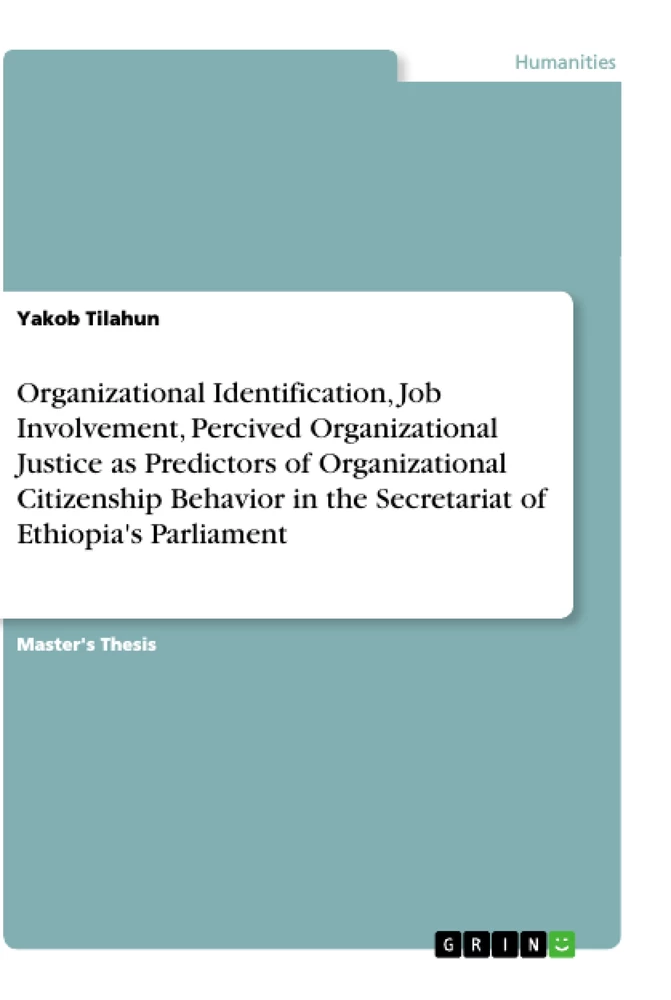
Table of Contents
Chapter One
Introduction
1.1 Background of the Study
1.2 Statement of the Problem
1.3 Objectives of the Study
1.4 Research Questions
1.5 Significance of the Study
1.6 Scope of the Study
1.7 Operational Definitions of Concepts
Chapter Two
Review of Related Literature
2.1 Introduction
2.2 Theoretical Foundations of Employees’ Attitudinal and Behavioral Patterns in an Organization
2.3 Organizational Identification
2.3.1 Basic Conceptualizations
2.3.2 Organizational Identity and Identification
2.3.3 Major Components of Organizational Identification
2.3.4 The Relationship between Organizational Identification and Organizational Citizenship Behavior
2.4 Job Involvement
2.4.1 Basic Conceptualizations
2.4.2 The Relationship between Job Involvement and Organizational Citizenship Behavior
2.5 Perceived Organizational Justice
2.5.1 Basic Conceptualizations
2.5.2 Dimensions of Organizational Justice Perceptions
2.5.3 Distributive Justice
2.5.4 Procedural Justice
2.5.5 Interactional Justice
2.5.6 The Relationship between Organizational Justice and Organizational Citizenship Behavior
2.6 Organizational Citizenship Behavior
2.6.1 Basic Conceptualizations
2.6.2 Dimensions of OCB
2.6.3 Altruism
2.6.4 Conscientiousness
2.6.5 Sportsmanship
2.6.6 Courtesy
2.6.7 Civic virtue
2.6.8 Antecedents and Consequences of OCB
2.7 Conceptual Framework of the Study
2.8 Summary
Chapter Three
Methods
3.1 Introduction
3.2 Research Design
3.3 Study Area
3.4 Population and Sample
3.4.1 Sampling Procedures
3.5 Measurement and Instrumentation
3.5.1 Description of Variables
3.5.2 Instrumentation
3.5.3 Organizational Identification Scale
3.5.4 Job Involvement Scale
3.5.5 Organizational Justice Perception Dimensions Scale
3.5.6 Organizational Citizenship Behavior scale
3.5.7 Validity and Reliability Check to the Local Context
3.5.8 Validity
3.5.9 Reliability
3.6 Data Collection Procedures
3.7 Scoring of Instruments
3.8 Data Analysis
3.9 Data Quality Assurance
3.10 Ethical Considerations
Chapter Four
Results
4.1 Introduction
4.2 Socio- Demographic Characteristics of the study participants
4.2.1 Socio – Demographic Variables and OCB
4.2.2 Gender and OCB
4.2.3 Age and OCB
4.2.4 Work Experience and OCB
4.2.5 Educational Status and OCB
4.3 The Relationships among Organizational Identification, Job Involvement, perceived Organizational Justice and OCB
4.4 The Proportion of Variance Accounted for by Predictor Variables on OCB
Chapter Five
Discussion
5.1 Introduction
5.2 Socio-Demographic variables and OCB
5.3 Organizational Identification and OCB
5.4 Job Involvement and OCB
5.5 Perceived Organizational Justice Dimensions and OCB
5.5.1 Distributive Justice and OCB
5.5.2 Procedural Justice and OCB
5.5.3 Interactional Justice and OCB
5.6 Overall Influences of the Predictor Variables on Employees OCB
Chapter Six
Conclusion, Implications and Recommendations
6.1 Conclusion
6.2 Implications
6.2.1 Theoretical Implication
6.2.2 Practical Implication
6.2.3 Organizational Implication
6.2.4 Research & Policy Implication
6.2.5 Limitation of the Study
6.3 Recommendations
6.3.1 Recommendations for Future Research
Research Objectives and Themes
The primary objective of this research is to investigate the predictive relationship between organizational identification, job involvement, and perceived organizational justice on the extra-role performance (Organizational Citizenship Behavior - OCB) of employees within the Secretariat of the Ethiopian Federal House of Peoples Representatives (SHOPR). The study seeks to understand how these psychological and attitudinal factors contribute to voluntary work behaviors that transcend formal job descriptions.
- Predictive impact of organizational identification on employee OCB.
- Influence of job involvement on extra-role performance.
- Role of distributive, procedural, and interactional justice perceptions in fostering OCB.
- The combined effect of identified predictors on organizational effectiveness.
- Contextual analysis of OCB within the Ethiopian public sector workforce.
Excerpt from the Book
2.6 Organizational Citizenship Behavior
Organizations are not always the formal task oriented entities, rather they also depend on voluntary activities such as task completions that are based on positive and helpful social behaviors which are not bounded by time or personnel inconvenience that are not intended to getting any opportunities or further benefits (Bez, 2010). In this regard, the concept of organizational citizenship behavior is an instance that is comprised of different dimensions and the cumulative effect of these dimensions are indeed very important to create an astonishing influence on organizational operations and effectiveness (Organ, 1988). As construct OCB is important in organizational contexts that could not be explained by different things like same inducements that prompt entity, conventionality to contractual role prescriptions, or high production (Smith, Organ & Near, 1983).
Summary of Chapters
Chapter One: Introduces the background, problem statement, research objectives, and scope of the study regarding predictors of OCB in the Ethiopian public sector.
Chapter Two: Provides a comprehensive review of theoretical foundations and literature related to organizational identification, job involvement, organizational justice, and OCB.
Chapter Three: Details the research design, study area, sampling procedures, and the measurement instruments used for data collection and analysis.
Chapter Four: Presents the results of the descriptive and inferential statistical analyses performed on the collected data.
Chapter Five: Discusses the findings of the study in the context of existing literature and organizational behavior theories.
Chapter Six: Concludes the research by summarizing key findings, discussing theoretical and practical implications, and providing recommendations for future research.
Keywords
Organizational Identification, Job Involvement, Distributive Justice, Procedural Justice, Interactional Justice, Organizational Citizenship Behavior, OCB, Public Sector, Employee Performance, Workplace Attitudes, Extra-Role Behavior, Ethiopia, Organizational Effectiveness, Social Exchange Theory, Psychological Cohesion.
Frequently Asked Questions
What is the core focus of this research?
The research focuses on identifying the psychological and attitudinal factors—specifically organizational identification, job involvement, and perceived organizational justice—that act as predictors for organizational citizenship behavior among employees in the Secretariat of the Ethiopian Federal House of Peoples Representatives.
Which key variables are analyzed in relation to employee behavior?
The key independent variables analyzed are organizational identification, job involvement, and three dimensions of organizational justice: distributive, procedural, and interactional justice.
What is the ultimate goal or primary research question?
The primary goal is to examine how the aforementioned factors predict OCB and to understand the combined influence of these variables on employee extra-role performance within the target organization.
What scientific methodology does the study employ?
The study utilizes a quantitative approach with a correlational design, collecting data through standardized measurement scales from 202 participants, followed by statistical analysis using descriptive statistics, MANOVA, and regression models.
What does the main body of the work cover?
The main body covers a literature review of organizational behavior theories, a detailed description of the research methodology used, the presentation of empirical results, and an in-depth discussion regarding the implications of the findings.
Which keywords best characterize this work?
The work is characterized by terms such as Organizational Identification, Job Involvement, Organizational Justice, and Organizational Citizenship Behavior (OCB).
How is the sample for this study determined?
The sample size was determined using the Yimane (1967) formula, targeting active employees of the Secretariat of the House of Peoples Representatives, employing stratified random sampling to ensure representation across different directorates.
Why is this research important for the Ethiopian context?
Empirical research on organizational behavior variables in Ethiopia is inadequate. This study provides local insights into how psychological factors influence public sector employees' extra-role behaviors, filling a significant research gap.
Ende der Leseprobe aus 214 Seiten
- nach oben
- Arbeit zitieren
- Yakob Tilahun (Autor:in), 2019, Organizational Identification, Job Involvement, Percived Organizational Justice as Predictors of Organizational Citizenship Behavior in the Secretariat of Ethiopia's Parliament, München, Page::Imprint:: GRINVerlagOHG, https://www.diplomarbeiten24.de/document/456165

neugierig - aktuell - relevant
Entdecken Sie hilfreiche Tipps und Tricks rund ums Studium!

Entdecken Sie hilfreiche Tipps und Tricks rund ums Studium!
Ihre Hausarbeit / Abschlussarbeit:

- - Publikation als E-Book und Buch
- - Hohes Honorar auf die Verkäufe
- - Für Sie komplett kostenlos - mit ISBN
- - Es dauert nur 5 Minuten
- - Jede Arbeit findet Leser

- © GRIN Publishing GmbH.
- Alle Inhalte urheberrechtlich geschützt. Kopieren und verbreiten untersagt.
- info@grin.com
- AGB
- Open Publishing
Der GRIN Verlag hat sich seit 1998 auf die Veröffentlichung akademischer eBooks und Bücher spezialisiert. Der GRIN Verlag steht damit als erstes Unternehmen für User Generated Quality Content. Die Verlagsseiten GRIN.com, Hausarbeiten.de und Diplomarbeiten24 bieten für Hochschullehrer, Absolventen und Studenten die ideale Plattform, wissenschaftliche Texte wie Hausarbeiten, Referate, Bachelorarbeiten, Masterarbeiten, Diplomarbeiten, Dissertationen und wissenschaftliche Aufsätze einem breiten Publikum zu präsentieren.
Kostenfreie Veröffentlichung: Hausarbeit, Bachelorarbeit, Diplomarbeit, Dissertation, Masterarbeit, Interpretation oder Referat jetzt veröffentlichen!
Folgen Sie GRIN auf


- GRIN Verlag GmbH
-
- Nymphenburger Str. 86
- 80636
- Munich, Deutschland
- +49 89-550559-0
- +49 89-550559-10
- info@grin.com
-
