
präsentiert von

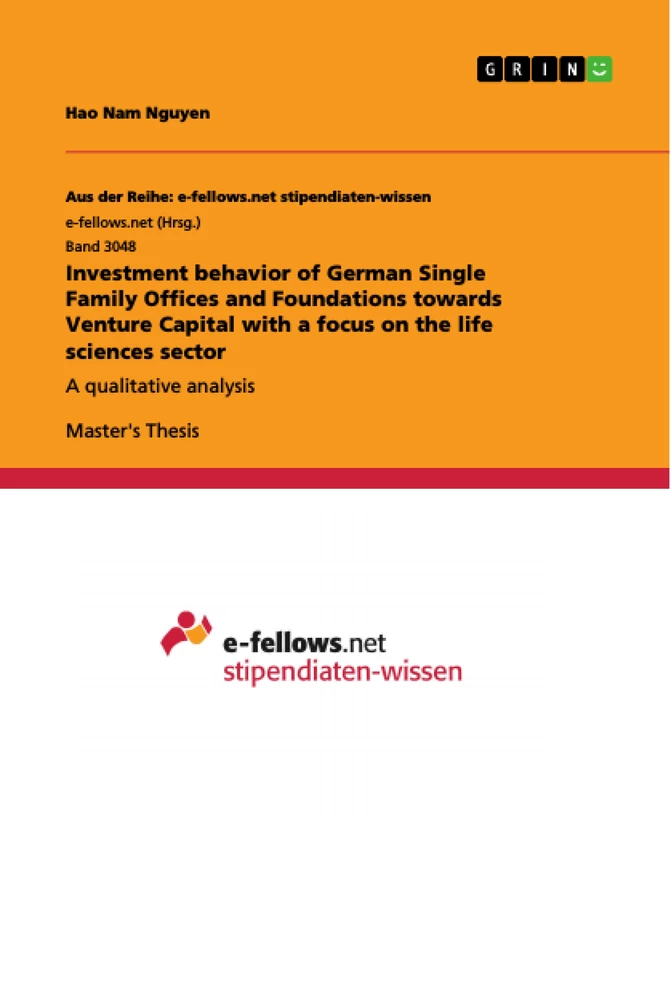
Table of Contents
1 INTRODUCTION
1.1 Background
1.2 Problem Statement
1.3 Purpose and Objective
1.4 Research Question
1.5 Delimitation
1.6 Thesis Structure
2 DEFINITION
2.1 Family Office
2.2 Life Sciences Sector
2.3 Venture Capital
3 BACKGROUND AND LITERATURE OVERVIEW
3.1 Financing of Life Sciences Start-ups
3.1.1 Life sciences – a challenging sector
3.1.2 Financing Models
3.1.3 Active VC investors
3.1.4 Financing Landscape in Germany
3.1.5 Entrepreneurial Ecosystem
3.2 Investment behavior of LPs – a literature review
3.3 Strategic Influence of Investment Companies
3.3.1 Agency Theory
3.3.2 Specialization and Success
4 METHODOLOGY
4.1 Research Design
4.2 Data Collection
4.2.1 Sample
4.2.2 Semi-structured Interviews
4.3 Inductive Analysis
4.4 Limitations of the Methodology
4.4.1 Validity
4.4.2 Reliability
5 RESULTS AND ANALYSIS
5.1 Summary of the Inductive Analysis
5.2 Analysis of the Investment Behavior
5.2.1 Framework Conditions
5.2.2 Allocation
5.2.3 Motivation
5.2.4 Criteria
5.2.5 Risk
5.2.6 Entrepreneurial Ecosystem
5.2.7 Governance
6 DISCUSSION
6.1 Investment Behavior of SFOs and Foundations and its Implications for Life Sciences VC Investments
6.2 Classification of the Investment Behavior Categories
7 SUMMARY AND CONCLUSIONS
7.1 Summary of Results
7.2 Theoretical Implications
Objectives and Research Themes
This thesis aims to analyze the investment behavior of German Limited Partners (LPs), specifically Single Family Offices (SFOs) and foundations, regarding their involvement in Venture Capital (VC), with a primary focus on the life sciences sector. The core research addresses how these institutional and private investors evaluate VC funds and identify the barriers that deter them from venturing into this specific industry.
- Investment criteria and decision-making processes of German SFOs and foundations regarding VC.
- Barriers and risks associated with life sciences venturing in Germany.
- Governance structures and principal-agent relationships between investors and VC funds.
- The impact of regional embedding and "Entrepreneurial Ecosystems" on investment behavior.
- Classification and development of an investment framework for SFOs and foundations.
Excerpt from the Book
3.1.1 Life sciences – a challenging sector
The life sciences sector is facing a tremendous change which is driven by several forces such as the digitization and the resulting disruption of established business models, the demographic change or the emergence of new competitors. This paves the way for future start-ups which can play a significant role in key areas like immunotherapeutic gene therapy, regenerative medicine or oncology. While oncology remains as the most important growth market, the demand for healthcare services are gaining in importance. Another challenge is the increasing unwillingness of financiers to fund discovery or early stages of clinical development phases. The start-ups which suffer most from this circumstance are those who are in a critical development phase to get a proof-of-concept. At the same time proof-of-concept constitutes the most important decision factor for a successful investment decision. This in fact has to do with the risks associated with life sciences projects in general – particularly pharma or biotech projects. For example, a drug in the biotech industry takes an average of 15 years from research to market launch, while the chances of success are rather low with a failure rate of 95 percent. According to the German Biotechnology Report 2015, more and more start-ups in the field of high-risk drug development today come from spin-offs of existing commercial companies or from incubators in the transition area between academia and industry. However, in Germany the predominant share of new start-ups continues to come from the academic environment in the immediate vicinity of established clusters in the Munich region, followed by the Rhine-Neckar region, the Rhineland region and Berlin.
Summary of Chapters
1 INTRODUCTION: Outlines the background of the German life sciences industry, the financing scarcity, and the research objectives of this thesis.
2 DEFINITION: Establishes clear definitions for key terms, including Family Office, life sciences sector, and Venture Capital.
3 BACKGROUND AND LITERATURE OVERVIEW: Discusses the financing challenges of life sciences start-ups and reviews existing literature on investor behavior and agency theory.
4 METHODOLOGY: Details the research design, specifically the use of semi-structured interviews with SFO and foundation experts to conduct an inductive analysis.
5 RESULTS AND ANALYSIS: Presents findings categorized by framework conditions, allocation, motivation, criteria, risk, ecosystem, and governance.
6 DISCUSSION: Integrates the findings into a theoretical framework and classifies the investment behaviors within the LP process.
7 SUMMARY AND CONCLUSIONS: Summarizes the study's results, offers theoretical implications, and proposes areas for future research.
Keywords
Venture Capital, Single Family Offices, Foundations, Life Sciences, Investment Behavior, Germany, Qualitative Analysis, Financing, Risk, Portfolio Diversification, Agency Theory, Entrepreneurial Ecosystem, Investment Criteria, Venture Capital Funding, Impact Investing.
Frequently Asked Questions
What is the core focus of this Master thesis?
This thesis examines the investment behavior of German Single Family Offices (SFOs) and foundations regarding their participation in Venture Capital (VC), with a specific emphasis on the life sciences sector.
Which investor groups are analyzed in this research?
The study focuses on German institutional investors (foundations) and private investors in the form of SFOs.
What is the primary objective of this work?
The objective is to fill the research gap on the "supply side" of Venture Capital, identifying the criteria and barriers that influence these specific investors' decisions to enter the life sciences VC market.
What methodology does the author apply?
The author uses a qualitative research approach, conducting semi-structured, expert-led interviews with professionals from SFOs, foundations, and consulting firms, followed by an inductive analysis of the gathered data.
What is covered in the main section of the thesis?
The main section analyzes investment behavior through seven central categories: Framework Conditions, Allocation, Motivation, Criteria, Risk, Entrepreneurial Ecosystem, and Governance.
Which keywords best characterize this work?
Key terms include Venture Capital, SFOs, Foundations, Life Sciences, Investment Behavior, and Entrepreneurial Ecosystem.
How do SFOs and foundations differ in their VC investment approach?
SFOs are often driven by personal interests and entrepreneurial backgrounds, whereas foundations act more conservatively, driven by capital preservation and regulatory constraints.
Why are foundations generally cautious regarding life science investments?
Foundations face restrictive laws regarding commercial income, limited expertise in high-risk sectors, and a need for large-ticket investments which are often unavailable in the German early-stage VC market.
What role does the "Entrepreneurial Ecosystem" play for the investors?
SFOs often embed themselves in the regional ecosystem and take on a supporting role for their investments, whereas foundations typically operate globally and do not identify as part of the local entrepreneurial ecosystem.
What is the conclusion regarding the LP-GP relationship?
Trust and information transparency are identified as the most crucial factors in the relationship between Limited Partners (LPs) and General Partners (GPs) for successful long-term collaboration.
Ende der Leseprobe aus 119 Seiten
- nach oben
- Arbeit zitieren
- Hao Nam Nguyen (Autor:in), 2018, Investment behavior of German Single Family Offices and Foundations towards Venture Capital with a focus on the life sciences sector, München, Page::Imprint:: GRINVerlagOHG, https://www.diplomarbeiten24.de/document/457590

neugierig - aktuell - relevant
Entdecken Sie hilfreiche Tipps und Tricks rund ums Studium!

Entdecken Sie hilfreiche Tipps und Tricks rund ums Studium!
Ihre Hausarbeit / Abschlussarbeit:

- - Publikation als E-Book und Buch
- - Hohes Honorar auf die Verkäufe
- - Für Sie komplett kostenlos - mit ISBN
- - Es dauert nur 5 Minuten
- - Jede Arbeit findet Leser

- © GRIN Publishing GmbH.
- Alle Inhalte urheberrechtlich geschützt. Kopieren und verbreiten untersagt.
- info@grin.com
- AGB
- Open Publishing
Der GRIN Verlag hat sich seit 1998 auf die Veröffentlichung akademischer eBooks und Bücher spezialisiert. Der GRIN Verlag steht damit als erstes Unternehmen für User Generated Quality Content. Die Verlagsseiten GRIN.com, Hausarbeiten.de und Diplomarbeiten24 bieten für Hochschullehrer, Absolventen und Studenten die ideale Plattform, wissenschaftliche Texte wie Hausarbeiten, Referate, Bachelorarbeiten, Masterarbeiten, Diplomarbeiten, Dissertationen und wissenschaftliche Aufsätze einem breiten Publikum zu präsentieren.
Kostenfreie Veröffentlichung: Hausarbeit, Bachelorarbeit, Diplomarbeit, Dissertation, Masterarbeit, Interpretation oder Referat jetzt veröffentlichen!
Folgen Sie GRIN auf


- GRIN Verlag GmbH
-
- Nymphenburger Str. 86
- 80636
- Munich, Deutschland
- +49 89-550559-0
- +49 89-550559-10
- info@grin.com
-
