
präsentiert von

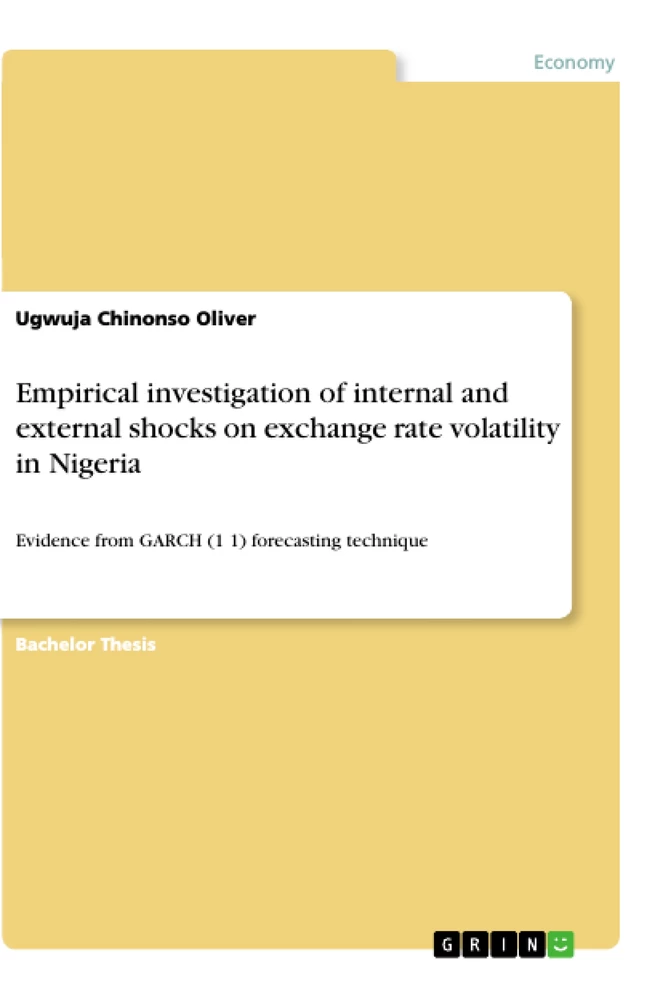
Table of Contents
CHAPTER ONE. INTRODUCTION
1.1 BACKGROUND TO THE STUDY
1.2 STATEMENT OF THE PROBLEM
1.3 THE OBJECTIVES OF THE STUDY
1.4 RESEARCH QUESTIONS
1.5 RESEARCH HYPOTHESIS.
1.6 DELIMITATION OF THE STUDY
1.7 SIGNIFICANCE OF THE STUDY
CHAPTER TWO. LITERATURE REVIEW
2.1 CONCEPTUAL FABRICS
2.2 THEORETICAL LITERATURE
2.2.1 THE THEORIES OF EXCHANGE RATE
2.3 EMPIRICAL REVIEW
2.3.1 FOREIGN STUDIES
2.3.2 DOMESTIC STUDIES
2.4 SUMMARY OF LITERATURE AND VALUE ADDED
CHAPTER THREE.RESEARCH METHODOLOGY
3.1 ANALYTICAL FRAMEWORK
3.1.1 GARCH (11) MODEL
3.2 MODEL SPECIFICATION
3.2.1 THE FUNCTIONAL FORM
3.2.2 THE MATHEMATICAL OR DETERMINISTIC MODEL SPECIFICATION
3.2.3 THE ECONOMETRIC OR STOCHASTIC MODEL SPECIFICATION
3.3 ESTIMATION TECHNIQUE
3.4 METHOD OF EVALUATION
3.4.1 ECONOMIC CRITERIA: A PRIORI EXPECTATIONS
3.4.2 STATISTICAL CRITERIA: FIRST ORDER TEST
3.4.3 THE ECONOMETRIC CRITERIA: THE SECOND ORDER TEST
3.5.1 STATIONARITY TEST OR TEST FOR THE PRESENCE OF UNIT ROOT
3.5.2 THE COINTEGRATION TEST
3.6 JUSTIFICATION FOR THE MODEL
3.7 SOURCES OF DATA
3.8 ECONOMETRIC SOFTWARE
CHAPTER FOUR. PRESENTATION AND ANALYSIS OF REGRESSION RESULTS
4.1 DESCRIPTIVE ANALYSIS:
4.1.1 TIME SERIES PLOT OF THE DATA AND THE TREND ANALYSIS
4.3 PRE-ESTIMATION TEST
4.4 THE GARCH (1 1) ESTIMATION RESULTS
4.7 THE INTERPRETATION OF THE REGRESSION RESULTS BASED ON THE THREE SELECTED CRITERIA
4.7.0: PARAMETER IDENTIFICATION
4.7.1 ECONOMIC CRITERIA
4.7.2 THE STATISTICAL CRITERIA (FIRST ORDER TEST
4.7.3 THE SECOND ORDER TESTS
4.8 EVALUATION OF WORKING HYPOTHESES AND ECONOMIC IMPLICATUONS OF THE FINDINGS.
CHAPTER FIVE- SUMMARY, POLICY IMPLICATION, RECOMMENDATION AND CONCLUSIONS
5.1 THE SUMMARY OF THE STUDY
5.2 POLICY IMPLICATIONS OF THE STUDY
5.3 RECOMMENDATIONS OF THE STUDY
5.4 CONCLUSIONS
5.5 SUGGESSTED AREARS FOR FURTHER STUDIES
Research Objectives and Key Topics
The primary objective of this study is to investigate both internal and external shocks on exchange rate volatility in Nigeria using time series data from 1986 to 2015. By applying the Generalized Autoregressive Conditional Heteroscedasticity (GARCH) model, the research seeks to decompose exchange rate fluctuations and determine which types of shocks exert more significant pressure on the volatility of the naira.
- Analysis of exchange rate volatility using GARCH (1,1) methodology.
- Evaluation of internal shocks (e.g., money supply, economic growth) versus external shocks (e.g., capital flight, trade openness).
- Assessment of the persistence and severity of volatility shocks in the Nigerian foreign exchange market.
- Investigation into the impact of historical policy changes on exchange rate stability.
Excerpt from the Book
CAPITAL FLIGHT
Capital flights is the movement of capital in and out of a country or sometimes refers to the movement of capital from one investment sector to another to capitalize on returns or mitigate risk. Berger (1987) refers to capital flight as illegal movement of capital from one country to another. Thus, he emphasized the legality of movement of capital across countries. Capital flight occurs when assets or money rapidly flows out of a country due to an event of economic consequence. This leads to a disappearance of wealth and is usually accompanied by a sharp drop in the exchange rate of the affected country – Take the Nigerian case where about 22.1 billion dollars was lost from the stock market as a result of capital flight in 2015. Capital flight has led to the depletion of Nigeria’s foreign reserve thus weakening the Naira.
The classical view on capital flight is that it is currency speculation that derives significant cross-border movements of private funds enough to affect financial market. All private capital outflows from developing countries whether short-term or long-term are classified as capital flight (ISU, 2002).
However, Khan and Hague (1987) maintained that the term capital flight is generally associated with short-term outflows resulting from economic and political uncertainties in the home country. By this, they mean that capital flight is money that is fleeing from the country rather than external investment guided by long term economic consideration.
Summary of Chapters
CHAPTER ONE. INTRODUCTION: Provides the background and problem statement regarding exchange rate volatility in Nigeria, highlighting the impact of policy shifts and the research objectives.
CHAPTER TWO. LITERATURE REVIEW: Examines theoretical frameworks and empirical studies concerning exchange rate determination and the various internal and external factors influencing volatility.
CHAPTER THREE.RESEARCH METHODOLOGY: Details the analytical framework, specifically the GARCH (1,1) model, and the specifications for the mean and variance equations used in the study.
CHAPTER FOUR. PRESENTATION AND ANALYSIS OF REGRESSION RESULTS: Reports the empirical findings, including descriptive statistics, unit root tests, and the results of the GARCH estimation and diagnostic checks.
CHAPTER FIVE- SUMMARY, POLICY IMPLICATION, RECOMMENDATION AND CONCLUSIONS: Concludes the study by summarizing the findings, offering policy recommendations, and suggesting areas for future research.
Keywords
Exchange Rate Volatility, GARCH Model, Nigeria, Internal Shocks, External Shocks, Capital Flight, Money Supply, Economic Growth, Trade Openness, Monetary Policy, Time Series Analysis, Economic Stability, Financial Econometrics, Currency Depreciation, Macroeconomic Indicators.
Frequently Asked Questions
What is the core focus of this research?
The research investigates the external and internal shocks influencing exchange rate volatility in Nigeria from 1986 to 2015.
What are the primary thematic fields covered?
The study covers international trade, monetary policy, financial econometrics, and capital flight dynamics within the Nigerian economy.
What is the main objective of this study?
The primary goal is to investigate which shocks (internal or external) most significantly impact the volatility of the naira and to provide policy recommendations for stabilizing the exchange rate.
Which scientific method is employed?
The researcher utilizes the Generalized Autoregressive Conditional Heteroscedasticity (GARCH) model (1,1) to forecast volatility and analyze shock persistence.
What does the main body address?
It provides an extensive literature review, detailed econometric model specifications, data analysis, and diagnostic testing to explain the behavior of real exchange rate volatility.
Which keywords best characterize this work?
Key terms include exchange rate volatility, GARCH model, capital flight, money supply, and macroeconomic shocks.
Why did the researcher choose the 1986–2015 timeframe?
This period was selected because 1986 marks the beginning of the Structural Adjustment Programme (SAP) in Nigeria, representing a critical transition from a fixed to a floating exchange rate regime.
What are the specific findings regarding capital flight?
The study finds that capital flight is a significant external driver of exchange rate volatility in Nigeria, contributing to the depletion of foreign reserves and currency weakening.
What is the conclusion regarding trade openness?
The research concludes that while trade openness often has a calming effect on exchange rate volatility in theory, it was not statistically significant in the model for the period under review, highlighting Nigeria's unique position as an import-dependent economy.
Ende der Leseprobe aus 90 Seiten
- nach oben
- Arbeit zitieren
- Ugwuja Chinonso Oliver (Autor:in), 2017, Empirical investigation of internal and external shocks on exchange rate volatility in Nigeria, München, Page::Imprint:: GRINVerlagOHG, https://www.diplomarbeiten24.de/document/457704

neugierig - aktuell - relevant
Entdecken Sie hilfreiche Tipps und Tricks rund ums Studium!

Entdecken Sie hilfreiche Tipps und Tricks rund ums Studium!
Ihre Hausarbeit / Abschlussarbeit:

- - Publikation als E-Book und Buch
- - Hohes Honorar auf die Verkäufe
- - Für Sie komplett kostenlos - mit ISBN
- - Es dauert nur 5 Minuten
- - Jede Arbeit findet Leser

- © GRIN Publishing GmbH.
- Alle Inhalte urheberrechtlich geschützt. Kopieren und verbreiten untersagt.
- info@grin.com
- AGB
- Open Publishing
Der GRIN Verlag hat sich seit 1998 auf die Veröffentlichung akademischer eBooks und Bücher spezialisiert. Der GRIN Verlag steht damit als erstes Unternehmen für User Generated Quality Content. Die Verlagsseiten GRIN.com, Hausarbeiten.de und Diplomarbeiten24 bieten für Hochschullehrer, Absolventen und Studenten die ideale Plattform, wissenschaftliche Texte wie Hausarbeiten, Referate, Bachelorarbeiten, Masterarbeiten, Diplomarbeiten, Dissertationen und wissenschaftliche Aufsätze einem breiten Publikum zu präsentieren.
Kostenfreie Veröffentlichung: Hausarbeit, Bachelorarbeit, Diplomarbeit, Dissertation, Masterarbeit, Interpretation oder Referat jetzt veröffentlichen!
Folgen Sie GRIN auf


- GRIN Verlag GmbH
-
- Nymphenburger Str. 86
- 80636
- Munich, Deutschland
- +49 89-550559-0
- +49 89-550559-10
- info@grin.com
-
