
präsentiert von

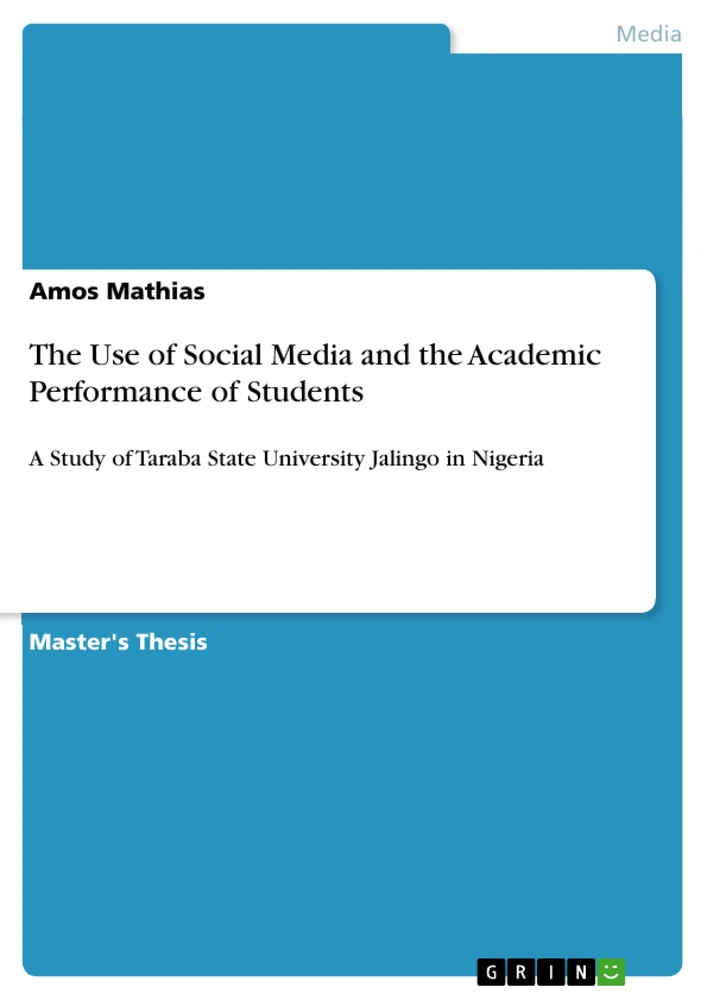
Table of Contents
1.0 Introduction
1.1 Background
1.2 Research Problem
1.3 Aims and Objectives
1.4 Research Questions
1.5 Significance of the Study
1.6 Methodology
1.7 Definitions
1.8 Delimitation and Scope
1.9 Outline of the Thesis
1.10 Conclusion
2.0 Introduction
2.1 Concept of Social Media
2.1.1 Use of Social Media: Global Perspectives
2.1.2 Use of Social Media in the United States of America
2.1.3 Use of Social Media in Nigeria
2.2 Social Media in Education
2.2.1 Use of Facebook in Education
2.2.2 Use of Twitter in Education
2.2.3 Use of WhatsApp in Education
2.2.4 Use of Google+ in Education
2.2.5 Other Social Media platforms used in Education
2.3 The Learning Process and Technology
2.4 Academic Performance
2.5 Facilitators and Barriers of Academic Performance
2.5.1 Facilitators of Academic Performance
2.5.2 Barriers of Academic performance.
2.6 Conclusion
3.0 Introduction
3.1 Research Methodology
3.2 The Research Onion
3.3 Research Philosophy
3.4 Research Approach
3.5 Methodological Choice
3.6 Research Strategies
3.6.1 Research Design
3.6.2 Sampling
3.7 Time Horizon
3.8. Techniques and Procedures:
3.8.1 Data Collection:
3.8.2 Data Analysis
3.8.3 Formation of Categories for Data Analysis
3.9 Credibility
3.10 Ethical Considerations
3.11 Conclusion
4.0 Introduction
4.1 Background of Taraba State University
4.2 Strategic Analysis of Taraba State University
4.2.1 Porter’s Value Chain Model
4.2.2 Application of McKinsey 7S Model on Taraba State University
4.2.3 Using Porter’s Five Forces to Analyse Taraba State University
4.3 Data Presentation and Analysis
4.3.1 Interview
4.3.2 Online Survey Questionnaires
4.3.3 Observation
4.4 Conclusion
5.0 Introduction
5.1 The Research Questions
5.2 Perception of Social Media
5.3 Use of Social Media for Educational Purposes
5.4 Improving Students’ Academic Performance Using Social Media
5.5 Factors Influencing use of social media
5.6 Recommendations
5.6.1 Short Term Recommendations
5.6.2 Long term Recommendation
5.7 Solution and Design Framework of Google Plus (google +)
5.7.1 Adding, following people and sharing on Google +
5.7.2 Benefits of Using Google Plus in Education
5.8 Conclusion
6.1 Conclusion
6.2 Limitations
6.3 Direction for Further Research
7.0 Introduction
7.1 Project Management
7.2 Project Management Life Circle
7.2.1 Project Initiation
7.2.2 Project Planning
7.2.3 Project Execution
7.2.4 Closure
7.3 Challenges Faced
7.4 Lessons Learnt
Research Objectives and Themes
The primary objective of this research is to explore how social media can be utilized as a facilitator to improve students' academic performance at Taraba State University, Nigeria. By evaluating current usage patterns and students' perceptions, the study aims to identify potential barriers and propose a structured implementation of Google+ to build an effective online learning community.
- The impact of social media platforms on student academic performance.
- Barriers and facilitators of academic achievement in higher education settings.
- Strategic analysis of university systems to integrate digital learning tools.
- Implementation framework for using Google+ in an educational context.
- Methods for improving student interaction and knowledge sharing via online communities.
Auszug aus dem Buch
1.1 Background
The evolution of social media and other technologies like Web 2.0 is unprecedented (Lenhart, Purcell, Smith and Zickuhr, 2010). Social media has become an integral part of people’s life as this technology enable people to network with friends and associates, share photographs, generate contents, interact in games and real time conversations. The ever-increasing proliferation of mobile technologies has increased the use of social media, more especially in universities where the technology is transforming the way students communicate, collaborate, interact and learn (Paul, 2013).
Several authors have researched on the use of social media in educational settings with the aim of improving students’ academic performance. Although, such research results are in divergence views as to whether social media is a barrier or facilitator of academic performance. While most of the studies conducted in developing countries like Nigeria suggests that social media is a barrier to academic performance (Ezekiel, Ruth and Leo, 2013).
Ezekiel, Ruth and Leo (2013) asserted that students are addicted to the use of social media in Nigeria and this takes most of their times. The authors maintained that students chat even in highly organized places of worships like churches, mosques and even in lecture halls. They opined that social media is a barrier to academic performance; as most students that engage in social media perform poorly in their academic performances.
In line with the above assertion, Oberiri (2016) argued that most of the platforms used by students are Facebook, WhatsApp and twitter and they use these platforms to interact and share opinions that has to do with friendship, common interests, beliefs and businesses etc. whereas, little or no attention is paid to academic matters. This is because social media has not been harnessed in most of the under-developed and developing countries for effective academic utilization. The reason been that most of the institutions in these countries still rely on traditional learning processes which are not learner centred.
Summary of Chapters
CHAPTER ONE: INTRODUCTION: This chapter introduces the study's background, research problem, objectives, and research questions concerning the use of social media for academic improvement.
CHAPTER TWO: LITERATURE REVIEW: This chapter reviews previous research on social media concepts, its role in education, academic performance theories, and identified facilitators and barriers in learning.
CHAPTER THREE: METHODOLOGY: This chapter details the qualitative case study approach, utilizing the research onion model, triangulation, and constant comparative analysis for data collection and interpretation.
CHAPTER FOUR: ANALYSIS AND FINDINGS: This chapter presents the data collected through interviews, surveys, and observation at Taraba State University, including strategic analysis of the institution.
CHAPTER FIVE: DISCUSSION AND RECOMMENDATIONS: This chapter interprets research findings in relation to the initial questions and provides actionable recommendations, including a framework for using Google+ to build learning communities.
CHAPTER SIX: CONCLUSION: This chapter summarizes the entire research process, addresses study limitations, and suggests directions for future research in the field.
CHAPTER SEVEN: PROJECT MANAGEMENT: This chapter reflects on the administrative and operational management of the thesis, including the project lifecycle, challenges faced, and lessons learned.
Keywords
social media, social media in education, academic performance, facilitators of academic performance, learning community, Taraba State University, Nigeria, higher education, Google+, qualitative research, student engagement, digital learning, online collaboration, communication skills, technology integration.
Frequently Asked Questions
What is the core focus of this research?
The research investigates whether and how social media platforms can be used as facilitators to improve the academic performance of students at Taraba State University, Jalingo.
What are the primary themes discussed in the work?
The central themes include the dual nature of social media as both a potential barrier and an academic facilitator, the role of learning communities, and the strategic integration of technology in higher education.
What is the main objective of the thesis?
The aim is to develop a template and design a platform using Google+ to foster learning communities where students can interact, share academic materials, and collaborate effectively.
Which research methodology was utilized?
The study followed a qualitative methodology, employing a case study design, triangulation through interviews, online surveys, and observations, and using constant comparative analysis to interpret the data.
What topics are covered in the main body chapters?
The main body covers the theoretical literature review, methodology, a detailed analysis of findings at Taraba State University (including strategic models like Porter’s Value Chain), discussion of findings, and a final section on project management and lessons learned.
Which keywords define this research?
The work is characterized by terms such as social media in education, academic performance, learning community, qualitative research, and technology integration.
What are the identified barriers for students at Taraba State University?
Students highlighted lack of internet connectivity, the use of outdated library textbooks, and a lack of encouragement from lecturers as major hurdles in their academic pursuit.
Why was Google+ recommended as a specific tool for the university?
Google+ was proposed because it allows for the creation of specific learning communities, facilitating class communication, sharing assignments, and providing an online space for students to interact without the distractions typical of other social platforms.
Ende der Leseprobe aus 101 Seiten
- nach oben
- Arbeit zitieren
- Amos Mathias (Autor:in), 2019, The Use of Social Media and the Academic Performance of Students, München, Page::Imprint:: GRINVerlagOHG, https://www.diplomarbeiten24.de/document/457838

neugierig - aktuell - relevant
Entdecken Sie hilfreiche Tipps und Tricks rund ums Studium!

Entdecken Sie hilfreiche Tipps und Tricks rund ums Studium!
Ihre Hausarbeit / Abschlussarbeit:

- - Publikation als E-Book und Buch
- - Hohes Honorar auf die Verkäufe
- - Für Sie komplett kostenlos - mit ISBN
- - Es dauert nur 5 Minuten
- - Jede Arbeit findet Leser

- © GRIN Publishing GmbH.
- Alle Inhalte urheberrechtlich geschützt. Kopieren und verbreiten untersagt.
- info@grin.com
- AGB
- Open Publishing
Der GRIN Verlag hat sich seit 1998 auf die Veröffentlichung akademischer eBooks und Bücher spezialisiert. Der GRIN Verlag steht damit als erstes Unternehmen für User Generated Quality Content. Die Verlagsseiten GRIN.com, Hausarbeiten.de und Diplomarbeiten24 bieten für Hochschullehrer, Absolventen und Studenten die ideale Plattform, wissenschaftliche Texte wie Hausarbeiten, Referate, Bachelorarbeiten, Masterarbeiten, Diplomarbeiten, Dissertationen und wissenschaftliche Aufsätze einem breiten Publikum zu präsentieren.
Kostenfreie Veröffentlichung: Hausarbeit, Bachelorarbeit, Diplomarbeit, Dissertation, Masterarbeit, Interpretation oder Referat jetzt veröffentlichen!
Folgen Sie GRIN auf


- GRIN Verlag GmbH
-
- Nymphenburger Str. 86
- 80636
- Munich, Deutschland
- +49 89-550559-0
- +49 89-550559-10
- info@grin.com
-
