
präsentiert von

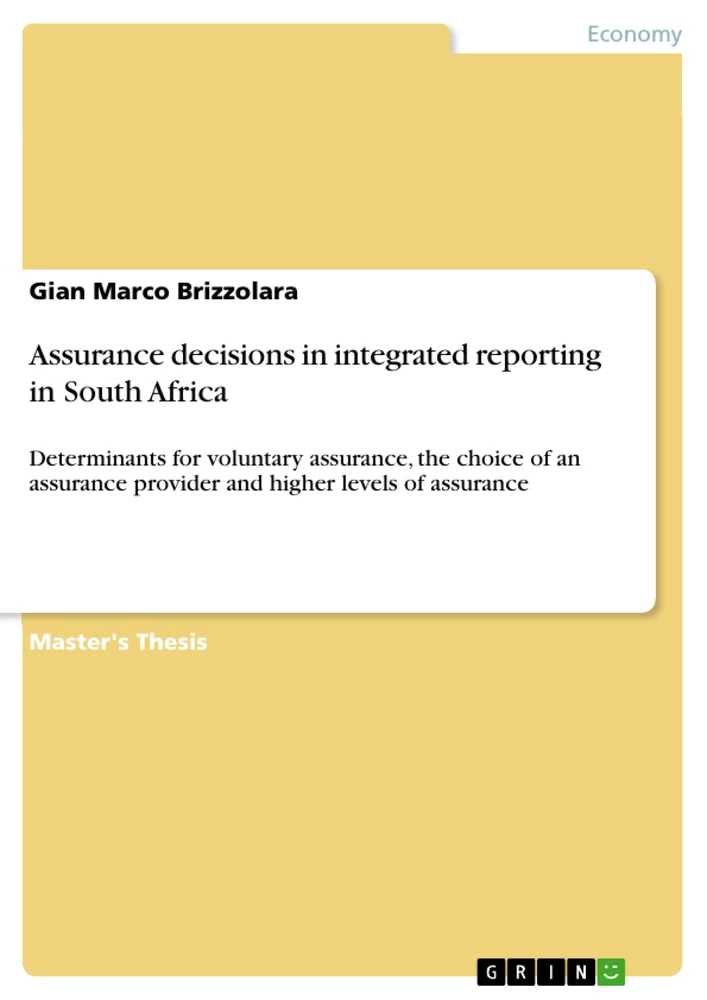
Table of Contents
1. Introduction
2. Introduction to Integrated Reporting and Assurance
2.1 Definition of Integrated Reporting
2.2 Development of Non-Financial Reporting
2.2.1 Development of Sustainability Reporting
2.2.2 Development of Integrated Reporting
2.2.3 Development of Integrated Reporting in South Africa
2.3 Advantages and Disadvantages of Integrated Reporting
2.4 Assurance of Integrated Reports
3. Literature Review and Hypotheses Development
3.1 Previous Research on the Determinants of Assurance
3.1.1 Methodological Approach
3.1.2 Country-level Variables
3.1.3 Industry-level Variables
3.1.4 Corporate Governance Variables
3.1.5 Financial Variables
3.2 Hypotheses Development
3.2.1 Research Questions and Independent Variables
3.2.2 Board Structure
3.2.3 Diversity of Board Members
3.2.4 Professional Background of Board Members
3.2.5 Shareholder Structure
3.2.6 Additional Hypotheses
4. Methodology and Data
4.1 Data Collection and Sampling
4.2 Model Specification and Variable Measurement
4.3 Multiple Imputation of Missing Data
5. Results
5.1 Descriptive Statistics
5.1.1 Means, Standard Deviations, Minimums, and Maximums
5.1.2 Development of Assurance Characteristics across Industries
5.1.3 Correlation Analysis on Textual Quality
5.1.4 Multicollinearity Tests
5.2 Multivariate Results
5.2.1 Decision to Adopt External Assurance
5.2.2 Decision to Mandate an Assurer from the Accounting Profession
5.2.3 Decision to Mandate Higher Levels of Assurance
6. Conclusion and Discussion
6.1 Main findings
6.2 Implications for the Main Constituents in Integrated Reporting
6.3 Limitations and Avenues for Future Research
Research Objectives and Focus
This thesis aims to close the research gap regarding the determinants of assurance decisions in Integrated Reporting (IR), focusing specifically on the South African context, the only country to enforce a mandatory IR disclosure regime. The study investigates why firms decide to adopt IR assurance, what factors influence the selection of a particular type of assurer, and what determines the level of assurance mandated.
- Determinants of voluntary IR assurance adoption.
- Influence of corporate governance (board and shareholder characteristics) on assurance.
- Impact of industry-level and financial variables on assurance decisions.
- Role of mandatory IR disclosure in the South African setting.
- Practical insights for IR constituents (companies, providers, and regulators).
Excerpt from the Book
1. Introduction
Impacting generations of managers, Milton Friedman famously said: “The social responsibility of business is to increase its profits” (Friedman, 1970). Since the financial crisis of 2007-2008, it is apparent that managers cannot continue to follow this paradigm. Companies are trapped to optimise short-term financial performance, while “overlooking the greatest unmet needs in the market as well as broader influences on their long-term success” (Porter & Kramer, 2011). As a result, the narrow approach of value creation creates not only adverse economic, but also negative environmental and social externalities.
The focus on financial reporting (FR) is seen as one of the roots of this vicious cycle, and the recent trend towards sustainability reporting (SR) does not represent more than an enhanced collection of sustainability information. Thus, integrated reporting (IR), which creates a link between both types of information and aims to promote companies to develop strategies that recognise sustainability aspects as significant drivers for financial performance, can be regarded as a promising innovation (International Integrated Reporting Council (IIRC), 2014).
However, IR is far from becoming the norm. In 2015, only 15% of the world’s largest 250 companies by revenue published integrated reports (IRs) and the absence of IR standards and limited understanding of IR assurance present key barriers for widespread adoption (KPMG, 2017). IR research has thus far mainly focused on the normative arguments for IR. Henceforth, this thesis represents a significant effort to close the large gap in research on IR assurance (Dumay, Bernardi, Guthrie, & La Torre, 2017; Cheng, Green, Condradie, Konishi, & Romi , 2014). It is the first study investigating the determinants of assurance decisions in IR. Additionally, it represents the only study focusing on South Africa, the first and only country to enforce a mandatory IR disclosure regime globally (De Villiers, Venter, & Hsio, 2017).
Summary of Chapters
1. Introduction: This chapter highlights the limitation of short-term profit paradigms and introduces Integrated Reporting (IR) as an innovation, while noting the research gap in IR assurance within the South African mandatory context.
2. Introduction to Integrated Reporting and Assurance: This chapter defines the IR concept, outlines the history of non-financial reporting, discusses advantages and disadvantages, and describes current IR assurance practices.
3. Literature Review and Hypotheses Development: This chapter reviews previous studies on voluntary assurance and develops hypotheses concerning the influence of board and shareholder characteristics on IR assurance decisions.
4. Methodology and Data: This chapter details the data collection from JSE-listed companies and explains the use of a Multiple Imputation Model to address missing data across 834 firm-year observations.
5. Results: This chapter presents descriptive statistics and multivariate logit regression results, analyzing the determinants for adopting assurance, choosing specific assurers, and mandating higher assurance levels.
6. Conclusion and Discussion: This chapter synthesizes the main findings, discusses implications for key stakeholders (companies, providers, regulators), and suggests future research avenues, including qualitative studies.
Keywords
Integrated Reporting, IR Assurance, South Africa, Corporate Governance, Sustainability Reporting, Board Structure, Shareholder Characteristics, Mandatory Disclosure, Assurance Providers, Multiple Imputation, Financial Reporting, Assurance Determinants, King Report, Accountability, Transparency.
Frequently Asked Questions
What is the primary focus of this thesis?
The thesis investigates the determinants of integrated reporting (IR) assurance, specifically why companies choose to adopt it, how they select their assurance provider, and why some mandate higher levels of assurance than others.
What makes the South African context unique for this research?
South Africa is the first and only country to enforce a mandatory IR disclosure regime globally, making it a unique natural experiment for observing corporate behavior regarding IR and assurance.
What is the central research question?
The research is driven by three questions: What determines the decision to adopt IR assurance? What factors influence the choice of a specific type of assurer? And what determines the decision to choose higher levels of assurance?
Which scientific methods are employed in this study?
The study uses logit analysis on a panel of 139 JSE-listed companies observed over six years. To handle missing data, a Multiple Imputation Model (Amelia II) is employed to maintain dataset validity.
What does the main body of the work cover?
The main body covers the theoretical foundations via a literature review, the development of hypotheses based on corporate governance and shareholder structure, detailed methodology, and the analysis of multivariate regression results.
Which key variables characterize this research?
The key variables include corporate governance indicators (board size, board meetings, independence, diversity), shareholder characteristics (free-float, institutional ownership, foreign investment), and firm-level variables (industry, size, profitability, leverage).
How does board composition affect the decision to assure integrated reports?
The results show that companies with a higher number of board members and more frequent board meetings are more likely to adopt assurance, suggesting that larger and more active boards prioritize credibility and control.
Why did the author conclude that results often contradicted hypotheses?
The author found that variables such as the percentage of female board members or chartered accountants had negative associations with certain assurance choices, which was unexpected and suggests that these groups might have different perceptions or preferences regarding IR assurance than initially hypothesized.
Ende der Leseprobe aus 75 Seiten
- nach oben
- Arbeit zitieren
- Gian Marco Brizzolara (Autor:in), 2018, Assurance decisions in integrated reporting in South Africa, München, Page::Imprint:: GRINVerlagOHG, https://www.diplomarbeiten24.de/document/458066

neugierig - aktuell - relevant
Entdecken Sie hilfreiche Tipps und Tricks rund ums Studium!

Entdecken Sie hilfreiche Tipps und Tricks rund ums Studium!
Ihre Hausarbeit / Abschlussarbeit:

- - Publikation als E-Book und Buch
- - Hohes Honorar auf die Verkäufe
- - Für Sie komplett kostenlos - mit ISBN
- - Es dauert nur 5 Minuten
- - Jede Arbeit findet Leser

- © GRIN Publishing GmbH.
- Alle Inhalte urheberrechtlich geschützt. Kopieren und verbreiten untersagt.
- info@grin.com
- AGB
- Open Publishing
Der GRIN Verlag hat sich seit 1998 auf die Veröffentlichung akademischer eBooks und Bücher spezialisiert. Der GRIN Verlag steht damit als erstes Unternehmen für User Generated Quality Content. Die Verlagsseiten GRIN.com, Hausarbeiten.de und Diplomarbeiten24 bieten für Hochschullehrer, Absolventen und Studenten die ideale Plattform, wissenschaftliche Texte wie Hausarbeiten, Referate, Bachelorarbeiten, Masterarbeiten, Diplomarbeiten, Dissertationen und wissenschaftliche Aufsätze einem breiten Publikum zu präsentieren.
Kostenfreie Veröffentlichung: Hausarbeit, Bachelorarbeit, Diplomarbeit, Dissertation, Masterarbeit, Interpretation oder Referat jetzt veröffentlichen!
Folgen Sie GRIN auf


- GRIN Verlag GmbH
-
- Nymphenburger Str. 86
- 80636
- Munich, Deutschland
- +49 89-550559-0
- +49 89-550559-10
- info@grin.com
-
