
präsentiert von

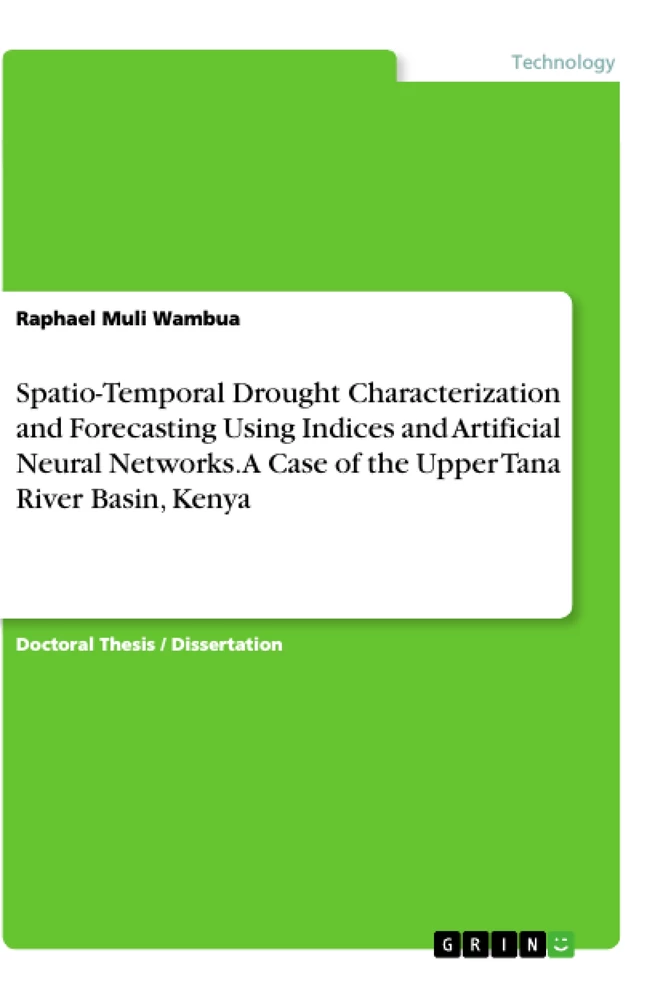
Table of Contents
CHAPTER ONE
INTRODUCTION
1.1 Background information
1.2 Statement of the problem
1.3 Objectives
1.3.1 Main objective
1.3.2 Specific objectives
1.4 Research questions
1.5 Justification
1.6 Scope
CHAPTER TWO
LITERATURE REVIEW
2.1 Occurrence of droughts
2.1.1 Types of droughts
2.1.2 Drought modelling
2.1.3 Determination of drought threshold level
2.1.4 Selection of drought threshold level
2.2 Climate change and variability
2.2.1 Impact of climate change on water resources
2.2.2 Effect of water balance components on drought
2.2.3 Effect of global warming on droughts
2.2.4 IPCC and IGAD approach
2.3 Major causes of drought in Kenya
2.3.1 Impact of drought in Kenya
2.3.2 Drought monitoring in Kenya
2.4 Drought forecasting
2.5 Drought mitigation
2.6 Drought assessment methods
2.7 Satellite based drought indices
2.7.1 Vegetative condition index
2.7.2 Normalized difference vegetative index
2.7.3 Normalized difference water index
2.7.4 Water supply vegetative index
2.7.5 Normalized difference drought index
2.8 Data driven drought indices
2.8.1 Standardized precipitation index
2.8.2 Palmer drought severity index
2.8.3 Surface water supply index
2.8.4 Aggregated drought index
2.8.5 Deciles index
2.9 Drought forecasting models
2.9.1 Seasonal autoregressive integrated moving average model
2.9.2 Adaptive Neuro-fuzzy inference system model
2.9.3 Markov chain model
2.9.4 Log-linear model
2.9.5 Artificial Neural Network models
2.10 Description of ANN model
2.10.1 Classification of ANN model architectures
2.10.2 Drought forecasting using ANN models
2.10.3 ANN data pre-processing
2.11 ANN learning processes
2.11.1 Supervised learning
2.11.2 Unsupervised learning
2.12 Purpose for ANNs learning process
2.12.1 Learning for classification
2.13 Drought assessment and forecasting in river basins
2.14 Drought assessment and forecasting in the upper Tana River basin
2.15 AquaCrop model
2.16 Kriging interpolation technique
CHAPTER THREE
MATERIALS AND METHODS
3.1 Study area
3.2 Assessment of spatial and temporal drought using selected DIs
3.2.1 Hydro-meteorological data acquisition
3.2.2 Stream flow data
3.2.3 Precipitation data
3.2.4 Consistency test of the hydro-meteorological data
3.2.5 Filling in missing data
3.2.6 Surface Water Supply Index
3.2.7 Stream flow drought index
3.2.8 Standardized precipitation index
3.2.9 Effective drought index
3.2.10 Soil Moisture Deficit Index
3.2.11 Smulation of Soil Water (SW) content using AquaCrop model
3.2.12 Palmer Drought Severity Index
3.2.13 Evaluation of Spatial distribution of drought severity
3.2.14 Mann-Kendall trend test for drought conditions
3.3 Drought forecasting using DIs and ANNs
3.3.1 Drought forecasting
3.3.2 Temporal drought forecasting using DIs
3.3.3 Short-term drought forecasting
3.3.4 Medium-term drought forecasting
3.3.5 Long-term drought forecasting
3.4 Formulation of Nonlinear-Integrated Drought Index (NDI)
3.4.1 Computation of principal components (PC)
3.4.2 Assessment of drought characteristics using the formulated NDI
3.5 Drought forecasting using NDI
3.5.1 Identification of ANN model structure
3.5.2 Drought projection using NDI and Recursive Multi-Step Neural Networks
3.6 Sensitivity analysis of drought indices
3. 7 Time series drought characterization
3.8 Model calibration
3.9 Model validation
3.9.1 The correlation coefficient
3.9.2 Mean absolute error
3.9.3 Mean square error
3.9.4 Nash–Sutcliffe efficiency
3.9.5 Modified index of agreement
CHAPTER FOUR
RESULTS AND DISCUSSIONS
4.1 Temporal and spatial drought conditions
4.1.1 Time series SWSI
4.1.2 Sensitivity of SWSI to weighting parameters
4.1.3 Development and modification of SWSI equation
4.1.4 Spatially distributed drought severity based on SWSI
4.1.5 Time series SDI
4.1.6 Time series SPI
4.1.7 Spatially distributed drought severity based on SPI
4.1.8 Monthly time series EDI
4.1.9 Spatially distributed drougt severity based on EDI
4.1.10 Time series Soil Moisture Deficit Index (SMDI)
4.1.11 Spatially distributed drought severity based on SMDI
4.1.12 Time series Palmer Drought Severity Index (PDSI)
4.1.13 Spatially distributed drought severity based on PDSI
4.1.4 Characteristics of time series drought conditions
4.2 Forecasted drought using DIs and ANNs
4.2.1 Hydrological drought forecasts
4.2.2 Meteorological drought forecasts
4.2.3 Agricultural drought forecasts
4.3 Formulated NDI for the upper Tana River basin
4.3.1 Sensitivity of NDI to the input parameters
4.4 Forecasts of NDI values using ANNs
4.4.1 Drought projections based on NDI and RMSNN
4.4.2 Spatially distributed drought severity based on NDI
CHAPTER FIVE
CONCLUSIONS AND RECOMMENDATIONS
5.1 Conclusions
5.2 Recommendations
Research Objective and Topics
This study aims to formulate optimal models for assessing and forecasting drought conditions within the upper Tana River basin in Kenya, utilizing a combination of established drought indices and Artificial Neural Networks (ANNs) to guide water resource management decisions.
- Development of drought assessment models using diverse hydro-meteorological indices.
- Evaluation of ANN model performance for short, medium, and long-term drought forecasting.
- Formulation of a Nonlinear-Integrated Drought Index (NDI) through Principal Component Analysis.
- Spatial and temporal mapping of drought severity and frequency across the upper Tana River basin.
- Analysis of trends in drought occurrence using the non-parametric Mann-Kendall test.
Auszug aus dem Buch
1.1 Background information
Drought is one of the critical stochastic natural disasters that adversely affect water resource systems, people and ecosystems (Zargar et al., 2011; Jahangir et al., 2013). Drought is defined as a hydro-meteorological event on land characterized by temporary and recurring water scarcity. According to Morid et al. (2007), the magnitude of the drought is indicated by the extent with which it falls below a defined threshold level over an extended period of time. Drought has been identified as the most complex natural hazards due to difficulty in its detection. Drought preparedness and mitigation depend upon timely information on its onset, and propagation in terms of temporal and spatial extent. Such information can be obtained if effective and continuous drought monitoring indices are used in drought evaluation. The study of spatial and temporal drought conditions has greatly been applied in planning and management of water resource systems such as water supplies, irrigation systems, and hydropower generation (Ceppi et al., 2014; Abad et al., 2013; Alaa, 2014; Okoro et al., 2014). These studies were undertaken in Lombarrdy region of norh Italy, Bashar river basin, Mashtul pilot area of Nile Delta and the river basins in Imo state of Nigeria respectively.
At a global scale, demand for water resources has continued to increase as a result of the population pressure and related socio-economic development needs. As a result, numerous sectors have been affected by water scarcity and thus, effective management of impacts of drought-induced water deficit is required. These drought impacts are more severe on Arid and Semi-Arid Lands (ASALs) than in the humid areas (UNDP, 2012). Therefore, management of drought has become an important issue in most of the countries in the world. The drought characteristics in terms of frequency, duration and severity have been assessed using Drought Indices (DI) in some parts of the world (Mishra and Sign, 2010; Barua, 2010; Belayneh and Adomowski, 2013). However in many regions of the world such as Kenya, drought forecasting is still inadequate and thus the need to develop forecasting techniques for Kenya.
Summary of Chapters
CHAPTER ONE: INTRODUCTION: Outlines the significance of drought as a stochastic natural disaster, the specific problems related to the upper Tana River basin, and defines the research objectives and scope.
CHAPTER TWO: LITERATURE REVIEW: Explores existing methods of drought characterization, modelling techniques, and the application of Artificial Neural Networks (ANNs) in hydrology and drought forecasting.
CHAPTER THREE: MATERIALS AND METHODS: Describes the study area, data acquisition from hydrometric and meteorological stations, the indices used (SWSI, SDI, SPI, etc.), and the methodology for constructing ANN-based forecasting models.
CHAPTER FOUR: RESULTS AND DISCUSSIONS: Presents the analysis of temporal and spatial drought conditions in the basin, evaluation of ANN models for drought forecasting, and the formulation and validation of the Nonlinear-Integrated Drought Index (NDI).
CHAPTER FIVE: CONCLUSIONS AND RECOMMENDATIONS: Provides a synthesis of research findings regarding drought trends and forecasting effectiveness in the upper Tana River basin and suggests directions for future research.
Keywords
Drought, Hydrological drought, Agricultural drought, Meteorological drought, Artificial Neural Networks, Upper Tana River Basin, Drought Indices, Drought forecasting, Climate change, Climate variability, Soil Moisture Deficit Index, Standardized Precipitation Index, Principal Component Analysis, Water Resource Management.
Frequently Asked Questions
What is the core focus of this research?
The research focuses on the characterization and forecasting of droughts in the upper Tana River basin, Kenya, using various drought indices and advanced computing models.
Which thematic areas are central to this work?
Central themes include the assessment of hydrological, agricultural, and meteorological drought categories, the use of Artificial Neural Networks (ANNs) for prediction, and the spatial mapping of drought severity.
What is the primary research goal?
The primary goal is to formulate appropriate models for assessing and forecasting drought to guide sustainable water resource planning and management in the upper Tana River basin.
Which scientific methodology is employed?
The study utilizes a data-driven approach, combining hydro-meteorological data with non-parametric trend tests (Mann-Kendall), statistical indices (e.g., SPI, SWSI), and Artificial Neural Networks (ANNs) for modeling and prediction.
What is covered in the main section of the study?
The main section covers the collection of hydro-meteorological data, the computation of drought indices, the formulation of a new Nonlinear-Integrated Drought Index (NDI), and the application of ANN models for both drought forecasting and long-term projection.
Which keywords best characterize this work?
Key terms include drought forecasting, Artificial Neural Networks, Tana River basin, drought indices, and climate variability.
What is the significance of the developed NDI tool?
The Nonlinear-Integrated Drought Index (NDI) acts as a unified tool capable of assessing and forecasting all three operational drought types—hydrological, meteorological, and agricultural—simultaneously within the basin.
How were the ANN models validated?
Validation was conducted using multiple performance criteria, including the Correlation Coefficient (R), Mean Absolute Error (MAE), Nash-Sutcliffe Efficiency (NSE), and the modified index of agreement (d1).
Why is this study vital for Kenya?
Given the heavy dependency of Kenya’s economy on rain-fed agriculture and hydropower, this study provides critical data for drought preparedness and early warning systems to mitigate significant socio-economic impacts.
Ende der Leseprobe aus 239 Seiten
- nach oben
- Arbeit zitieren
- Raphael Muli Wambua (Autor:in), 2016, Spatio-Temporal Drought Characterization and Forecasting Using Indices and Artificial Neural Networks. A Case of the Upper Tana River Basin, Kenya, München, Page::Imprint:: GRINVerlagOHG, https://www.diplomarbeiten24.de/document/458529

neugierig - aktuell - relevant
Entdecken Sie hilfreiche Tipps und Tricks rund ums Studium!

Entdecken Sie hilfreiche Tipps und Tricks rund ums Studium!
Ihre Hausarbeit / Abschlussarbeit:

- - Publikation als E-Book und Buch
- - Hohes Honorar auf die Verkäufe
- - Für Sie komplett kostenlos - mit ISBN
- - Es dauert nur 5 Minuten
- - Jede Arbeit findet Leser

- © GRIN Publishing GmbH.
- Alle Inhalte urheberrechtlich geschützt. Kopieren und verbreiten untersagt.
- info@grin.com
- AGB
- Open Publishing
Der GRIN Verlag hat sich seit 1998 auf die Veröffentlichung akademischer eBooks und Bücher spezialisiert. Der GRIN Verlag steht damit als erstes Unternehmen für User Generated Quality Content. Die Verlagsseiten GRIN.com, Hausarbeiten.de und Diplomarbeiten24 bieten für Hochschullehrer, Absolventen und Studenten die ideale Plattform, wissenschaftliche Texte wie Hausarbeiten, Referate, Bachelorarbeiten, Masterarbeiten, Diplomarbeiten, Dissertationen und wissenschaftliche Aufsätze einem breiten Publikum zu präsentieren.
Kostenfreie Veröffentlichung: Hausarbeit, Bachelorarbeit, Diplomarbeit, Dissertation, Masterarbeit, Interpretation oder Referat jetzt veröffentlichen!
Folgen Sie GRIN auf


- GRIN Verlag GmbH
-
- Nymphenburger Str. 86
- 80636
- Munich, Deutschland
- +49 89-550559-0
- +49 89-550559-10
- info@grin.com
-
