
präsentiert von

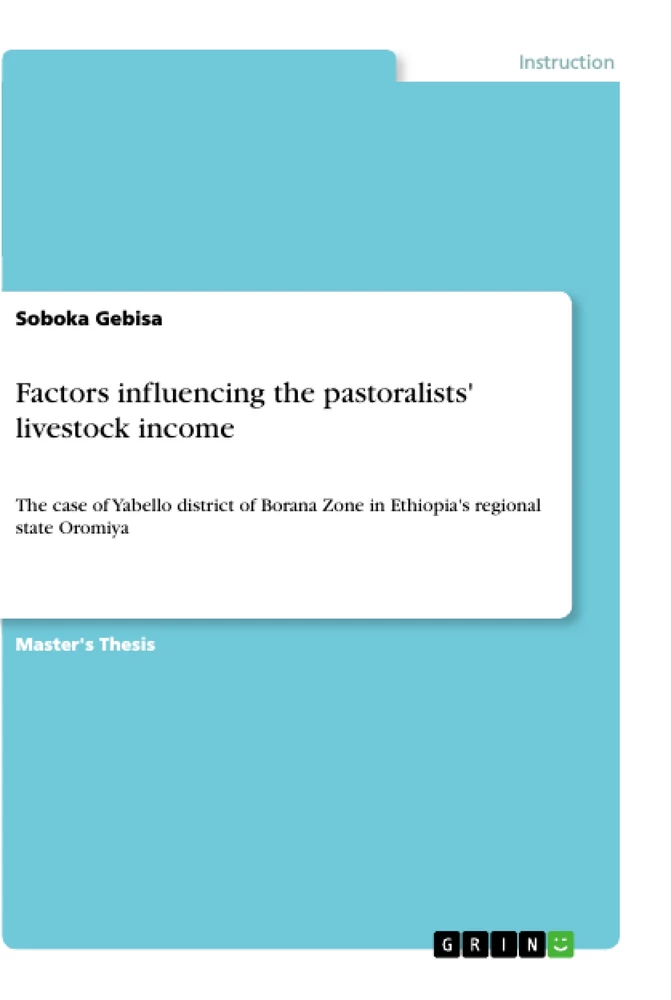
Table of Contents
1. INTRODUCTION
1.1. Background
1.2. Statement of the problem
1.3. Research questions
1.4. Objectives of the study
1.5. Study hypothesis
1.6. Significance of the study
1.7. Scope of the study
1.8. Limitations of the study
1.9. Organization of the study
2. LITERATURE REVIEW
2.1. Definitions and Concepts
2.1.1. Pastoralist, livestock herds and income
2.1.2. Livestock income
2.1.3. Livelihood systems in pastoral areas of Ethiopia
2.1.4. Pastoral livelihoods in Oromia region
2.1.5. The Borana pastoralists livelihoods
2.1.6. Livestock production systems
2.1.7. Pastoralists and Livestock
2.1.8. The importance of livestock in countries economy
2.1.9. The challenges and constraints in livestock production systems
2.1.10. Classification of household income
2.1.11. The sources of household income and share of livestock income
2.1.12. Estimation methods of household income
2.1.13. The strength, weakness, opportunities and threats of livestock production
2.1.14. Theoretical literature on factors affecting household income
2.1.15. Empirical studies on factors influencing household income
2.1.16. Conceptual framework of the study
3. RESEARCH METHDOLOGY
3.1. Description of the Study Area
3.2. The Study design
3.3. Types and sources of data
3.4. Procedures and method of data collection
3.4.1. Sample procedure
3.4.1.1. Sample size determination
3.4.2. Method of data collection
3.4.2.1. Household survey
3.4.2.2. Key informants interview
3.4.2.3. Group discussion
3.4.2.4. Field observation
3.5. Methods of data analysis
3.5.1. Descriptive statistics
3.5.2. Multiple linear regression model
3.6. Definition of variables and working hypothesis
3.6.1. The dependent variable of the model
3.6.1. Explanatory variables
4. RESULTS AND DISCUSSIONS
4.1. Results of Descriptive analysis
4.1.1. Demographic, socio-economic and institutional characteristics
4.1.1.1. Sex of the household
4.1.1.2. Age of the household heads
4.1.1.3. Educational level
4.1.1.4. Family size
4.1.1.5. Livelihood strategy
4.1.1.5.1. Why do pastoralists’ households diversify their activities?
4.1.1.6. Livestock price in the market
4.1.1.6.1. Reason for low market price of pastoral livestock
4.1.1.7. Livestock market participation
4.1.1.7.1. Inspirations for selling livestock
4.1.1.8. Livestock breed types
4.1.1.9. Livestock mobility
4.1.1.9.1. Households’ perception related livestock mobility
4.1.1.10. Total livestock compositions
4.1.1.11. Grazing land availability
4.1.2. Pastoralists’ household income sources
4.1.3. Households income
4.1.3.1. Household annual income from livestock production
4.1.3.2. Household annual income from crop production
4.1.3.2.1. The purpose of crop production
4.1.3.3. Household income from off-farm activities
4.1.3.4. Expenditure on production input
4.1.3.5. Pastoralists’ perception of income sources
4.1.3.6. The proportion of household wealth categories
4.1.3.7. Focus group discussion for factors analysis
4.1.4. The share of livestock income in to the total pastoralists’ income
4.1.5. SWOT analysis
4.2. Multiple linear regression for factors analysis
4.2.1. Factors affecting pastoralists’ livestock income model result
5. CONCLUSIONS AND RECOMMENDATIONS
5.1. Conclusion
5.2. Recommendations
Research Objectives and Themes
This study aims to analyze the factors influencing pastoralist households' livestock income in the Yabello district of the Borana Zone, Ethiopia. The research seeks to identify income sources, assess the economic significance of livestock, and determine the key socio-economic and institutional factors affecting income levels using primary data and statistical modeling.
- Analysis of diverse income sources for pastoral households.
- Estimation of the contribution of livestock income to total household income.
- Assessment of internal and external strengths, weaknesses, opportunities, and threats (SWOT) in livestock production.
- Identification of critical determinants of livestock income using multiple linear regression.
Excerpt from the book
2.1.2. Livestock income
Livestock income represents the sum of net income from livestock transaction, income from animal rent, sale of animal products and imputed value of home consumption from livestock products (Dercon and Krishnan, 1996; Barrett et al., 2000). Additionally, Pica-Ciamarra et al. (2011b) defined livestock income as the value of sales and barter of livestock, plus the value of sales, barter and self-consumption of livestock products (such as milk, meat, eggs, honey, and so forth) minus the expenditures related to livestock production which, depending on the country, may include feed, labour and veterinary services. The livestock income variable are calculated only for livestock keeping households, which ensures that results are not influenced by the pattern of livestock ownership among the population (Pica-Ciamarra et al., 2011b). In the evaluation of the different income activities, three different aspects are analyzed: participation, activity incomes, and income shares. Participation measures whether a household is involved in an activity or not. By definition, the household participates if the activity income is different from zero. In the case of zero activity incomes, the household does not participate. Activity income refers to the income from a certain activity measured in that country’s currency. The percentage shares in activity incomes are calculated by dividing the mean activity incomes by the mean total income. These shares provide an insight into the importance of certain activities for the region. They should not be mixed-up with income shares, which is the mean of the percentage share of the income from an activity in total household income. Income shares highlight the importance of activities at the household level (Schwarze, 2004).
Summary of Chapters
1. INTRODUCTION: Provides the background of the Ethiopian livestock sector, defines the research problem, and outlines the objectives and significance of the study in the Borana region.
2. LITERATURE REVIEW: Reviews theoretical concepts of pastoralism, income classification, livelihood systems, and empirical studies on factors determining household income in pastoral settings.
3. RESEARCH METHDOLOGY: Details the study area, data collection methods including household surveys and group discussions, and the econometric models used for data analysis.
4. RESULTS AND DISCUSSIONS: Presents findings from descriptive statistics and regression analysis regarding demographics, income sources, SWOT analysis, and determinants of livestock income.
5. CONCLUSIONS AND RECOMMENDATIONS: Synthesizes the major research findings and provides policy recommendations to enhance pastoral livestock income and resilience.
Keywords
Pastoralists, Livestock Income, Yabello, Borana Zone, Livelihood Strategy, Household Income, Ethiopia, SWOT Analysis, Regression Model, Livestock Production, Livestock Mobility, Market Participation, Drought Risk, Agricultural Economics, Livestock Breed Type
Frequently Asked Questions
What is the primary focus of this research?
The research examines the economic structure of pastoralist households in the Yabello district and identifies the specific factors that determine their livestock-based income.
What are the central themes investigated in this work?
The study centers on household income sources, the relative contribution of livestock, the impact of various socio-economic and environmental factors, and the role of management practices in livestock rearing.
What is the core research objective?
The objective is to empirically determine which factors—such as family size, extension contact, market price, and herd size—significantly influence the total annual livestock income of the households.
Which methodology is applied in this thesis?
The study employs a quantitative approach, utilizing both descriptive statistics and a multiple linear regression model to analyze primary data collected from 120 households.
What topics are discussed in the main body of the work?
The main sections detail the livelihood systems in the Borana region, provide a SWOT analysis of livestock rearing, and present regression model results assessing determinants of income.
Which keywords best characterize this study?
Key terms include pastoralists, livestock income, Borana zone, livelihood diversification, and agricultural economic determinants.
How is the wealth of the households determined?
Wealth is defined primarily by the size of the livestock herd owned by the household, categorized into five groups ranging from "Very rich" to "Destitute".
What role does livestock mobility play in household income?
The study evaluates whether livestock mobility acts as a risk management strategy and how it affects overall income, finding complex trade-offs between herd survival and production costs.
Ende der Leseprobe aus 150 Seiten
- nach oben
- Arbeit zitieren
- Soboka Gebisa (Autor:in), 2018, Factors influencing the pastoralists' livestock income, München, Page::Imprint:: GRINVerlagOHG, https://www.diplomarbeiten24.de/document/460832

neugierig - aktuell - relevant
Entdecken Sie hilfreiche Tipps und Tricks rund ums Studium!

Entdecken Sie hilfreiche Tipps und Tricks rund ums Studium!
Ihre Hausarbeit / Abschlussarbeit:

- - Publikation als E-Book und Buch
- - Hohes Honorar auf die Verkäufe
- - Für Sie komplett kostenlos - mit ISBN
- - Es dauert nur 5 Minuten
- - Jede Arbeit findet Leser

- © GRIN Publishing GmbH.
- Alle Inhalte urheberrechtlich geschützt. Kopieren und verbreiten untersagt.
- info@grin.com
- AGB
- Open Publishing
Der GRIN Verlag hat sich seit 1998 auf die Veröffentlichung akademischer eBooks und Bücher spezialisiert. Der GRIN Verlag steht damit als erstes Unternehmen für User Generated Quality Content. Die Verlagsseiten GRIN.com, Hausarbeiten.de und Diplomarbeiten24 bieten für Hochschullehrer, Absolventen und Studenten die ideale Plattform, wissenschaftliche Texte wie Hausarbeiten, Referate, Bachelorarbeiten, Masterarbeiten, Diplomarbeiten, Dissertationen und wissenschaftliche Aufsätze einem breiten Publikum zu präsentieren.
Kostenfreie Veröffentlichung: Hausarbeit, Bachelorarbeit, Diplomarbeit, Dissertation, Masterarbeit, Interpretation oder Referat jetzt veröffentlichen!
Folgen Sie GRIN auf


- GRIN Verlag GmbH
-
- Nymphenburger Str. 86
- 80636
- Munich, Deutschland
- +49 89-550559-0
- +49 89-550559-10
- info@grin.com
-
